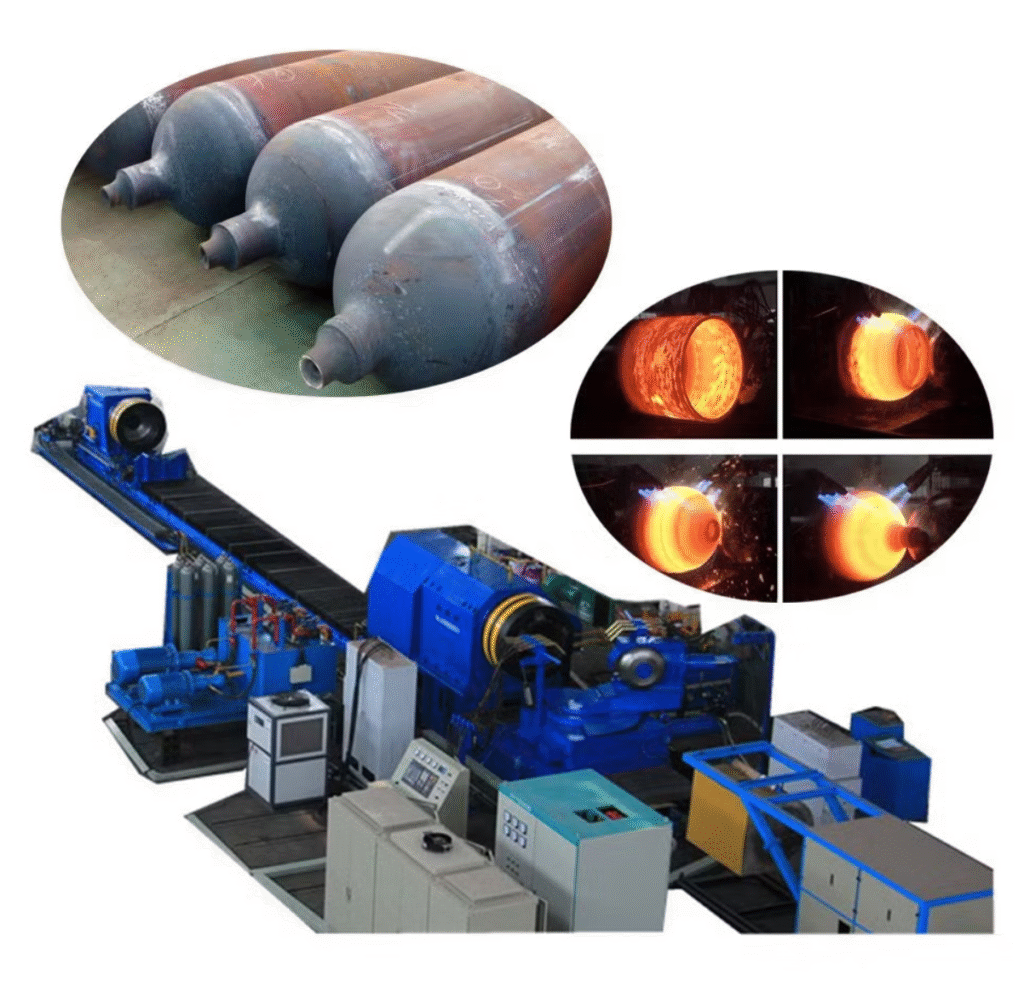
Hot Spinning is a chipless metal forming process used to shape thick-walled or high-strength metals into seamless, hollow, rotational parts. Unlike cold metal spinning, which is performed at room temperature, the hot spinning process introduces localized, intense heat to the workpiece.
From aerospace nose cones to heavy-duty industrial pressure vessels, hot metal spinning bridges the gap between raw metallurgical strength and intricate geometric design.
What is Hot Metal Spinning Technology?
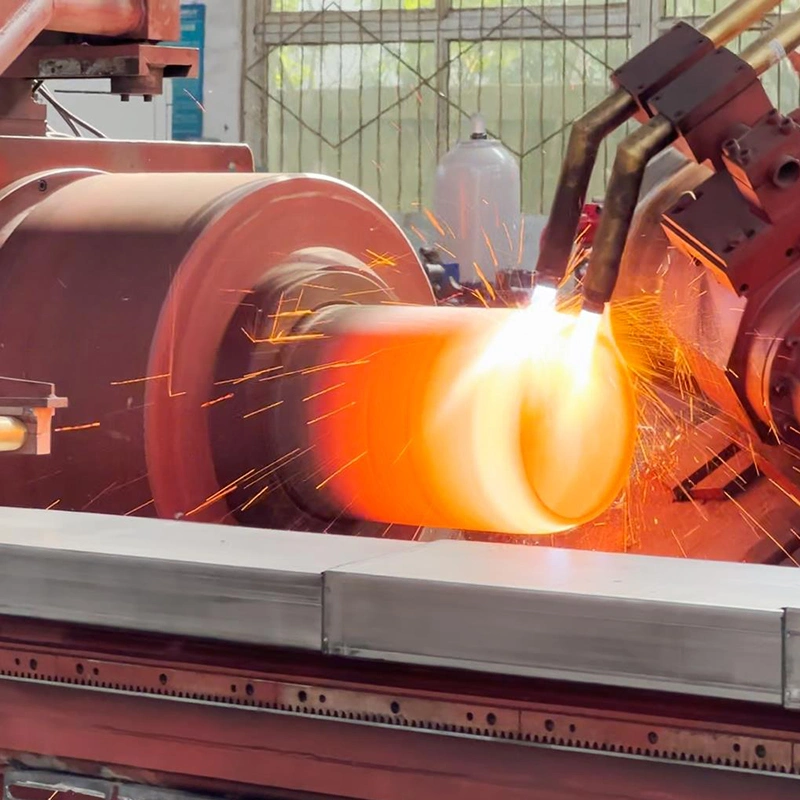
At its core, hot metal spinning is a chipless metal forming process used to shape thick-walled or high-strength metals into seamless, hollow, rotational parts. Unlike cold metal spinning, which is performed at room temperature, the hot spinning process introduces localized, intense heat to the workpiece.
By heating the metal—often using integrated gas torches, induction heating systems, or laser technology—the material reaches its recrystallization temperature. This drastically reduces the yield strength of the metal, making it highly malleable and eliminating the risk of work hardening, cracking, or material failure during deformation.
The Role of a Hot Metal Spinning Machine
A modern hot metal spinning machine is a powerhouse of mechanical, hydraulic, and electronic engineering. These heavy-duty machines secure a metal blank (or pre-formed tube) onto a rotating mandrel. As the workpiece spins at high speeds, heavy-duty forming rollers apply immense, controlled pressure to flow the heated metal over the mandrel, progressively shaping it into the desired contour.
Key Features of Modern Hot Metal Spinning Machines
To handle the extreme thermal and mechanical stresses of the process, industrial hot metal spinning equipment incorporates advanced engineering features:
- Integrated Heating Systems: Automated CNC-controlled gas burners or induction heaters track the forming roller to maintain optimal material temperature throughout the cycle.
- High-Torque Spindles & Heavy-Duty Bearings: Crucial for handling massive structural loads and maintaining precise RPMs under intense friction.
- CNC Precision Controls: Advanced CNC hot metal spinning machines utilize multi-axis synchronous control to guide the forming rollers with sub-millimeter accuracy.
- Force and Temperature Monitoring: Real-time feedback loops monitor the workpiece’s temperature and the roller’s force, ensuring consistent wall thickness and preventing structural defects.
Advantages of Hot Metal Spinning Technology
Why do top-tier manufacturers choose hot metal spinning over traditional casting, forging, or stamping? The benefits are both structural and economic.
Seamless Structural Integrity
Because the metal is formed without cutting or welding, the finished component is entirely seamless. The hot deformation process actually refines the grain structure of the metal, aligning it with the contours of the part. This results in superior tensile strength, high fatigue resistance, and exceptional structural integrity.
High Material Utilization (Minimal Waste)
Traditional machining can result in massive material waste due to chipping and turning. Hot metal spinning is a form-fill process that redistributes the existing material, achieving near-100% material utilization. For expensive alloys like titanium or Inconel, this translates to massive cost savings.
Ability to Form Thick and Exotic Alloys
Cold forming has its limits. When dealing with thick-walled steel, high-strength titanium, superalloys, or refractory metals, a cold spinning lathe simply cannot exert enough force without rupturing the material. Hot spinning effortlessly shapes these challenging metals.
Cost-Effective Tooling
Compared to the massive, expensive dies required for deep drawing or drop forging, hot metal spinning utilizes relatively simple, cost-effective mandrels and rollers. This makes it highly economical for both prototyping and high-volume production runs.
Common Applications Across Key Industries
The unique capabilities of hot metal spinning technology make it indispensable across sectors where component failure is not an option.
| Industry | Typical Spun Components |
| Aerospace & Defense | Rocket nozzle liners, missile nose cones, engine cowlings, satellite dishes. |
| Energy & Petrochemical | Pressure vessel ends, tank heads, heat exchanger components, oil field funnels. |
| Automotive & Transport | Heavy-duty wheel rims, catalytic converter cones, drive shafts, gas cylinders. |
| Industrial Manufacturing | Large ventilation cones, heavy-duty separator bowls, custom industrial piping. |
Material Compatibility
An industrial hot metal spinning machine can process a vast array of ferrous and non-ferrous metals, provided the correct thermal parameters are met:
- Carbon Steels & Alloy Steels: Frequently used for heavy industrial tanks and structural cones.
- Stainless Steel (300 & 400 Series): Ideal for corrosion-resistant pressure vessels and aerospace parts.
- Titanium & Titanium Alloys: Handled seamlessly at high temperatures for lightweight, high-strength aerospace components.
- Nickel-Based Superalloys (Inconel, Hastelloy): Formed under precise thermal control for extreme high-temperature environments.
Choosing the Right Hot Metal Spinning Equipment
When investing in hot metal spinning technology, several variables must be evaluated to ensure optimal production efficiency:
- Maximum Swing Diameter and Bed Length: Determines the maximum physical dimensions of the blanks and finished parts the machine can accommodate.
- Wall Thickness Capacity: The maximum material thickness the hydraulic rollers can deform at temperature.
- Automation & CNC Capabilities: Play a massive role in cycle times, repeatability, and reducing human error in high-throughput environments.
- Heating Efficiency: The machine’s ability to quickly heat the metal and maintain tight temperature windows determines part quality and overall energy costs.
Industry Note: Transitioning to an automated CNC hot metal spinning machine not only drastically improves safety by removing operators from immediate thermal zones, but it also ensures flawless part-to-part consistency that manual or hydraulic-assist machines simply cannot match.
Process Mechanics: Step-by-Step Hot Metal Deformation
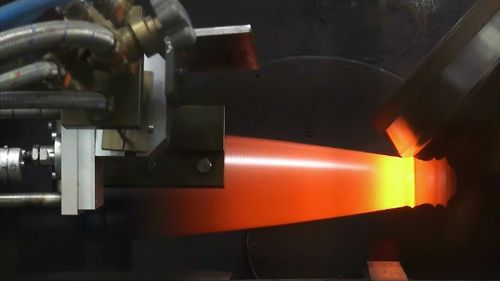
To fully comprehend how a hot metal spinning machine manipulates robust alloys, it is essential to look at the exact mechanical and thermal sequence. The transition from a flat metal blank to a geometrically complex, high-strength hollow component involves four distinct, highly controlled phases
- Blank Clamping & Alignment: The raw material—either a flat circular disc, a pre-formed cup, or a heavy-walled tube—is hydraulically clamped against a custom-engineered mandrel. The high-torque spindle begins rotation, establishing the required angular velocity.
- Localized Thermal Activation: Integrated heating systems (such as automated gas burner rings or high-frequency induction coils) focus intense thermal energy directly onto the specific zone targeted for deformation. The material is heated uniformly until it clears its specific recrystallization threshold.
- Dynamic CNC Roller Pass: Once the target temperature is reached, heavy-duty forming rollers move along a multi-axis CNC path. Applying immense compressive forces, the rollers shear and flow the plasticized metal directly over the contours of the rotating mandrel.
- Controlled Cooling & Calibration: After the final forming pass, the thermal input is throttled. The machine can apply a controlled cooling cycle (using air or specific quenching mediums) to lock in the refined grain microstructure and prevent thermal warping or micro-cracking.
In-Depth Structural Comparison: Hot Spinning vs. Alternative Manufacturing
When specifying industrial production methods for thick-walled, rotational parts, engineers frequently weigh hot metal spinning technology against traditional forging, casting, or cold stamping.
| Performance Metric | Hot Metal Spinning | Traditional Forging | Metal Casting | Cold Stamping / Drawing |
| Tooling & Setup Cost | Low to Moderate: Requires only a mandrel and standard roller wheels. | Very High: Demands massive, custom-machined progressive dies. | High: Requires complex mold patterns and casting cores. | Very High: Utilizes expensive, dedicated male/female die sets. |
| Material Grain Structure | Refined & Contoured: Continuous grain flow aligns directly along the part geometry. | Excellent: Highly compressed grain structure, but limited to coarser geometries. | Porous/Random: Discontinuous grain structure prone to internal voids and defects. | Stressed: Elongated grains prone to severe work hardening and cracking. |
| Wall Thickness Capability | Exceptional: Easily processes heavy-walled structural materials via thermal softening. | High: Capable of thick cross-sections but lacks precise wall-thinning control. | Variable: Thick walls are achievable but significantly increase component weight. | Limited: Restricted by the cold tonnage limits of the press and material tearing. |
| Prototyping Flexibility | Excellent: CNC programs and mandrels can be rapidly altered at minimal cost. | Poor: Altering a component design requires scrapping massive forging dies. | Moderate: Requires modifying or completely remaking the casting mold. |
Advanced Thermal Control Paradigms
The defining metric of success for a CNC hot metal spinning machine lies in its capacity for real-time thermal management. If the metal drops below its recrystallization temperature, tool wear escalates, and the risk of micro-fractures increases dramatically. Conversely, if the material is overheated, it risks burning, scaling, or localized melting.
Modern hot spinning lathes counter this through closed-loop feedback mechanisms:
- Infrared Pyrometry: Non-contact optical pyrometers continuously scan the exact point of roller contact, feeding instantaneous temperature data back to the central CNC unit.
- Synchronized Burner Tracking: The CNC system automatically adjusts the physical position and fuel-flow rate of the heating torches or induction heads in perfect harmony with the roller’s feed rate. If the roller slows down to form a tight radius, the thermal output scales back proportionally to prevent overheating.
Future Horizons: Industry 4.0 and Smart Spinning Technology
As industrial manufacturing marches toward total digitization, hot metal spinning technology is undergoing a profound transformation. The integration of artificial intelligence, machine learning, and advanced sensor networks is paving the way for the next generation of smart forming machinery:
Digital Twin Modeling
Before a single metal blank is clamped onto a mandrel, advanced finite element analysis (FEA) software allows engineers to build a complete digital twin of the hot spinning cycle. This simulates thermal distribution, material flow, and potential thinning stress zones. The verified program is then exported directly to the CNC hot metal spinning machine, cutting physical prototyping times down to near zero.
Adaptive Force Compensation
Leveraging real-time hydraulic and electric servo feedback, smart spinning machines can feel how the metal is responding during deformation. If a slight material variance or structural anomaly is detected within an exotic alloy blank, the CNC dynamically adjusts its roller pressure and feed rates on the fly to compensate, ensuring a 100% yield rate even when handling volatile materials.
Green Manufacturing Efficiency
By utilizing ultra-focused induction heating systems rather than wide-dispersion gas lines, modern hot spinning equipment concentrates thermal energy exclusively where work is being performed. Combined with the technology’s inherent near-zero material waste architecture, it stands out as one of the most eco-efficient, sustainable methods for heavy-duty industrial fabrication available today.
Industrial Hot Metal Spinning Machine for Heavy-Duty Manufacturing
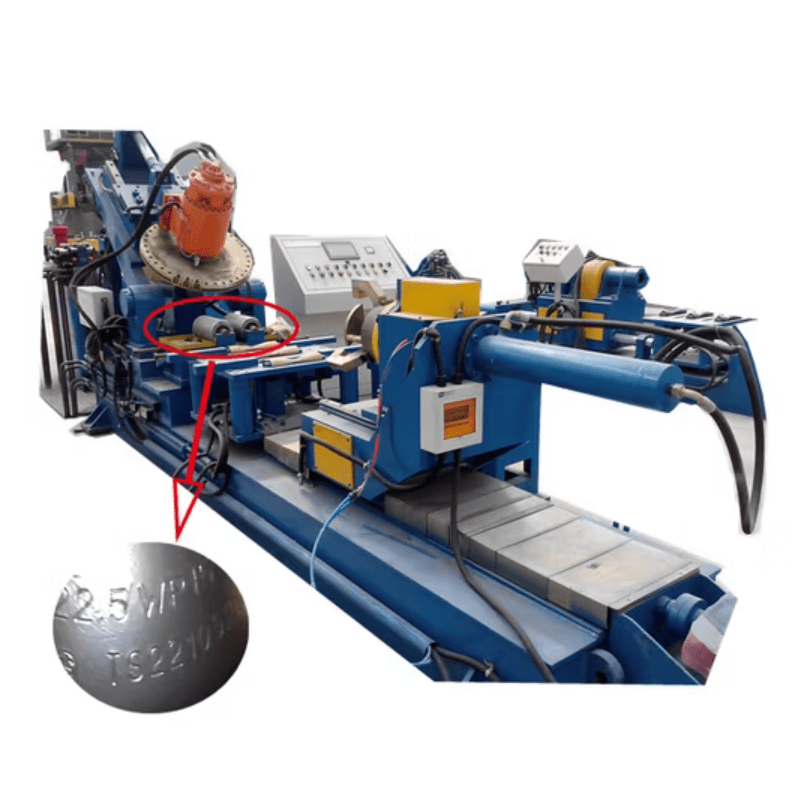
An industrial hot metal spinning machine represents the absolute pinnacle of heavy-duty metal forming equipment. Specifically engineered to transform massive, high-thickness metal blanks into seamless structural components , these high-capacity machines have become vital assets for modern heavy manufacturing plants. Unlike conventional, lighter cold-forming equipment that operates entirely at room temperature, an industrial hot metal spinning machine uses high-tonnage hydraulic force combined with targeted, intense thermal energy to reshape metals past their natural yield points without causing material fracturing or surface tearing.
Manufacturing facilities heavily utilize these systems to develop robust, rotationally symmetrical or asymmetrical hollow parts designed to withstand severe working pressures and extreme environment stresses. By implementing an industrial-grade machine, factories ensure continuous production uptime, minimize mechanical tool wear, and successfully process large-scale workpieces that traditional mechanical presses simply cannot handle.
Furthermore, the fundamental mechanics of a heavy-duty spinning machine center on securing a raw workpiece onto a rotating mandrel. As the spindle spins at high speeds, heavy-duty forming rollers apply immense, controlled pressure. This forces the plasticized metal to flow directly over the contours of the mandrel, progressively building the final shape. Because this process relies on a continuous flow of material rather than removing pieces, it optimizes structural efficiency. The massive structural frames of these machines are built to absorb thousands of kilonewtons of force while maintaining absolute mechanical alignment under extreme thermal loads.
This thermal integration means the machine frame must incorporate thermal shielding and specialized cooling zones to prevent structural sagging or alignment errors during multi-hour production cycles. Ultimately, these machines act as the primary manufacturing method for large-scale, heavy-walled hardware where structural integrity cannot be compromised.
Industrial Hot Metal Spinning Machine for Heavy-Duty Manufacturing
The manufacturing landscape demands stronger, lighter, and more complex asymmetrical or symmetrical hollow parts. To bridge the gap between raw metallurgical strength and intricate geometric design, heavy-duty manufacturing increasingly relies on high-performance hot metal spinning machines and advanced spinning technology. This comprehensive technical guide details the core principles, mechanics, advantages, and applications of industrial hot metal spinning technology.
1. Core Technology and Process Fundamentals
What is Hot Metal Spinning Technology?
At its core, hot metal spinning is a chipless metal forming process used to shape thick-walled or high-strength metals into seamless, hollow, rotational parts. Unlike cold metal spinning, which is performed at room temperature, the hot spinning process introduces localized, intense heat to the workpiece.
By heating the metal—often using integrated gas torches, induction heating systems, or laser technology—the material reaches its recrystallization temperature. This thermal activation drastically reduces the yield strength of the metal, making it highly malleable and eliminating the risk of work hardening, cracking, or material failure during severe deformation.
The Mechanical Sequence of Hot Metal Deformation
To manipulate robust alloys, an industrial hot metal spinning machine executes a highly controlled four-phase process:
- Blank Clamping & Alignment: The raw material—either a flat circular disc, a pre-formed cup, or a heavy-walled tube—is hydraulically clamped against a custom-engineered mandrel while a high-torque spindle begins rotation to establish the required angular velocity.
- Localized Thermal Activation: Integrated heating systems concentrate intense thermal energy directly onto the specific zone targeted for deformation until the material uniformly clears its specific recrystallization threshold.
- Dynamic CNC Roller Pass: Once the target temperature is reached, heavy-duty forming rollers move along a multi-axis CNC path, applying immense compressive forces to shear and flow the plasticized metal directly over the contours of the rotating mandrel.
- Controlled Cooling & Calibration: After the final forming pass, thermal input is throttled and a controlled cooling cycle (using air or specific quenching mediums) is applied to lock in a refined grain microstructure and prevent thermal warping or micro-cracking.
2. Key Engineering Features of Industrial Hot Metal Spinning Equipment
A modern hot metal spinning machine represents a powerhouse of mechanical, hydraulic, and electronic engineering built to handle extreme thermal and mechanical stresses.
- Integrated Heating Systems: Automated CNC-controlled gas burners or induction heaters track the forming roller dynamically, maintaining optimal material temperature windows throughout the entire cycle.
- High-Torque Spindles & Heavy-Duty Bearings: These components are engineered with reinforced frame architectures to absorb massive structural vibrations, handle extreme structural loads, and maintain precise RPMs under intense friction.
- Rigid Machine Beds & Tailstocks: Heavy-duty machines utilize a rigid bed fabricated from high-tensile cast iron or welded steel structures alongside specialized hydraulic tailstocks to hold high-thickness blanks securely in place.
- Multi-Axis CNC Precision Controls: Advanced CNC systems use multi-axis synchronous control to guide the forming rollers with sub-millimeter accuracy along complex paths, eliminating human error.
- Real-Time Force and Temperature Monitoring: Non-contact infrared pyrometers continuously scan the roller contact zone, establishing a closed-loop feedback mechanism that monitors forces and regulates temperature to ensure consistent wall thickness.
3. Comparative Advantage: Spinning vs. Alternative Methods
When specifying manufacturing methods for thick-walled, rotational parts, engineers choose hot metal spinning over traditional casting, forging, or stamping due to clear structural and economic advantages.
| Performance Metric | Hot Metal Spinning | Traditional Forging | Metal Casting | Cold Stamping / Drawing |
| Tooling & Setup Cost | Low to Moderate: Requires only a mandrel and standard roller wheels. | Very High: Demands massive, custom-machined progressive dies. | High: Requires complex mold patterns and casting cores. | Very High: Utilizes expensive, dedicated male/female die sets. |
| Material Grain Structure | Refined & Contoured: Continuous grain flow aligns directly along the part geometry. | Excellent: Highly compressed grain structure, but limited to coarser geometries. | Porous/Random: Discontinuous grain structure prone to internal voids and defects. | Stressed: Elongated grains prone to severe work hardening and cracking. |
| Wall Thickness Capability | Exceptional: Easily processes heavy-walled structural materials via thermal softening. | High: Capable of thick cross-sections but lacks precise wall-thinning control. | Variable: Thick walls are achievable but significantly increase component weight. | Limited: Restricted by the cold tonnage limits of the press and material tearing. |
| Prototyping Flexibility | Excellent: CNC programs and mandrels can be rapidly altered at minimal cost. | Poor: Altering a component design requires scrapping massive forging dies. | Moderate: Requires modifying or completely remaking the casting mold. | Poor: High financial penalties for engineering design changes mid-run. |
4. Key Advantages of Advanced Hot Metal Spinning Technology
Seamless Structural Integrity & Metallurgical Benefits
Because the metal is formed without cutting or welding, the finished component is entirely seamless. The compressive deformation applied during hot spinning refines the internal grain structure of the metal, forcing the grain boundaries to recrystallize and align continuously along the curved contours of the spun part. This uniform microstructure alignment yields exceptional tensile strength, high fatigue resistance, and removes internal stresses, ensuring uncompromised structural reliability under high operational stress.
High Material Utilization (Near-Zero Waste)
Traditional subtractive machining methods (like boring or turning) mill away massive percentages of raw material as metal chips, leading to excessive waste. Hot metal spinning is a chipless, form-fill process that stretches and redistributes the existing mass of the blank, achieving near-100% material utilization. For expensive alloys, this translates into massive raw material procurement savings.
Processing of Thick and Exotic Alloys
Cold forming tools can rupture stubborn or thick materials due to work hardening limits. By applying precise thermal induction or gas tracking directly to the contact point, industrial hot metal spinning machines easily manipulate thick-walled industrial steels, heavy-gauge plates, and high-strength, heat-resistant superalloys.
5. Material Compatibility Matrix
An industrial hot metal spinning machine can process a vast array of ferrous and non-ferrous metals, provided the correct thermal parameters and recrystallization thresholds are maintained:
- Carbon Steels & Alloy Steels: Frequently used for heavy industrial structural cones, large venturis, and robust mechanical components.
- Stainless Steel (300 & 400 Series): Extensively formed for corrosion-resistant chemical storage, industrial mixing bowls, and aerospace components.
- Titanium & Titanium Alloys: Handled seamlessly at high temperatures to create lightweight, high-strength parts without tearing or tool damage.
- Nickel-Based Superalloys (Inconel, Hastelloy): Prized for extreme heat environments, these stubborn materials are formed under highly precise closed-loop thermal control.
6. Industrial Applications Across Demanding Vertical Sectors
The unique capabilities of advanced hot metal spinning equipment make it indispensable across industries where safety-critical components operate under harsh conditions.
Aerospace & Defense
Aerospace hardware must minimize dead weight while maximizing structural durability under severe thermal and pressure extremes. High-precision, multi-axis CNC hot spinning machinery provides the articulation needed to track non-linear aerospace geometries. It is used to produce rocket nozzle liners, missile nose cones, engine cowlings, satellite dishes, and structural satellite components with total dimensional accuracy.
Energy & Petrochemical Production
Safety compliance in high-pressure gas storage and chemical processing relies heavily on components free from weak points. By taking a heavy-walled tube or pre-formed cylinder and spinning the ends inward at high temperatures, heavy-duty spinning machines close and seal containers seamlessly. Typical spun components include tank heads, seamless pressure vessel ends, heat exchanger components, and oil field funnels.
Automotive & Heavy Transport
In high-throughput transport sectors, hot spinning equipment offers rapid cycle times, excellent material utilization, and high mechanical performance. Manufacturers utilize hot spinning lathes to fabricate heavy-duty alloy wheel rims, catalytic converter cones, seamless drive shafts, and high-pressure CNG fuel cylinders.
Industrial Manufacturing & Piping Systems
For custom, large-scale plant operations, these systems shape large ventilation cones, heavy-duty separator bowls, custom industrial piping networks, and large venturis.
7. Industry 4.0 Integration and Smart Spinning Horizons
As industrial manufacturing marches toward total digitization, hot metal spinning technology is shifting into an intelligent, connected ecosystem.
Digital Twin Modeling
Before a physical metal blank is clamped onto a machine, advanced finite element analysis (FEA) software allows engineering teams to build a complete digital twin of the spinning cycle. This virtual environment accurately simulates thermal distribution, material flow, and potential thinning stress zones. Once verified, the program is exported directly to the CNC machine, cutting physical setup times and prototyping waste down to near zero.
Adaptive Force Compensation
Intelligent spinning machines leverage real-time hydraulic and electric servo feedback loops to continuously “feel” how the metal responds during deformation. If a slight material variance, thickness anomaly, or hardness variation is detected within a blank, the central CNC dynamically adjusts its roller pressure and feed rates on the fly to compensate, ensuring a flawless 100% yield rate even when handling volatile materials.
Green Manufacturing Efficiency
Environmental responsibility and corporate sustainability align perfectly with modern hot spinning machinery. By utilizing ultra-focused, high-frequency induction heating systems rather than wide-dispersion gas lines, modern hot spinning equipment concentrates thermal energy exclusively where work is being performed. Combined with the process’s inherent near-zero material waste architecture, it stands out as one of the most eco-efficient, sustainable methods for heavy-duty industrial fabrication available today.
CNC Hot Metal Spinning Machine: Precision Engineering for Complex Geometries
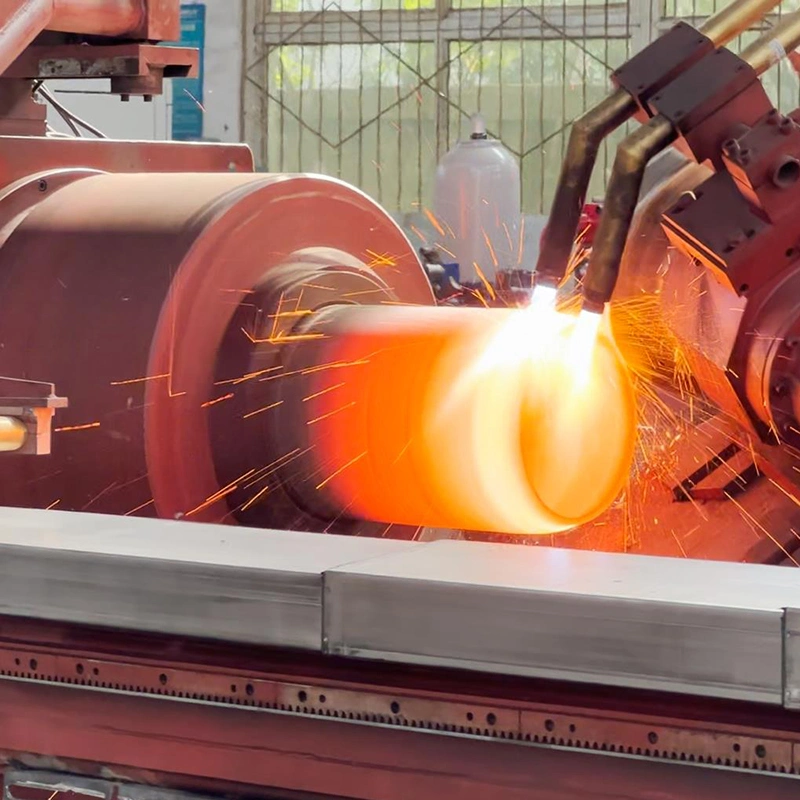
The integration of Computer Numerical Control (CNC) has completely revolutionized the sheet metal industry, making the CNC hot metal spinning machine an indispensable asset for high-tech manufacturing. Precision engineering demands exact repeatability, especially when fabricating complex components with intricate geometries like parabolic cones, re-entrant shapes, and variable wall thicknesses. A CNC hot metal spinning machine utilizes advanced multi-axis synchronous control systems to direct the heavy forming rollers with sub-millimeter precision. By programming exact tool paths via customized CAD/CAM software interfaces, operators can completely eliminate human error and achieve flawless part-to-part consistency across thousands of cycles.
This level of precision engineering drastically reduces downstream machining requirements, shortens production cycle times, and allows for the seamless creation of intricate profiles that manual spinning lathes fail to replicate.
Modern CNC systems manage multiple axes simultaneously, adjusting the longitudinal feed, cross-feed, and roller angle in real time. This ensures that the forming tool maintains an ideal angle of contact relative to the curved surface of the workpiece, which is critical for preventing localized wrinkling or wall thinning. Additionally, the CNC unit acts as the central brain that synchronizes the rotation of the high-torque spindle with the physical movement of the automated heating torches or induction coils. As a result, if the roller slows down to form a tight radius, the CNC automatically throttles the thermal output to prevent localized overheating or material melting.
The digital storage of these programs means that a facility can switch production from a complex aerospace cone to a heavy-duty industrial vessel within minutes by simply loading a different code string and swapping the mandrel. This high degree of flexibility makes CNC hot metal spinning machines highly economical for high-mix, low-volume production environments as well as massive, automated manufacturing campaigns.
CNC Hot Metal Spinning Machine: Precision Engineering for Complex Geometries
The integration of Computer Numerical Control (CNC) with advanced thermo-mechanical metal forming has revolutionized the precision fabrication of complex geometries. For decades, traditional sheet metal forming relied on aggressive multi-stage stamping presses, material-wasting subtractive machining, or labor-intensive manual spinning techniques. While those legacy methodologies sufficed for basic structural geometries or low-consequence components, modern industrial paradigms—spanning aerospace defense, high-pressure chemical containment, nuclear power generation, and advanced transportation—demand components that display near-flawless dimensional accuracy, uniform structural density, and highly irregular, non-linear geometries.
The CNC hot metal spinning machine stands at the absolute pinnacle of this manufacturing evolution. By combining multi-axis synchronous control with specialized localized thermal activation, these highly automated systems enable precision engineering teams to manipulate high-thickness blanks and stubbornly rigid superalloys past their natural physical yield thresholds without inducing macro-fractures, structural wrinkles, or material tearing. This comprehensive technical analysis explores the engineering architecture, mathematical control frameworks, thermal integration strategies, and metallurgical advancements that define CNC hot metal spinning technology as an indispensable pillar of modern precision engineering.
1. Fundamentals of the CNC Hot Metal Spinning Process
To truly appreciate the precision engineering embodied by a CNC hot metal spinning machine, one must first look at its foundational, chipless mechanical sequence. Unlike traditional machining centers that carve away material to expose a final shape, or stamping presses that violently punch sheets into a die cavity, hot spinning uses a highly disciplined redistribution of mass. The process relies on forcing a plasticized workpiece—be it a flat circular blank, a pre-formed deep-drawn cup, or a heavy-walled tubular structure—to flow directly over the exterior geometry of a rotating mandrel under intense, localized roller pressure.
The Kinematics of Chipless Deformation
When a metal alloy is subjected to standard cold-forming operations at room temperature, its internal crystal lattice structure quickly experiences dislocation accumulation, resulting in a phenomenon known as work hardening. As the material hardens, its yield strength rises rapidly while its structural ductility plummets. If the forming forces continue past a specific threshold without intervention, the material will inevitably rupture, snap, or exhibit catastrophic micro-void propagation.
CNC hot metal spinning entirely bypasses these rigid physical limits through the precise application of localized heat. By continuously elevating the specific zone of contact ahead of the forming roller past the material’s precise metallurgical recrystallization threshold, the atomic bonds within the crystal lattice are rendered temporary cooperative and mobile. In this highly plasticized state, the metal’s yield strength drops to a minor fraction of its cold rating.
The CNC-guided forming roller can then execute progressive, sweeping passes, applying targeted compressive forces that stretch, iron, and flow the metal over the spinning mandrel. Because this mechanical manipulation takes place within an ideal thermal envelope, the metal undergoes dynamic recrystallization in real time. Old, distorted, highly stressed grains are continuously replaced by fresh, strain-free grain boundaries, allowing engineers to achieve drastic, sweeping dimensional transformations that would be utterly impossible using cold press or standard drawing methodologies.
The Role of Multi-Axis Synchronous Control
The true intelligence of a modern CNC hot metal spinning machine is driven by its multi-axis synchronous control architecture. In legacy manual or semi-automated hydraulic spinning lathes, the tool path of the forming roller was dictated entirely by an operator’s physical tactile feedback or mechanical template tracers. While skilled manual craftsmen could produce uniform cylinders or basic domes, achieving absolute repeatability across thousands of complex, varying-thickness components was an statistical impossibility. Human lag, mechanical play, and inconsistent feed rates inevitably translated into severe part-to-part geometric variations, localized wall thinning, and high factory rejection rates.
A CNC system replaces human guesswork with high-speed digital processing units capable of coordinating multiple independent axes of motion simultaneously. In a typical premium-tier machine configuration, these axes include:
- The Longitudinal Axis (Z-Axis): Manages the forward and backward movement of the heavy tool carriage parallel to the main rotation spindle. This governs the primary length tracking of the component.
- The Cross-Feed Axis (X-Axis): Directs the radial inward and outward movement of the forming roller relative to the centerline of the rotating mandrel. This controls the specific diameter and profile depth of the part.
- The Swivel Axis (Y-Axis or Pivot Axis): Controls the angular presentation of the forming roller wheel relative to the curved surface profile of the workpiece. Maintaining an optimized, perpendicular tool angle prevents localized material bunching or dragging.
- The Tailstock Axis (W-Axis): Regulates the high-pressure clamping force required to hold the raw blank firmly against the face of the mandrel during rapid rotation and structural engagement.
By executing high-speed interpolation algorithms, the CNC unit synchronizes the positions of these linear and rotary axes with the exact angular velocity of the main spindle. As the roller tracks a complex parabolic arc, the system micro-adjusts the feed rate and roller-gap distance within milliseconds, ensuring that the material is compressed uniformly against the mandrel face without a single instance of mechanical path lag.
2. Advanced Architectural Features and Machine Anatomy
Operating continuously under a combination of intense localized thermal output (frequently exceeding 1,000°C) and massive hydraulic forces (ranging from hundreds to thousands of kilonewtons) requires an exceptionally robust machine architecture. Every structural component within a CNC hot metal spinning machine must be explicitly engineered to withstand severe thermal expansion, absorb continuous mechanical harmonic vibrations, and maintain micro-meter alignment metrics over multi-hour production campaigns.
Structural Frame and Cast Bed Integrity
The foundational bed of a heavy-duty CNC hot metal spinning machine is almost exclusively cast from premium high-damping iron alloys or engineered as a heavily reinforced, stress-relieved welded steel structure. Because the forming rollers exert massive orthogonal forces against the rotating spindle, a standard flexible machine frame would flex or distort, resulting in immediate dimensional errors on the finished component surface.
The massive cast beds are deliberately designed with extra-wide box-style guideways and optimal structural webbing to completely neutralize these mechanical reactions. Furthermore, because these machines operate in close proximity to automated open-flame gas rings or high-penetration induction coils, the main bed structure includes integrated thermal shielding and internal water-cooling channels. This localized thermal management prevents heat from radiating into the main guideways, protecting the precision ball screws and linear encoders from thermal expansion errors that could jeopardize sub-millimeter part accuracy.
Main Spindle and High-Torque Drive Assembly
At the heart of the machine’s mechanical performance is the main spindle assembly. The spindle must rotate large, heavy mandrels and thick-walled metal blanks at consistent angular velocities, even when facing extreme structural resistance from the engaging forming rollers. To accomplish this, the spindle is driven by high-torque AC synchronous servo motors matched with multi-stage heavy-duty planetary gearboxes.
The spindle housing incorporates oversized, ultra-precision tapered roller bearings and double-row cylindrical bearings designed to absorb both extreme radial forces and immense axial thrust loads simultaneously. Because the mandrel absorbs significant heat directly from the glowing workpiece, this thermal energy is conducted down the spindle shaft; to safeguard the bearing grease and preserve component alignment, high-performance spinning lathes employ automated oil-circulation cooling units that continuously cycle chilled lubrication fluid through the entire spindle housing, locking in operational stability.
Heavy-Duty Forming Carriage and Servo Actuation
The carriage assembly holds and maneuvers the hardened steel or tungsten carbide forming rollers that physically shape the metal blank. Driven by high-resolution digital brushless servo motors paired with ultra-precise preloaded ball screws or high-tonnage hydraulic proportional cylinders, the carriage moves with absolute authority.
The tool sliders are engineered with zero-backlash linear roller guideways, enabling smooth, uninterrupted motion under maximum load. The forming rollers themselves are critical wear components; they are engineered from advanced hot-work tool steels (such as AISI H13) or specialized metal matrix composites, and undergo advanced vacuum heat-treatments and surface nitriding to maximize resistance to thermal fatigue, localized deformation, and abrasive wear.
3. The Math and Logic of Path Programming for Complex Geometries
Fabricating complex geometries—such as variable-thickness re-entrant profiles, deep parabolic cones, multi-radius venturis, and stepped structural cylinders—demands sophisticated CNC programming logic. Unlike standard turning centers where a single tool path cleanly slices away a layer of material, hot metal spinning requires a series of progressive, overlapping roller strokes known as “passes.” Designing these paths is both a science and an art, requiring an intricate understanding of material flow mechanics and volumetric conservation laws.
Volumetric Conservation and Conventional Spinning vs. Shear Spinning
When designing a CNC path program for an industrial component, engineering teams must differentiate between two primary operational modalities: Conventional Spinning and Shear Spinning (or Flow Forming).
Conventional Spinning:
Raw Blank Diameter > Finished Part Diameter
Wall Thickness remains relatively constant or is controlled progressively via multi-pass ironing strokes.

Shear Spinning (Flow Forming):
Raw Blank Diameter = Finished Part Diameter
Wall Thickness is drastically reduced as material is actively sheared parallel to the mandrel surface.
In Conventional Spinning, the forming roller executes multiple forward and backward weaving strokes, progressively pushing the outer flange of the metal blank down toward the mandrel face. The raw blank diameter is significantly larger than the final part diameter. The primary objective of the CNC path is to carefully control the material’s circumferential compression; if the roller sweeps inward too quickly, the outer flange will buckle under compressive stress, resulting in deep, unrecoverable structural wrinkles. Conversely, if the feed rate is too slow, the roller will repeatedly knead the same localized zone, causing premature wall thinning and material separation.
In Shear Spinning, the material deformation obeys a precise mathematical relationship known as the Sine Law:
$$t_f = t_i \cdot \sin(\alpha)$$
Where:
- $t_f$ is the final wall thickness of the spun component.
- $t_i$ is the initial thickness of the starting flat blank.
- $\alpha$ is the semi-cone angle of the mandrel profile.
During a shear spinning pass, the outer diameter of the blank remains completely unchanged, while the forming roller applies massive compressive and shearing forces that physically squeeze the material down against the mandrel, reducing its wall thickness while elongating its axial length. The CNC path must track along the sine law profile with sub-micrometer alignment; any minor path deviation will violate the volumetric balance of the metal, leading to localized material tearing or the formation of an unmanageable metal wave ahead of the roller tool.
Advanced Multi-Pass Path Strategies
To map a flat disc into a deep, complex geometry without causing physical defects, programmers utilize advanced multi-pass tracking strategies. These path profiles are generally categorized into three distinct formatting geometries:
- Linear Progressive Passes: The roller moves along straight, angled lines, gradually closing the envelope between the blank and the mandrel with each successive stroke. This is ideal for standard conical profiles.
- Concave/Convex Curvilinear Passes: The tool path utilizes complex spline curves to map the material over sweeping, non-linear geometries. This strategy is critical for fabricating high-efficiency aerodynamic venturis, satellite dishes, and paraboloid nose cones.
- Involute and Forward-Reverse Ironing Combinations: The roller sweeps forward to stretch and thin the material, then immediately executes a reverse ironing stroke to compress the grain boundaries and smooth out surface micro-ridges. This specialized combination is highly valued when processing ultra-high-strength defense hardware that demands exceptional surface finishes and tight dimensional tolerances.
Modern CAD/CAM software suites allow manufacturing engineers to input specific material properties, thermal parameters, and final geometric profiles to automatically generate these complex multi-pass codes. The software uses advanced mathematical simulations to analyze the predicted material thinning rate at every single coordinate step, ensuring that the final component maintains a highly uniform, structurally sound wall profile throughout its entire structural envelope.
4. Thermal Management and Integration Strategies
The defining advantage of a CNC hot metal spinning machine is its capacity to integrate intense, localized thermal energy directly into an automated mechanical forming cycle. Precise thermal management is not merely an optional enhancement; it is a critical metallurgical requirement. If the temperature of the workpiece drops even slightly below its targeted plasticized window, the material’s yield strength will spike instantly, causing severe roller tool wear, localized surface cracking, or immediate component destruction. Conversely, if the zone is overheated, the metal risks experiencing rapid grain growth (which ruins mechanical properties) or localized melting and scaling.
Induction Heating Systems vs. Automated Gas Burners
Industrial facilities rely on two primary technologies to deliver the high-intensity thermal energy required for hot metal spinning operations:
High-Frequency Induction Heating
Induction heating represents the absolute gold standard for clean, efficient, and ultra-precise thermal activation. These systems utilize custom-contoured electromagnetic induction coils positioned immediately ahead of the forming roller carriage. When high-frequency alternating electrical current flows through the coil, it generates an intense, rapidly fluctuating magnetic field that penetrates directly into the rotating metal workpiece. This field induces powerful localized eddy currents and magnetic hysteresis losses directly within the metal structure, causing the material to heat up from the inside out within seconds.
Induction heating offers unparalleled operational advantages:
- Ultra-Focused Energy Concentration: Thermal energy is directed exclusively into the exact zone slated for imminent roller deformation, leaving the rest of the component structurally stable and minimizing overall energy consumption.
- Instantaneous Response Speeds: The CNC system can modulate the electrical power output of the induction generator instantly, allowing for precise real-time temperature throttling as the roller transitions across varying material thicknesses.
- Pristine Surface Environments: Because there is no open combustion flame, the generation of surface oxidation, carbon scaling, and atmospheric contamination is drastically reduced.
Automated Multi-Point Gas Burner Manifolds
While induction heating is exceptionally precise, it requires specialized, custom-shaped coils that must be tailored to match specific mandrel geometries. For facilities that manage a high-mix, low-volume production profile, automated gas burner manifolds provide a highly versatile, cost-effective alternative. These systems employ multi-point burner nozzles fueled by a regulated mixture of oxygen, acetylene, natural gas, or propane.
Modern CNC hot metal spinning machines feature fully automated gas tracking modules. The burner assemblies are mounted onto independent auxiliary CNC slides that track the primary forming roller with absolute precision. If the forming roller alters its feed path to process a tight corner, the gas burner moves in perfect synchronization, ensuring a steady, uniform thermal envelope ahead of the tool. Advanced mass flow controllers manage the fuel gas ratio dynamically, tailoring the flame profile from a wide, gentle heating brush to a highly concentrated, intense thermal point based on real-time material requirements.
Closed-Loop Temperature Tracking with Infrared Pyrometry
To achieve true precision engineering, a CNC hot metal spinning machine must operate via a fully closed-loop thermal feedback network. Non-contact infrared pyrometers and advanced thermal imaging cameras are aimed directly at the dynamic intersection point where the forming roller meets the glowing metal workpiece. These sensors continuously sample the material’s thermal emission spectrum, streaming high-speed temperature data directly back to the central CNC processing unit.
+-----------------------------------------------------------+
|                  Infrared Pyrometer                       |
|           (Measures Workpiece Temperature)                |
+-----------------------------------------------------------+
                              |
                              v  (Real-Time Temperature Data)
+-----------------------------------------------------------+
|                     CNC Control Unit                      |
|          (Compares Data Against Target Window)            |
+-----------------------------------------------------------+
                              |
       +----------------------+----------------------+
       | (If Too Hot)                                | (If Too Cold)
       v                                             v
+-----------------------------+               +-----------------------------+
| Decrease Induction Power or |               | Increase Induction Power or |
|  Throttle Gas Flow Rate     |               |   Open Gas Control Valves   |
+-----------------------------+               +-----------------------------+
If the infrared pyrometer detects a localized thermal drop caused by the heatsink effect of the massive underlying mandrel, the CNC system reacts instantly, throttling up the induction power or opening the gas control valves within milliseconds. If a thin-walled zone begins to overheat, the system scales back thermal output to safeguard the material’s structural integrity. This seamless integration of real-time thermal monitoring ensures that the entire component is formed within its absolute sweet spot for metallurgical transformation, delivering uniform properties across every single production cycle.
5. Metallurgical Transformations and Structural Optimization
The mechanical and thermal inputs applied during a CNC hot metal spinning cycle alter the internal microstructure of the processed alloy, yielding significant metallurgical enhancements that cannot be replicated by traditional cutting or stamping methods.
Dynamic Recrystallization and Grain Refinement
When a raw metal disc or tube is manufactured via standard casting or heavy forging, it often possesses a coarse, non-uniform, or random grain structure. If this material is machined using standard subtractive turning centers, the natural grain flow lines of the metal are severed and exposed to the environment, creating microscopic stress-concentration points that are highly vulnerable to premature fatigue failure, corrosion, and cracking under cyclic pressure loading.
CNC hot metal spinning entirely eliminates these structural weak points. As the forming roller compresses and kneads the plasticized metal at high temperatures, the original coarse grain boundaries are broken down mechanically. Because the material is held past its recrystallization threshold, a process known as Dynamic Recrystallization (DRX) takes place. Fresh, incredibly fine, and equiaxed crystal grains nucleate and grow in real time.
Crucially, these newly formed grain boundaries are forced to align continuously and seamlessly along the exact curved contours and geometric radii of the spun part. This uninterrupted internal grain structure acts as an elite mechanical defense system, maximizing the finished part’s ultimate tensile strength and drastically increasing its long-term fatigue life span.
Elimination of Internal Porosity and Volumetric Defects
Metal castings are notorious for harboring hidden internal defects, such as micro-porosity, gas pockets, cooling shrink cracks, and localized alloy segregation zones. In high-consequence industries like aerospace defense or nuclear engineering, a single hidden void can cause catastrophic component failure under operational loads.
The intense compressive tonnage exerted by a CNC hot metal spinning machine acts as a highly effective physical purification process. As the forming roller irons the plasticized alloy against the hardened mandrel, it subjects the material to massive multi-directional hydrostatic pressures. These intense forces physically crush any existing internal voids, welding micro-porosity pockets shut and compressing the metal into an exceptionally dense, completely homogeneous structure.
In effect, the hot spinning process acts as a real-time quality assurance mechanism; if a raw metal blank contains a massive structural flaw or unmanageable inclusion, the severe localized stresses of the forming cycle will cause the material to fracture immediately on the lathe bed, working as a natural filter that prevents defective hardware from ever reaching downstream assembly tracks.
6. Advanced Material Capabilities and exotic Superalloys
While standard carbon steels and structural aluminum alloys are easily processed on basic machinery, precision engineering centers increasingly leverage CNC hot metal spinning machines to manipulate highly advanced, exotic superalloys. These high-grade materials are selected for their capacity to withstand extreme heat, aggressive chemical corrosion, and intense mechanical loads, but they are notoriously difficult to form using traditional cold methods.
Titanium Alloys (Grade 5 / Ti-6Al-4V)
Titanium is highly prized in the aerospace and medical fields due to its exceptional strength-to-weight ratio and bio-compatibility. However, at room temperature, titanium exhibits high yield strength, low ductility, and an exceptionally stubborn tendency to spring back after deformation, making cold stamping or standard manual spinning completely non-viable.
By utilizing a CNC hot metal spinning machine equipped with precision thermal zones configured between 600°C and 700°C, titanium transitions into a highly cooperative, workable state. The multi-axis CNC system can precisely map complex parabolic nose cones or fuel tank domes with sub-millimeter tracking accuracy. Forming within this exact thermal window eliminates the risk of surface contamination or excessive alpha-case embrittlement, delivering high-performance, ultra-lightweight aerospace components with flawless structural profiles.
Nickel-Based Superalloys (Inconel 625 / 718, Hastelloy)
Inconel and other nickel-based superalloys are engineered specifically to maintain their exceptional mechanical strength even when subjected to temperatures exceeding 900°C, making them the premier choice for gas turbine engines, aerospace rocket nozzles, and high-heat exhaust systems. Because these alloys are built to resist thermal softening, trying to shape them requires massive mechanical force, even when glowing hot.
Processing Inconel demands an exceptionally rigid CNC hot metal spinning machine architecture matched with ultra-high-tonnage hydraulic proportional cylinders and heavy-duty induction arrays. The induction system must continuously saturate the material ahead of the roller tool with intense energy, maintaining a precise, narrow forming window (often between 950°C and 1,050°C). The adaptive force compensation systems within the CNC unit continuously monitor the roller’s resistance, making micro-adjustments to the feed paths to ensure the superalloy flows smoothly over the mandrel contours without experiencing localized shear cracks or tool-destroying force spikes.
Refractory Metals (Tantalum, Molybdenum, Tungsten)
For specialized nuclear, electronic, and space propulsion applications, engineers utilize refractory metals that possess extremely high melting points. These metals are incredibly brittle at room temperature and will fracture instantly if subjected to cold deformation. A CNC hot metal spinning machine provides the exact environment needed to handle these extreme materials, using focused laser or high-penetration induction heating to elevate the blank past its specific ductile-to-brittle transition temperature (DBTT), unlocking the ability to form seamless, highly dense chemical crucibles, x-ray targets, and nuclear shielding components with zero structural defects.
7. Industrial Applications Across High-Consequence Sectors
The capacity of CNC hot metal spinning machines to repeatedly deliver exceptional dimensional precision, seamless geometries, and enhanced metallurgical characteristics has made this technology a critical production asset across a broad array of demanding industrial sectors.
Aerospace, Space Exploration, and Defense
In the aerospace sector, every single gram of excess structural weight directly penalizes a vehicle’s payload capacity and fuel efficiency. Aerospace engineers heavily utilize multi-axis CNC hot metal spinning machinery to fabricate critical single-piece components that replace heavy, expensive multi-part welded assemblies.
Aerospace Components Produced via CNC Hot Metal Spinning:
├── Rocket Engine Thrust Chambers & Liners
├── Parabolic Missile Nose Cones & Radomes
├── High-Efficiency Aero-Engine Cowlings & Intake Lips
└── Seamless Spherical Fuel Tank Domes
By forming these parts as a single, seamless component with optimized variable wall thicknesses (leaving extra material in high-stress attachment zones while ironing down low-load zones to save weight), aerospace manufacturers can eliminate extensive non-destructive weld inspection protocols (such as X-ray and ultrasonic testing), while guaranteeing absolute structural safety under extreme aerodynamic and orbital stresses.
High-Pressure Containment and Chemical Process Infrastructure
The safe storage and transport of high-pressure gases, cryogenic liquids, and volatile chemical compounds demand containment vessels that are entirely free from structural vulnerabilities. Traditional pressure vessels are built by rolling heavy steel plates and welding them together along longitudinal and circumferential lines, leaving long weld seams that are inherently vulnerable to stress-corrosion cracking and structural fatigue.
Advanced heavy-duty CNC hot metal spinning machines completely redefine this manufacturing paradigm through a process known as “spinning-down” or “necking.” A seamless, heavy-walled steel tube is loaded onto the machine spindle and rotated at high speed while automated burner rings heat the protruding ends to a glowing plasticized state.
The heavy-duty CNC forming rollers then execute a series of progressive inward sweeps, physically closing and sealing the tube ends to form an integrated, completely seamless tank head directly from the original parent material. This seamless architecture satisfies the most stringent global safety codes (such as ASME Section VIII), providing unmatched safety margins and an extended operational life span for industrial gas cylinders and chemical reactors.
Power Generation and Nuclear Infrastructure
In nuclear power plants and high-efficiency thermal generation facilities, components must withstand continuous cyclic thermal expansion and aggressive steam environments. CNC hot metal spinning lathes are used to fabricate massive, thick-walled steam pipe reducers, specialized containment penetration sleeves, and heavy-duty separator bowls. The grain refinement achieved via dynamic recrystallization during the hot spinning process ensures these critical power components offer maximal resistance to creep deformation, protecting utility infrastructures from catastrophic failure over multi-decade operational horizons.
8. Smart Manufacturing and Industry 4.0 Integration
The modern manufacturing landscape is undergoing a massive digital transformation, and CNC hot metal spinning technology is shifting into a highly intelligent, fully connected Industry 4.0 ecosystem. Precision engineering is no longer restricted to executing fixed, pre-programmed code; it is driven by real-time data tracking, adaptive machine learning, and cloud-connected diagnostics.
Adaptive Force Compensation and Smart Feedback Loops
Raw metal blanks, even those produced under exceptionally rigorous metallurgical quality controls, frequently display minor internal variations, such as localized grain segregation, minor thickness variances, or unpredictable hardness anomalies. A standard legacy CNC machine tracks along its pre-programmed path blindly, completely ignoring these subtle variations, which can result in localized surface scuffing, micro-tearing, or wall-thickness errors when encountering a tough zone.
Next-generation intelligent CNC hot metal spinning machines combat this issue through the integration of Adaptive Force Compensation. The hydraulic actuators and electric servo drives that maneuver the forming carriage are embedded with high-speed piezoelectric force sensors that continuously measure tool resistance at a rate of thousands of samples per second.
If the forming roller encounters a localized hard spot or a minor thermal drop, the force sensors instantly detect the resulting structural resistance spike. The intelligent CNC unit processes this data within milliseconds and automatically adapts the process parameters in real time—either by backing off the roller feed rate slightly to prevent material tearing, executing an emergency localized heating boost to further soften the zone, or dynamically adjusting the tool-gap distance to distribute material flow evenly. This level of real-time machine intelligence transforms the spinning lathe into an adaptive forming system, delivering near-flawless part consistency and driving scrap rates down to near zero.
IoT Diagnostic Arrays and Predictive Maintenance
To ensure maximum factory uptime and maintain rigorous process control across continuous multi-shift manufacturing campaigns, smart CNC hot metal spinning systems are outfitted with extensive Internet of Things (IoT) sensor networks. These sensors continuously stream critical machine health data to cloud-based monitoring platforms, tracking variables such as:
- High-frequency acoustic emissions and micro-vibration profiles from the main spindle bearings to detect early signs of mechanical fatigue or lubrication failure.
- The exact power consumption profiles and hydraulic pressure variations across every independent axis slider to monitor mechanical wear and backlash development.
- The surface condition and thermal deformation metrics of the heavy-duty forming mandrels using laser-guided measuring systems integrated directly within the machine envelope.
By processing this continuous data stream through advanced predictive AI algorithms, the manufacturing system can accurately forecast when a specific component—such as a spindle bearing, a ball screw, or a forming roller—is approaching its physical wear limit. The factory can then schedule targeted maintenance windows proactively, completely eliminating unplanned production line shutdowns and ensuring that the machine always operates at its peak performance window.
End-to-End Digital Traceability
In safety-critical sectors like aerospace exploration and nuclear energy, components must be backed by a definitive, untampered historical record of their manufacturing journey. Industry 4.0-integrated CNC hot metal spinning systems automate this compliance requirement completely by generating an individual “digital birth certificate” for every single part formed on the lathe bed.
Throughout the spinning cycle, the machine logs a continuous stream of data points synchronized with the part’s serial number, recording the exact thermal history from the infrared pyrometers, the precise force profiles from the carriage sliders, the spindle rotation speeds, and the final dimensional calibration metrics measured by the machine’s internal laser probes. This comprehensive digital record is archived securely within the enterprise network, providing engineering teams with total end-to-end traceability and absolute confirmation that the finished hardware complies with every single proprietary quality standard.
9. Conclusion: The Future of Precision Sheet Metal Forming
The CNC hot metal spinning machine represents a highly successful convergence of advanced multi-axis numerical control, precise thermal integration, and sophisticated material flow mechanics. By replacing traditional, high-waste subtractive machining and expensive, rigid die-stamping presses with an intelligent, adaptive mass redistribution process, this technology has redefined the boundaries of precision sheet metal forming.
From the clean, targeted energy of induction heating to the real-time vigilance of adaptive force compensation loops, every aspect of a modern hot spinning system is engineered to maximize geometric freedom and unlock elite metallurgical performance. As engineering teams continue to design more complex, lightweight, and high-strength hardware to face the challenges of space exploration, sustainable energy production, and advanced transportation, CNC hot metal spinning technology will undoubtedly remain an indispensable pillar of global precision manufacturing, shaping the future of industrial engineering one seamless turn at a time.
3. Advanced Hot Metal Spinning Technology for High-Strength Alloys
As industrial projects continue to scale in mechanical complexity, the utilization of advanced hot metal spinning technology is critical when manipulating high-strength alloys. Traditional cold-forming methods introduce severe work hardening and structural brittleness into robust metals, making them prone to cracking. Advanced hot metal spinning technology completely bypasses these physical limitations by heating the metal to its exact recrystallization temperature. This localized thermal activation temporarily drops the material’s yield strength, rendering it highly malleable and cooperative under compression.
Consequently, high-strength alloys can be severely deformed into complex, hollow parts without inducing internal micro-cracks, tensile voids, or catastrophic material failure. This technology is a cornerstone for engineering firms that require uncompromised structural performance from complex metals.
The application of this technology is particularly relevant when working with exotic materials like titanium, Inconel, and cobalt-based superalloys. These metals possess high strength-to-weight ratios but are notoriously stubborn at room temperature, quickly destroying standard tool steel dies. Advanced hot metal spinning technology introduces precise, concentrated heat directly ahead of the forming roller, changing the crystal lattice structure of the metal in real time. This allows the material to flow like clay under the roller’s pressure.
Because the heat is localized, the surrounding areas of the component remain structurally stable, preventing the overall geometry from collapsing or warping. Furthermore, the technology enables the production of parts with tailored wall profiles, allowing engineers to leave extra material thickness in high-stress zones while thinning out low-load areas. This exact material optimization is impossible with traditional subtractive methods, making advanced hot spinning technology the preferred choice for handling the world’s most demanding industrial alloys.
Advanced Hot Metal Spinning Technology for High-Strength Alloys
The relentless progression of modern engineering demands structural materials that can endure increasingly hostile environments. In fields such as deep-space exploration, military defense, nuclear power generation, and advanced chemical processing, mechanical assemblies must routinely survive extreme pressures, volatile corrosive fluids, and severe cyclic thermal stresses. To meet these performance parameters, material scientists and structural design engineers have turned away from standard carbon steels and basic aluminum formulations, choosing instead to utilize high-strength alloys and exotic superalloys.
Materials like Grade 5 Titanium (Ti-6Al-4V), various nickel-based superalloys (Inconel 625, Inconel 718, Hastelloy), high-cobalt structural matrices, and ultra-high-strength maraging steels possess high strength-to-weight ratios and exceptional thermal durability. However, the precise physical properties that make these high-strength alloys highly valuable in the field also make them incredibly stubborn and difficult to manipulate during fabrication.
Traditional metal forming methodologies quickly hit their mechanical boundaries when attempting to process high-strength alloys. Cold stamping, heavy-die drawing, and legacy manual spinning are fundamentally restricted by the physics of room-temperature deformation. At ambient temperatures, high-strength alloys possess elevated yield limits and high work-hardening coefficients. When subjected to severe cold compression or stretching, their internal crystal lattices lock up rapidly, accumulating massive residual stresses that inevitably translate into surface tearing, macro-fracturing, or sudden, catastrophic tool destruction.
Subtractive manufacturing techniques, such as milling or turning the desired hollow configurations out of large forged blocks, are equally problematic; they result in high material waste, destroy the natural grain alignment lines of the metal, and involve costly machining timelines. Advanced hot metal spinning technology provides an elegant, highly precise solution to this manufacturing bottleneck. By introducing targeted, intense thermal energy directly into an automated, multi-axis chipless deformation cycle, this technology changes the metallurgical state of high-strength alloys in real time, enabling the seamless fabrication of ultra-complex, high-consequence rotational components with optimized structural properties.
1. Thermo-Mechanical Mechanics of High-Strength Alloy Processing
To understand why advanced hot metal spinning technology is uniquely suited for processing high-strength alloys, one must examine the microstructural modifications that occur at the intersection of thermal energy and mechanical pressure. The process is not merely a method of bending sheet metal over a form; it is a highly disciplined, precisely orchestrated thermo-mechanical transformation that reshapes the metal blank at the atomic level.
Overcoming the Yield Barrier via Recrystallization Physics
Every metallic alloy possesses a specific yield strength rating at room temperature, which defines the precise threshold of mechanical force required to transition the material from elastic deformation (where it springs back to its original shape) to plastic deformation (where it takes on a permanent new shape). For an alloy like Inconel 718, this cold yield threshold is exceptionally high. Trying to force a thick plate of Inconel to conform to a curved mandrel at room temperature requires massive mechanical forces that frequently exceed the structural capacity of standard industrial presses.
Advanced hot metal spinning handles this physical barrier by elevating the material’s internal temperature past its precise Recrystallization Threshold. This threshold represents the specific temperature zone where a metal’s heavily strained, distorted crystal lattice structure relaxes, allowing a fresh, strain-free set of crystalline grains to nucleate and grow.
When a high-strength alloy blank is heated past this point, its yield strength drops instantly to a minor fraction of its cold rating, while its structural ductility expands dramatically. In this plasticized state, the metal’s resistance to deformation is stripped away, allowing heavy-duty CNC-guided forming rollers to compress, stretch, and iron the material over a rotating mandrel using manageable force vectors.
The Phenomenon of Dynamic Recrystallization (DRX)
A key metallurgical benefit achieved via hot metal spinning is the active management of Dynamic Recrystallization (DRX). Unlike static recrystallization, which occurs when a part is statically cooked inside a heat-treat furnace after cold work is completed, DRX takes place simultaneously with mechanical deformation. As the forming roller wheel presses against the glowing, spinning alloy blank, it continuously injects dislocation density and mechanical energy into the plasticized crystal matrix. Because the zone is held within its ideal thermal envelope, these dislocations do not accumulate to cause brittle work hardening. Instead, they act as active catalyst points for the continuous nucleation of fresh, highly refined micro-grains.
[Coarse, Random Raw Grains] + [Focused Heat + Intense Roller Compression]
                         │
                         ▼
[Dynamic Recrystallization Event (Real-Time Atom Re-Alignment)]
                         │
                         ▼
[Fine, Equiaxed Grains Aligned Seamlessly Along Part Contours]
This continuous microstructural renewal has an immense impact on the final component’s structural integrity. Old, coarse, or uneven grain structures typically found in raw cast or heavily rolled plates are eliminated. They are replaced by an exceptionally dense, uniform, and fine grain matrix.
Crucially, because the material flows over the mandrel progressively under the sweeping path of the roller tool, these fresh grain boundaries are physically aligned to follow the exact contour curves and tapering radii of the finished part. This seamless microstructure alignment acts as a robust barrier against crack propagation and delivers high fatigue life ratings, making the component highly reliable when subjected to high-pressure cyclic loading in the field.
2. Advanced Architectural Engineering of Hot Spinning Systems
Processing stubborn materials that remain physically resistant even when heated to temperatures exceeding 1,000°C requires a specialized machine architecture. Advanced hot metal spinning machines are heavy-duty industrial systems engineered to withstand intense thermal radiation and massive mechanical forces simultaneously without a single micrometer of frame deflection.
High-Damping Structural Frames and Thermal Isolation
The physical beds and structural pillars of advanced hot metal spinning machinery are cast from premium high-damping iron alloys or engineered as heavily reinforced box-section weldments that undergo deep thermal stress-relief cycles during fabrication. When the machine’s heavy carriage pushes a hardened roller against a thick-walled superalloy blank, the frame is subjected to massive orthogonal and axial separation forces. Any flexibility or structural twist within the machine frame would immediately translate into dimensional wall-thickness errors or harmful geometric chatter marks on the finished component’s surface.
Furthermore, because these machines operate in close proximity to automated open-flame gas rings or high-output electromagnetic induction arrays, thermal isolation is an absolute engineering requirement. The main structural beds incorporate integrated heat shields and internal closed-loop water circulation jackets. This thermal protection prevents intense heat from radiating into the primary linear guideways and absolute optical encoders, neutralizing thermal expansion errors and preserving precise alignment over multi-hour production campaigns.
High-Torque Spindle Drives and Chilled Bearings
The primary spindle must rotate massive mandrels and heavy alloy blanks at precise, unwavering angular velocities under extreme mechanical braking loads caused by the forming rollers. To maintain consistent rotational speed, advanced spinning systems utilize high-capacity AC synchronous servo drives matched with multi-stage planetary gearboxes capable of generating massive torque outputs at low operational RPMs.
The spindle shaft is supported by an oversized network of ultra-precision tapered roller bearings and double-row cylindrical bearings designed to absorb extreme radial forces and immense axial thrust simultaneously. Because the underlying mandrel absorbs massive thermal energy directly from the glowing workpiece, this heat conducts down the spindle shaft toward the bearing housing.
To safeguard the specialized bearing greases and prevent thermal lock-up, premium hot spinning machinery incorporates automated oil-chilling units that continuously cycle temperature-regulated lubrication fluid directly through the spindle core, locking in operational stability under maximum thermal loading.
Multi-Axis Tool Carriages and Proportional Actuation
The carriage assemblies that maneuver the forming tools are driven by high-torque digital servo motors paired with preloaded, zero-backlash ball screws or high-capacity proportional hydraulic cylinders. The linear sliders track along wide, hardened steel guideways embedded with roller bearing blocks, ensuring smooth, linear motion under full load.
The forming rollers themselves are critical wear components subjected to severe thermal shock and intense frictional abrasion. They are typically machined from high-performance hot-work tool steels (such as AISI H13), advanced powder-metallurgy tool steels, or solid tungsten carbide formulations. These rollers undergo advanced vacuum heat-treatments, cryogenic quenching, and specialized chemical vapor deposition (CVD) surface nitriding. This creates an elite surface shield that resists thermal fatigue cracking, localized deformation, and the tendency for glowing alloys to micro-weld themselves to the tool face during intensive processing passes.
3. High-Performance Thermal Activation Technologies
The defining characteristic of advanced hot metal spinning technology is its capacity to deliver precise, highly reliable thermal energy directly to the localized zone of deformation in perfect synchronization with automated roller tool paths. Manufacturing engineers utilize two primary thermal delivery methodologies to establish this plasticized material envelope:
High-Frequency Induction Heating Systems
Electromagnetic induction heating represents the pinnacle of clean, energy-efficient, and highly focused thermal activation for advanced alloys. These systems feature custom-engineered copper induction coils positioned immediately ahead of the forming roller carriage, tracking its movement across the workpiece surface. When a high-frequency alternating electrical current passes through the induction coil, it generates a rapidly fluctuating magnetic field that penetrates deep into the rotating alloy blank.
This oscillating magnetic field induces powerful localized eddy currents and magnetic hysteresis losses directly within the internal structure of the alloy, causing the material to heat up from the inside out within a matter of seconds. Induction heating offers significant operational advantages when processing high-strength alloys:
- Targeted Energy Zoning: Thermal energy is directed exclusively into the localized zone slated for immediate deformation, allowing the remainder of the component to stay cool and structurally stable, preventing overall geometric sagging or warping.
- Instantaneous Thermal Modulation: The machine’s central control unit can adjust the power output of the induction generator instantly, allowing for rapid temperature adjustments as the roller moves between thick and thin cross-sections.
- Minimal Surface Degradation: Because there is no open chemical combustion flame, the generation of surface oxidation, scale formation, and atmospheric carbon contamination is drastically reduced, preserving pristine surface profiles.
Automated Multi-Point Gas Burner Manifolds
While induction systems offer exceptional precision, they require custom-shaped coils tailored to specific component and mandrel shapes. For manufacturing job shops that handle a high-mix, low-volume production profile, automated multi-point gas burner manifolds provide a highly flexible, cost-effective alternative. These systems utilize advanced burner nozzles fueled by a highly regulated mixture of oxygen paired with acetylene, propane, or natural gas.
Modern hot spinning machinery features fully automated gas tracking slides that operate as independent auxiliary CNC axes. These slides position the burner rings directly ahead of the active forming roller. If the roller modifies its feed path to form a tight radius or complex parabolic curve, the burner assembly moves in perfect harmony, ensuring a steady, uniform thermal envelope. High-precision mass flow controllers manage the gas mixing ratios dynamically, adjusting the flame envelope from a broad heating brush to an intense thermal point based on real-time material requirements.
4. Advanced Tooling and Mandrel Design for High Temperatures
The ultimate success of any advanced hot metal spinning campaign hinges completely upon the engineering design and material selection of the underlying mandrel tooling. The mandrel acts as the solid geometric mold over which the glowing alloy is formed; it must simultaneously absorb immense compressive tonnage from the hydraulic rollers and endure continuous thermal conduction from workpieces glowing at temperatures exceeding 1,000°C. Under these severe conditions, standard industrial steels would soften, lose their dimensional tolerances, or crack due to thermal fatigue.
High-Temperature Tooling Materials
To survive the intense environment of hot alloy spinning, mandrels are engineered from premium, heat-resistant refractory materials and specialized hot-work tool steels:
- AISI H13 Hot-Work Tool Steel: The industry standard for high-volume production, H13 undergoes specialized vacuum hardening and multiple tempering cycles to achieve an ideal balance of hot hardness, thermal shock resistance, and impact toughness.
- Nickel-Chromium Superalloys (e.g., Inconel 718): For ultra-high-temperature runs where the workpiece must be held above 900°C for extended periods, mandrels can be machined from solid Inconel blocks, ensuring the tooling maintains its rigid yield boundaries even when glowing cherry red.
- Refractory Alloys and Metal Matrix Composites: For specialized, low-volume aerospace runs processing tungsten or molybdenum blanks, mandrels are fabricated from exotic alloys that display zero structural softening at extreme thermal limits.
Thermal Expansion Calibration and Internal Cooling Networks
When a mandrel absorbs heat during continuous production cycles, it experiences physical thermal expansion. A cold mandrel sitting on a workstation is physically smaller than it will be after running ten consecutive hot parts. Precision engineering teams must calculate this volumetric expansion coefficient and sub-size the cold mandrel geometry during the CAD design phase, ensuring that it expands to the exact target dimensions when it reaches its stable operational temperature envelope.
Furthermore, premium mandrel tooling incorporates advanced internal engineering features to regulate its internal thermal profile:
[Chilled Fluid In] ──► [Internal Cooling Channels] ──► [Heat Dissipated] ──► [Fluid Out]
                                 │
                                 ▼
           (Prevents Mandrel Core Overheating & Distortion)
By circulating a steady flow of temperature-regulated oil or specialized thermal fluids through the core of the tool, the machine prevents the mandrel’s center from overheating and losing structural integrity, ensuring tight dimensional tolerances across long production runs.
Segmented and Collapsible Mandrel Architectures
When fabricating advanced, complex geometries—such as re-entrant bottles, hourglass venturis, or structural casings where the entry neck diameter is narrower than the internal body cavity—a standard solid mandrel cannot be extracted from the finished part. To overcome this limitation, engineers design advanced Segmented or Collapsible Mandrels.
These highly intricate tool sets are composed of multiple precision-machined interlocking steel segments that lock together around a central tapered driving wedge to form a solid, continuous exterior shape. Once the hot spinning cycle is completed and the alloy part has cooled, the central driving wedge is hydraulically withdrawn through the front neck of the machine. This action unlocks the internal interlocking segments, allowing them to collapse inward and be extracted one by one through the narrow opening of the finished component.
Designing these systems requires deep expertise in mechanical tolerances and thermal expansion tracking, as even a minor mismatch between the segments under intense roller pressure would emboss deep, structural defect lines onto the interior surface of the high-strength alloy component.
5. Tailoring Complex Materials: Superalloys and Titanium
Advanced hot metal spinning technology is uniquely qualified to shape materials that are notoriously difficult or impossible to form using conventional cold sheet-metal techniques. Each high-strength material family requires a carefully tailored blend of thermal management, roller force control, and CNC path planning.
Grade 5 Titanium (Ti-6Al-4V) and Alpha-Beta Alloys
Titanium is widely utilized across the aerospace, defense, and medical sectors due to its exceptional strength-to-weight ratio and elite corrosion resistance. However, at room temperature, titanium is highly stubborn, displays a narrow plastic deformation window, and exhibits a strong tendency to spring back after bending, which makes cold press forming non-viable for complex shapes.
By implementing advanced hot spinning technology, titanium is processed within a highly precise thermal window configured between 600°C and 700°C. Within this narrow envelope, the material’s yield boundaries relax, and its ductility increases dramatically without triggering excessive grain growth.
Precision CNC path tracking allows for the seamless formation of parabolic nose cones and hemispherical fuel tank domes with sub-millimeter geometric accuracy. Maintaining this exact temperature range also prevents the titanium from absorbing excessive atmospheric oxygen and nitrogen, eliminating the risk of forming a brittle outer surface layer known as an “alpha case,” which would otherwise require extensive chemical milling to remove.
Nickel-Based Superalloys (Inconel 625, Inconel 718, Hastelloy)
Nickel-based superalloys are designed specifically to retain their exceptional mechanical strength, oxidation resistance, and creep durability even when subjected to continuous environments exceeding 900°C. Because these materials are engineered to resist thermal softening, they demand massive physical forces to deform, even when heated to a bright glow.
Processing Inconel requires a highly rigid hot spinning machine architecture matched with ultra-high-tonnage hydraulic cylinders and high-output induction arrays. The induction system must continuously saturate the material ahead of the roller tool, maintaining a precise, stable forming window between 950°C and 1,050°C.
The machine’s adaptive force compensation loops continuously monitor tool resistance; if the Inconel cools slightly and begins to harden, the system slows down the feed rate and increases thermal output within milliseconds. This real-time control ensures the superalloy flows smoothly over the mandrel face without experiencing localized shear cracks, delamination, or force spikes that could destroy the tooling.
Maraging Steels and Ultra-High-Strength Alloys
Maraging steels are low-carbon, ultra-high-strength iron alloys containing high percentages of nickel, cobalt, and molybdenum. They are widely utilized in defense systems, missile casings, and uranium enrichment centrifuges due to their extreme tensile strength and fracture toughness.
Advanced hot metal spinning allows for the deep shear spinning (or flow forming) of maraging steels into long, seamless, ultra-thin-walled structural tubes. By heating the material past its specific austenitizing temperature during the spinning passes, the forming rollers can achieve total wall-thickness reductions exceeding 80% in a single continuous multi-pass run. This intense deformation irons out any microscopic metallurgical voids and creates an exceptionally dense, balanced structure that satisfies the most rigid defense and nuclear security parameters.
6. Real-Time Quality Control via Closed-Loop Automation
Precision engineering demands exact repeatability across every production cycle, which is achieved by replacing human guesswork with advanced closed-loop automation networks. An advanced hot metal spinning machine acts as an intelligent, adaptive forming system driven by high-speed digital feedback loops.
┌─────────────────────────────────────────────────────────┐
│              Non-Contact Infrared Sensors               │
│          (Continuous Surface Thermal Scanning)          │
└────────────────────────────┬────────────────────────────┘
                             │
                             ▼ (High-Speed Thermal Data Stream)
┌─────────────────────────────────────────────────────────┐
│                Central CNC Processing Brain             │
│        (Real-Time Parametric Adjustment Analysis)       │
└────────────────────────────┬────────────────────────────┘
                             │
        ┌────────────────────┴────────────────────┐
        ▼ (Force Adjustments)                     ▼ (Thermal Adjustments)
┌──────────────────────────────┐          ┌──────────────────────────────┐
│  Proportional Servo Valves   │          │  High-Frequency Induction    │
│ (Regulates Roller Tonnage to │          │   Power Modulators / Gas     │
│   Prevent Surface Tearing)   │          │   Mass Flow Control Units    │
└──────────────────────────────┘          └──────────────────────────────┘
Closed-Loop Thermal Stabilization
Non-contact infrared pyrometers and multi-spectral thermal imaging cameras are focused directly on the active zone where the forming roller contacts the glowing alloy blank. These sensors scan the material’s thermal emission spectrum at high speeds, streaming data back to the central CNC unit.
If the system detects a localized thermal drop caused by the heatsink effect of the massive underlying mandrel, it reacts within milliseconds, increasing the induction generator’s power output or opening the gas mass flow valves. This instant adjustment stabilizes the material within its ideal plasticized processing envelope, eliminating the risk of micro-cracking due to under-heating or material degradation from over-heating.
Adaptive Force Compensation and Ironing Analytics
Advanced tool carriages are outfitted with high-capacity piezoelectric load cells and integrated pressure transducers that continuously monitor the precise mechanical forces exerted by the forming rollers across all axes. When processing high-strength alloys, minor metallurgical variations within the raw blank—such as localized segregation zones or minor gauge variations—can cause sudden changes in material resistance.
A standard CNC system would blindly follow its pre-programmed coordinates, which can result in surface gouging or localized thin spots when encountering a tough zone. An advanced system featuring Adaptive Force Compensation analyzes these force spikes in real time.
If the tool resistance spikes beyond a safe threshold, the CNC brain adjusts the process parameters on the fly—either by backing off the roller’s forward feed rate, modifying the tool-gap distance to distribute material flow evenly, or executing corrective ironing passes to smooth out surface micro-ridges. This real-time adaptability ensures that the material is compressed and flowed under ideal structural conditions, keeping wall-thickness tolerances within sub-millimeter bounds and driving factory scrap rates down to near zero.
7. Strategic Economic Advantages and High-Consequence Applications
While the capital acquisition cost of an advanced CNC hot metal spinning machine represents a significant investment, its long-term operational efficiencies and structural capabilities offer immense strategic and economic advantages over traditional manufacturing methodologies.
Near-Zero Material Waste and Improved Buy-to-Fly Ratios
In high-consequence industries like aerospace exploration, the Buy-to-Fly Ratio is a critical financial metric, representing the weight of the raw starting material relative to the weight of the final finished component. When fabricating complex conical or hemispherical parts out of titanium or Inconel using standard subtractive machining, a massive forged block must be carved away on a mill. This process routinely converts up to 85% of the valuable superalloy into scrap metal chips, resulting in high material costs and substantial recycling expenses.
Subtractive Machining (High-Waste Profile):
[Massive Forged Block] ──► [Deep Milling / Turning] ──► [85% Scrap Chips / 15% Finished Part]

Advanced Hot Metal Spinning (Form-Fill Efficiency):
[Optimized Flat Blank] ──► [Thermo-Mechanical Flow] ──► [Near-Zero Waste / ~100% Material Yield]
Advanced hot metal spinning is an entirely chipless, form-fill process that stretches and redistributes the existing mass of an optimized flat disc or tube blank, achieving near-100% material utilization. Any minor edge trimming required can be integrated directly into the lathe cycle using an attached cutting tool, leaving a minimal, easily recyclable ring of scrap. For high-value, high-strength alloys, this efficiency drastically reduces raw material procurement costs and aligns factory floor practices with modern sustainable manufacturing standards.
Elimination of Structural Welds and Quality Testing Costs
Traditional methods of constructing large hollow components—such as rocket engine venturis, chemical mixing vessels, or deep-sea containment modules—frequently rely on rolling separate sheet sections and welding them together along structural lines. Every single weld seam introduces a localized heat-affected zone (HAZ) that possesses altered metallurgical properties, making it highly vulnerable to stress-corrosion cracking, thermal fatigue, and catastrophic rupture under operational loads.
Advanced hot metal spinning completely eliminates these structural vulnerabilities by forming the entire component as a single, seamless piece from the parent blank. This seamless architecture significantly increases the maximum burst pressure rating of the part, allowing engineers to design components with thinner walls that match or exceed the safety margins of thicker, welded alternatives.
Furthermore, by eliminating structural welds, factories can bypass expensive downstream non-destructive testing (NDT) protocols, such as extensive X-ray inspections and ultrasonic weld charting. This dramatically shortens production cycle times and provides substantial cost savings across the manufacturing lifecycle.
Key High-Consequence Applications
| Industrial Sector | Critical Spun Components | Primary Alloys Utilized | Core Operational Benefit |
| Aerospace & Space Exploration | Rocket Engine Thrust Chambers, Launch Vehicle Fuel Tank Domes, Satellite Dishes | Titanium (Ti-6Al-4V), Inconel 718, Aluminium-Lithium Alloys | Drastic weight reduction, optimized variable wall thickness, absolute structural safety under vacuum loads. |
| Military & Defense Systems | Guided Missile Nose Cones, Solid Rocket Motor Casings, Torpedo Hull Segments | Maraging Steels, Ultra-High-Strength Carbon Alloys, Cobalt Matrices | Sub-millimeter tracking tolerances, seamless high-density structures capable of enduring extreme aerodynamic shock. |
| Nuclear & Power Generation | Gas Turbine Exhaust Cones, High-Pressure Steam Pipe Reducers, Nuclear Fuel Containment Sleeves | Inconel 625, Hastelloy, Stainless Steel (316L / 347) | Exceptional resistance to creep deformation, localized thermal fatigue, and high-temperature oxidation over multi-decade spans. |
| Chemical & Petrochemical Processing | Seamless Pressure Vessel Heads, Industrial Separator Bowls, Distillation Column Components | Nickel Alloys, Duplex Stainless Steels, Tantalum Liners | Complete elimination of hazardous weld seams, providing maximum security against volatile chemical leaks and corrosive stress cracking. |
8. Conclusion: Shaper of Next-Generation Industrial Manufacturing
Advanced hot metal spinning technology represents a highly successful convergence of advanced multi-axis automation, precise thermal engineering, and sophisticated material flow mechanics. By unlocking the plastic deformation potential of high-strength alloys and exotic superalloys past their traditional room-temperature boundaries, this technology provides a highly reliable method for fabricating seamless, geometrically complex, and structurally optimized components.
From the clean, targeted energy of induction arrays to the automated adjustments of adaptive force compensation loops, every aspect of the modern hot spinning process is engineered to maximize material utilization and deliver elite metallurgical performance. As global industries continue to design high-consequence hardware capable of venturing into deep space, operating deep within the ocean, and driving high-efficiency power networks, advanced hot metal spinning technology will remain an indispensable asset, shaping the toughest materials into the world’s most critical components.
4. High-Performance CNC Hot Metal Spinning Equipment & Systems
Investing in high-performance CNC hot metal spinning equipment & systems ensures that high-volume production facilities remain competitive in global markets. These advanced industrial systems are characterized by high-torque spindles, robust heavy-duty bearings, and reinforced frame architectures that effortlessly absorb massive mechanical vibrations. High-performance CNC hot metal spinning equipment incorporates multi-tiered software interfaces that allow production engineers to optimize feed rates, track spindle RPMs, and regulate automated material-handling systems simultaneously.
By creating a fully unified system, businesses can maximize total throughput, drastically improve operator safety, and maintain ultra-tight tolerances across intensive, multi-shift production runs.
These systems are engineered with high-efficiency hydraulic power units capable of delivering consistent, proportional pressure to the forming rollers, even under fluctuating thermal conditions. The structural beds are often cast from high-damping iron alloys to minimize harmonic vibrations that could translate into surface defects on the spinning part. Furthermore, high-performance systems feature advanced integration capabilities, allowing them to connect directly with factory-wide manufacturing execution systems (MES) for real-time data logging and quality assurance tracking.
The sensors embedded within the spindle housing monitor thermal expansion and bearing health, providing predictive maintenance alerts before a mechanical failure can occur. By minimizing unplanned downtime and optimizing the energy consumption of both the hydraulic pumps and heating systems, these high-performance equipment suites provide a highly reliable, cost-effective infrastructure for advanced industrial components fabrication.
High-Performance CNC Hot Metal Spinning Equipment & Systems
The continuous advancement of global heavy industry demands components capable of operating reliably under escalating mechanical, thermal, and fluid pressures. Sectors spanning deep-space exploration, deep-sea oil and gas extraction, high-efficiency chemical synthesis, and clean energy generation rely on large-scale, seamless, hollow structural geometries. Historically, components such as parabolic rocket nose cones, massive pressure vessel heads, and heavy-walled pipeline venturis were manufactured using high-waste subtractive machining, costly multi-stage forging dies, or labor-intensive manual forming techniques.
High-performance CNC hot metal spinning equipment & systems represent a major leap forward from these legacy methodologies. By seamlessly pairing high-tonnage multi-axis Computer Numerical Control (CNC) motion with localized thermal activation technologies, these unified production centers allow precision manufacturing facilities to reshape heavy-gauge steel plates and stubbornly rigid exotic superalloys into seamless, geometrically optimized structures with sub-millimeter repeatable precision.
This comprehensive technical guide provides an exhaustive analysis of the system architecture, electronic synchronization frameworks, closed-loop process parameters, and metallurgical outcomes that define high-performance hot metal spinning systems as an indispensable pillar of modern capital-intensive manufacturing infrastructure.
1. System Architecture and Mechanical Engineering Foundations
To execute heavy-gauge thermo-mechanical deformation without a single micrometer of structural deflection, high-performance CNC hot metal spinning equipment requires an exceptionally robust physical architecture. The machine tool must act as a highly rigid, energy-absorbing anchor capable of handling orthogonal, axial, and radial force vectors that routinely reach into thousands of kilonewtons, all while operating in immediate proximity to intense thermal radiation sources.
+-----------------------------------------------------------------------+
|              HIGH-PERFORMANCE HEAVY-DUTY MACHINE BED                   |
|  (Premium High-Damping Cast Iron / Internal Liquid-Cooling Channels)  |
+-------------------+-------------------------------+-------------------+
                    |                               |
                    v                               v
+----------------──────────────────+ +──────────────────────────────────+
|      MAIN SPINDLE ASSEMBLY       | |     HEAVY-DUTY TOOL CARRIAGE     |
| • Oversized Tapered Bearings     | | • Dual-Axis Proportional Servos  |
| • High-Torque Planetary Gearbox  | | • Preloaded Linear Roller Guides |
| • Oil-Chilling Thermal Loop      | | • Vacuum Hardened H13 Rollers    |
+----------------──────────────────+ +----------------──────────────────+
High-Damping Structural Frames and Thermal Isolation Beds
The physical foundation of a premium-tier hot spinning system is almost exclusively engineered from advanced high-damping cast iron alloys or heavily ribbed, stress-relieved steel box weldments. During a severe deformation pass—such as the rapid reduction of a thick-walled stainless steel tube—the mechanical forces transmitted from the forming roller through the machine frame are intensely disruptive. High-damping cast structures neutralize these internal harmonic vibrations, preventing surface finish imperfections, structural chatter marks, and accelerated tool wear.
Furthermore, because these systems utilize automated, high-output open-flame gas rings or high-frequency electromagnetic induction coils to elevate workpiece temperatures past 1,000°C, the machine structure must be isolated from thermal expansion errors. Premium equipment features integrated heavy-duty thermal radiation shields and active internal liquid-cooling networks running directly beneath the main linear guideways. This active stabilization locks the absolute optical encoders and ball screw tracks into a stable temperature envelope, ensuring the machine maintains micro-meter dimensional accuracy across continuous multi-shift manufacturing campaigns.
High-Torque Spindle Driving Networks and Active Oil Chilling
At the center of the machine’s mechanical performance is the main spindle assembly. The spindle must rotate massive custom-machined forming mandrels and heavy raw blanks at consistent angular velocities, even when facing severe braking friction from the advancing hydraulic rollers. High-performance systems employ heavy-duty, liquid-cooled AC synchronous servo motors matched with multi-stage planetary gearboxes to generate massive torque profiles at low operational RPMs.
The spindle shaft is supported by an oversized network of ultra-precision tapered roller bearings and double-row cylindrical bearings designed to handle extreme radial loads and massive axial thrust simultaneously. Because the underlying mandrel tooling absorbs significant thermal energy via direct conduction from the glowing workpiece, this heat is continuously conducted down the spindle shaft toward the bearing housing.
To safeguard specialized synthetic bearing greases and prevent physical binding, high-performance systems incorporate closed-loop oil-chilling units. These units continuously cycle temperature-regulated lubrication fluid through the spindle core, stabilizing the assembly under maximum thermo-mechanical loads.
Multi-Axis Forming Carriages and High-Tonnage Proportional Actuation
The carriage assemblies that maneuver the hardened forming rollers are engineered with wide, preloaded linear roller guideways, enabling smooth, unyielding linear motion under full load. Carriage movement across the longitudinal (Z-axis) and cross-feed (X-axis) directions is driven by high-torque digital brushless servo motors paired with ultra-precise preloaded ball screws or heavy-duty proportional hydraulic cylinders.
The forming roller wheels themselves are critical wear components subjected to harsh combinations of thermal shock and frictional abrasion. They are typically machined from high-performance hot-work tool steels (such as AISI H13), vacuum-hardened powder-metallurgy steels, or solid tungsten carbide formulations.
These rollers undergo multiple advanced tempering cycles, deep cryogenic quenching, and specialized chemical vapor deposition (CVD) or physical vapor deposition (PVD) surface nitriding treatments. This process establishes an elite external shield that resists thermal fatigue cracking, localized deformation, and the tendency for glowing alloys to micro-weld themselves to the tool face during high-pressure ironing strokes.
2. Advanced Multi-Axis CNC Frameworks and Programming Logic
Shaping a flat, heavy-gauge plate or a thick-walled cylindrical blank into an intricate, non-linear geometry requires highly sophisticated digital programming logic. Unlike standard subtractive turning centers that cleanly shave away layers of material in a single motion, a CNC hot metal spinning system must execute a series of progressive, overlapping tool strokes, known as “passes,” to guide the material flow without structural failure.
Kinematic Path Interpolation and Volumetric Conservation
To map complex geometries—such as variable-thickness re-entrant profiles, deep parabolic cones, and stepped structural cylinders—the central CNC unit coordinates multiple independent axes of motion simultaneously. The system uses high-speed digital processing architectures to execute complex mathematical interpolation algorithms, synchronizing the linear carriage slides with the rotational angle of the spindle.
When developing a CNC tool path program, engineering teams must mathematically account for volumetric conservation. Hot metal spinning is essentially a mass-redistribution process. In conventional multi-pass spinning, the forming roller executes a series of forward and reverse sweeping paths, gradually pushing the outer flange of the metal blank down over the mandrel contours.
The CNC path program must precisely regulate the material’s circumferential compression; if the roller sweeps inward too rapidly, the outer perimeter of the blank will buckle under extreme compressive stresses, generating deep, unrecoverable structural wrinkles. Conversely, if the feed rate is too slow, the roller will repeatedly compress the exact same localized zone, causing premature wall thinning and material tearing.
For deep-shear spinning (or flow forming) operations, the material deformation obeys a precise mathematical relationship known as the Sine Law:
$$t_f = t_i \cdot \sin(\alpha)$$
Where:
- $t_f$ is the final wall thickness of the spun component.
- $t_i$ is the initial thickness of the starting flat blank.
- $\alpha$ is the semi-cone angle of the mandrel profile.
During a shear spinning pass, the outer diameter of the raw blank remains unchanged, while the forming roller applies massive compressive and shearing forces that physically squeeze the material down against the mandrel, reducing its wall thickness while elongating its axial length. The CNC path must track along the sine law profile with absolute alignment; any minor path deviation will violate the volumetric balance of the metal, leading to localized material tearing or the formation of an unmanageable metal wave ahead of the roller tool.
Advanced Multi-Pass Path Strategies
Modern CAD/CAM software platforms allow manufacturing engineers to input specific material properties, thermal parameters, and final geometric profiles to automatically generate these complex multi-pass codes.
Path Geometry 1: Linear Progressive Passes
├── Straight, angled tracking steps
└── Ideal for standard conical geometries

Path Geometry 2: Concave/Convex Curvilinear Passes
├── Complex spline curve coordinates
└── Crucial for aerodynamic venturis & satellite dishes

Path Geometry 3: Forward-Reverse Ironing Combinations
├── Forward stretching paired with reverse compression
└── Valued for exceptional surface finishes and tight tolerances
The programming software uses advanced finite element modeling to analyze the predicted material thinning rate at every coordinate step, ensuring that the final component maintains a highly uniform, structurally sound wall profile throughout its entire structural envelope.
3. Integrated Thermal Activation Technologies
The primary advantage of high-performance hot metal spinning equipment is its capacity to integrate intense thermal energy directly into an automated mechanical forming cycle. Precise thermal management is a critical metallurgical requirement; if the material temperature drops even slightly below its targeted plasticized window, the alloy’s yield strength will spike instantly, causing severe roller wear or immediate component fracture.
Conversely, overheating risks triggering rapid grain growth, which degrades final mechanical properties, or causing surface scaling and localized melting. High-performance systems utilize two primary methodologies to deliver this high-intensity thermal energy:
High-Frequency Induction Heating Systems
Electromagnetic induction heating represents the pinnacle of clean, energy-efficient, and highly focused thermal activation for industrial manufacturing. These configurations employ custom-contoured copper induction coils positioned immediately ahead of the forming roller carriage, tracking its movement across the workpiece surface. When a high-frequency alternating electrical current passes through the coil, it generates an intense, rapidly fluctuating magnetic field that penetrates deep into the rotating metal blank.
This oscillating field induces powerful localized eddy currents and magnetic hysteresis losses directly within the internal structure of the alloy, causing the material to heat up from the inside out within seconds. Induction heating offers immense operational benefits:
- Targeted Energy Concentration: Thermal energy is directed exclusively into the localized zone slated for immediate roller deformation, leaving the remainder of the component structurally stable and minimizing overall factory energy consumption.
- Instantaneous Thermal Modulation: The machine’s central control unit can adjust the power output of the induction generator instantly, allowing for rapid temperature adjustments as the roller moves between thick and thin cross-sections.
- Pristine Surface Profiles: Because there is no open chemical combustion flame, the generation of surface oxidation, scale formation, and atmospheric carbon contamination is drastically reduced.
Automated Multi-Point Gas Burner Manifolds
While induction systems offer exceptional precision, they require custom-shaped coils tailored to specific component and mandrel shapes. For manufacturing environments that handle a high-mix, low-volume production profile, automated multi-point gas burner manifolds provide a highly flexible, cost-effective alternative. These setups utilize advanced burner nozzles fueled by a highly regulated mixture of oxygen paired with acetylene, propane, or natural gas.
Modern hot spinning machinery features fully automated gas tracking slides that operate as independent auxiliary CNC axes. These slides position the burner rings directly ahead of the active forming roller. If the roller modifies its feed path to form a tight radius or complex parabolic curve, the burner assembly moves in perfect harmony, ensuring a steady, uniform thermal envelope. High-precision mass flow controllers manage the gas mixing ratios dynamically, adjusting the flame envelope from a broad heating brush to an intense thermal point based on real-time material requirements.
4. Closed-Loop Automation and Intelligent Sensing Networks
Precision engineering requires exact repeatability across every production cycle, which high-performance systems achieve by replacing human guesswork with advanced closed-loop automation networks. An advanced hot metal spinning machine acts as an intelligent, adaptive forming system driven by high-speed digital feedback loops.
+-----------------------------------------------------------+
|               INFRARED PYROMETER ARRAY                    |
|       (Continuous Surface Temperature Scanning)          |
+----------------------------+------------------------------+
                             |
                             v (Real-Time Data Feed)
+-----------------------------------------------------------+
|                  CENTRAL CNC ENGINE                       |
|   (Processes Force Metrics and Temperature Deviations)    |
+----------------------------+------------------------------+
                             |
         +-------------------+-------------------+
         | (Thermal Control)                     | (Force Regulation)
         v                                       v
+-----------------------------+         +-----------------------------+
| Adjust Induction Kilowatts  |         | Modulate Proportional Servo |
|  or Gas Mass Flow Delivery  |         | Valves to Maintain Tonnage  |
+-----------------------------+         +-----------------------------+
Closed-Loop Thermal Stabilization via Infrared Pyrometry
Non-contact infrared pyrometers and multi-spectral thermal imaging cameras are focused directly on the active zone where the forming roller contacts the glowing metal workpiece. These sensors scan the material’s thermal emission spectrum at high speeds, streaming data back to the central CNC unit.
If the system detects a localized thermal drop caused by the heatsink effect of the massive underlying mandrel, it reacts within milliseconds, increasing the induction generator’s power output or opening the gas mass flow valves. This instant adjustment stabilizes the material within its ideal plasticized processing envelope, eliminating the risk of micro-cracking due to under-heating or material degradation from over-heating.
Adaptive Force Compensation and Ironing Analytics
Advanced tool carriages are outfitted with high-capacity piezoelectric load cells and integrated pressure transducers that continuously monitor the precise mechanical forces exerted by the forming rollers across all axes. When processing high-strength alloys, minor metallurgical variations within the raw blank—such as localized segregation zones or minor gauge variations—can cause sudden changes in material resistance.
A standard CNC system would blindly follow its pre-programmed coordinates, which can result in surface gouging or localized thin spots when encountering a tough zone. An advanced system featuring Adaptive Force Compensation analyzes these force spikes in real time.
If the tool resistance spikes beyond a safe threshold, the CNC brain adjusts the process parameters on the fly—either by backing off the roller’s forward feed rate, modifying the tool-gap distance to distribute material flow evenly, or executing corrective ironing passes to smooth out surface micro-ridges. This real-time adaptability ensures that the material is compressed and flowed under ideal structural conditions, keeping wall-thickness tolerances within sub-millimeter bounds and driving factory scrap rates down to near zero.
5. Advanced Tooling and Mandrel Engineering
The ultimate success of any high-volume, high-temperature forming run hinges completely upon the engineering design and material selection of the underlying mandrel tooling. The mandrel acts as the solid geometric mold over which the glowing alloy is formed; it must simultaneously absorb immense compressive tonnage from the hydraulic rollers and endure continuous thermal conduction from workpieces glowing at temperatures exceeding 1,000°C. Under these severe conditions, standard industrial steels would soften, lose their dimensional tolerances, or crack due to thermal fatigue.
High-Temperature Tooling Materials
To survive the intense environment of hot alloy spinning, mandrels are engineered from premium, heat-resistant refractory materials and specialized hot-work tool steels:
- AISI H13 Hot-Work Tool Steel: The industry standard for high-volume production, H13 undergoes specialized vacuum hardening and multiple tempering cycles to achieve an ideal balance of hot hardness, thermal shock resistance, and impact toughness.
- Nickel-Chromium Superalloys (e.g., Inconel 718): For ultra-high-temperature runs where the workpiece must be held above 900°C for extended periods, mandrels can be machined from solid Inconel blocks, ensuring the tooling maintains its rigid yield boundaries even when glowing cherry red.
- Refractory Alloys and Metal Matrix Composites: For specialized, low-volume aerospace runs processing tungsten or molybdenum blanks, mandrels are fabricated from exotic alloys that display zero structural softening at extreme thermal limits.
Thermal Expansion Calibration and Internal Cooling Networks
When a mandrel absorbs heat during continuous production cycles, it experiences physical thermal expansion. A cold mandrel sitting on a workstation is physically smaller than it will be after running ten consecutive hot parts. Precision engineering teams must calculate this volumetric expansion coefficient and sub-size the cold mandrel geometry during the CAD design phase, ensuring that it expands to the exact target dimensions when it reaches its stable operational temperature envelope.
Furthermore, premium mandrel tooling incorporates advanced internal engineering features to regulate its internal thermal profile: circulating a steady flow of temperature-regulated oil or specialized thermal fluids through the core of the tool prevents the mandrel’s center from overheating and losing structural integrity, ensuring tight dimensional tolerances across long production runs.
Segmented and Collapsible Mandrel Architectures
When fabricating advanced, complex geometries—such as re-entrant bottles, hourglass venturis, or structural casings where the entry neck diameter is narrower than the internal body cavity—a standard solid mandrel cannot be extracted from the finished part. To overcome this limitation, engineers design advanced Segmented or Collapsible Mandrels.
These highly intricate tool sets are composed of multiple precision-machined interlocking steel segments that lock together around a central tapered driving wedge to form a solid, continuous exterior shape. Once the hot spinning cycle is completed and the alloy part has cooled, the central driving wedge is hydraulically withdrawn through the front neck of the machine. This action unlocks the internal interlocking segments, allowing them to collapse inward and be extracted one by one through the narrow opening of the finished component.
Designing these systems requires deep expertise in mechanical tolerances and thermal expansion tracking, as even a minor mismatch between the segments under intense roller pressure would emboss deep, structural defect lines onto the interior surface of the high-strength alloy component.
6. Metallurgical Evolution and Microstructural Alignment
Beyond superficial geometric shaping, the primary engineering driver for implementing high-performance hot metal spinning systems is the exceptional metallurgical enhancement achieved within the processed alloy’s crystalline matrix. Traditional cutting, boring, or machining operations physically slice through and sever the natural grain flow lines of a metal, establishing microscopic stress-concentration points that are highly vulnerable to premature fatigue failure, hydrogen embrittlement, and crack propagation.
Dynamic Recrystallization and Grain Refinement
High-performance hot metal spinning completely eliminates these structural vulnerabilities. As the heavy forming roller compresses, stretches, and kneads the plasticized metal against the hardened mandrel at high temperatures, the original coarse, non-uniform grain structures typically found in raw cast or heavily rolled plates are broken down mechanically. Because the material is continuously held within its ideal thermal envelope past its recrystallization threshold, a process known as Dynamic Recrystallization (DRX) occurs. Fresh, exceptionally fine, and equiaxed crystal grains nucleate and grow in real time.
Crucially, because the material flows over the mandrel progressively under the sweeping path of the roller tool, these fresh grain boundaries are physically forced to align continuously and seamlessly along the exact curved contours and geometric radii of the finished part. This uninterrupted internal grain structure acts as an elite mechanical defense system, maximizing the finished part’s ultimate tensile strength and drastically increasing its long-term fatigue life span.
Physical Void Elimination and Consolidation
Raw metallurgical blanks frequently harbor hidden internal defects, such as gas porosity pockets, shrinkage cracks, and minor alloy segregation zones. Under the intense multi-directional hydrostatic pressures applied by a high-performance forming carriage, these internal voids are physically crushed and welded shut.
The resulting metal structure is exceptionally dense and completely homogeneous. This physical consolidation ensures that the finished component behaves uniformly under operational loads, allowing engineering teams to down-gauge wall thicknesses safely, which reduces overall component weight without sacrificing structural safety.
7. Industry 4.0 Integration and Connected Factory Systems
Modern high-performance hot metal spinning equipment does not operate in digital isolation; it is fully integrated into connected factory environments via advanced Industrial Internet of Things (IIoT) architectures and cloud-based Manufacturing Execution Systems (MES).
Predictive Maintenance and Vibrational Diagnostics
To minimize unplanned production downtime, intelligent hot spinning equipment is outfitted with extensive arrays of condition-monitoring sensors. High-frequency accelerometers mounted directly to the main spindle housing continuously track vibrational signatures and acoustic emissions.
By analyzing these harmonic patterns through advanced edge-computing algorithms, the system can detect the earliest micro-fractures within a bearing race or identify progressive gear wear long before a mechanical failure can cause a shutdown or a drop in part precision. Similarly, pressure sensors track the performance of hydraulic circuits, alerting maintenance teams to internal valve leaks or fluid degradation proactively.
Digital Prototyping via Virtual Twins
Before clamping an expensive titanium or nickel superalloy blank onto a physical machine bed, manufacturing engineers build a complete virtual replica of the process using advanced finite element analysis (FEA) software. This digital twin precisely simulates the entire thermo-mechanical lifecycle of the forming run, modeling variables such as real-time material flow, localized thermal gradients, and predicted wall-thinning patterns.
+-----------------------------------------------------------+
|                 DEVELOP CAD MODEL                         |
+----------------------------+------------------------------+
                             |
                             v
+-----------------------------------------------------------+
|             RUN DIGITAL TWIN FEA SIMULATION              |
|  (Predict Thinning Stress, Wrinkles, & Thermal Gradients)  |
+----------------------------+------------------------------+
                             |
                             v (Optimize Paths Digitally)
+-----------------------------------------------------------+
|              EXPORT VERIFIED CNC PROGRAM                  |
|     (Immediate Physical Production with Zero Waste)       |
+-----------------------------------------------------------+
By refining tool paths virtually, production teams can entirely eliminate the traditional trial-and-error prototyping phase, preventing the destruction of expensive raw blanks and maximizing machine tool availability for active commercial manufacturing campaigns.
8. High-Consequence Applications and Strategic Economics
The unique structural and mechanical capabilities delivered by high-performance CNC hot metal spinning equipment make it a critical production asset across industries where component failure could result in catastrophic economic or human loss.
Aerospace Exploration and Defense Engineering
In aerospace and defense engineering, maximizing structural strength while minimizing dead weight is a continuous design objective. Multi-axis hot spinning systems are utilized to fabricate rocket engine thrust chambers, ballistic nose cones, guided missile casings, and large satellite reflectors.
By forming these complex parts as single, seamless components with tailored variable wall profiles (leaving extra thickness in high-stress attachment joints while ironing out low-load zones to save weight), aerospace manufacturers can eliminate heavy welded joints, minimize aerodynamic drag, and guarantee absolute structural survival under intense atmospheric and launch loads.
High-Pressure Containment and Petrochemical Infrastructure
The safe containment of high-pressure gases, cryogenic liquids, and aggressive chemical compounds demands containment vessels free from localized structural vulnerabilities. High-performance hot metal spinning equipment handles this safety requirement through a specialized process known as “necking-down.”
A heavy-walled seamless pipe is loaded onto the machine spindle and rotated at high speed while automated induction fields plasticize its extended ends. The high-tonnage forming rollers then sweep inward progressively, physically closing and sealing the tube ends to form an integrated, completely seamless tank head directly from the parent material. This seamless architecture satisfies the most rigid international pressure boundary codes (such as ASME Section VIII), completely removing hazardous welded joints that are highly vulnerable to stress-corrosion cracking and chemical leaks.
Comparative Economic Lifecycle Profile
| Manufacturing Attribute | High-Performance CNC Hot Metal Spinning Systems | Traditional Multi-Stage Die Forging | Subtractive Forging Machining |
| Upfront Tooling Capital | Low to Moderate: Requires a single mandrel and generic roller wheels. | Extremely High: Demands massive, custom progressive die sets. | Minimal: Relies on standard cutting inserts and generic fixtures. |
| Material Utilization Rate | Near 100%: Chipless redistribution flows metal directly into target dimensions. | Moderate: Generates significant flash material that must be sheared off. | Very Poor: Routinely carves away up to 85% of raw alloy blocks as scrap chips. |
| Design Revision Agility | Exceptional: Geometric modifications are executed via rapid software code changes. | Extremely Poor: Altering a radius requires scrapping multi-ton steel tools. | High: Tool paths can be reprogrammed easily on standard software. |
| Structural Integrity | Elite: Seamless architecture with fine grain boundaries aligned to part contours. | Excellent: High structural density, but geometry is limited by die release parameters. | Compromised: Slicing through parent metal severs natural grain flow lines. |
9. Conclusion: The Foundation of Advanced Forming Systems
High-performance CNC hot metal spinning equipment & systems represent a highly successful convergence of heavy mechanical engineering, high-speed multi-axis digital control, precise thermal processing, and advanced closed-loop automation. By moving away from traditional, high-waste subtractive methods and expensive, rigid die-stamping presses, this technology provides an elegant, highly adaptive method for processing the world’s most stubborn and heavy-gauge alloys into optimized hollow configurations.
From the clean, localized energy of high-frequency induction heating to the real-time vigilance of adaptive force compensation networks, every component within these advanced industrial platforms is engineered to maximize manufacturing flexibility and deliver uncompromised metallurgical performance. As global industries continue to push the boundaries of mechanical exploration and energy infrastructure, high-performance CNC hot metal spinning systems will undoubtedly remain an indispensable foundation of advanced manufacturing, shaping critical industrial hardware with absolute, repeatable precision.
5. Automated Hot Metal Spinning Production Lines for Industrial Fabrication
For modern factories aiming for maximum operational scalability, installing automated hot metal spinning production lines represents the ultimate step toward automated industrial fabrication. A fully automated line seamlessly connects the core hot metal spinning machine with robotic arm loaders, automated induction pre-heaters, and secondary CNC finishing stations. The entire process—from raw sheet blank loading to thermal activation, multi-pass roller forming, and automated cooling cycles—is handled with minimal human intervention.
Automated hot metal spinning production lines dramatically slash cycle times, minimize factory floor hazards by removing personnel from heated thermal zones, and offer unmatched manufacturing efficiency for high-volume component distribution.
The workflow of an automated line begins when a robotic arm selects a raw metal disc from a supply pallet and places it into a high-speed induction furnace. Once the blank reaches the target recrystallization temperature, the robot transfers the glowing metal directly onto the machine’s mandrel, where a hydraulic tailstock locks it into place. The CNC hot metal spinning cycle initiates immediately, forming the part via pre-programmed roller paths. After forming, a secondary robotic system extracts the hot component and places it into a controlled cooling chamber or quenching bath to lock in the desired metallurgical properties.
By automating these transitions, material cooling during transport is eliminated, ensuring that every part is formed within its perfect thermal window. This completely eliminates the variances associated with manual handling, delivering flawless part-to-part consistency and allowing factories to run continuous “lights-out” manufacturing operations safely and efficiently.
Automated Hot Metal Spinning Production Lines for Industrial Fabrication
The push toward smart manufacturing and extreme operational efficiency has triggered a major evolution on the modern factory floor. In heavy industrial fabrication, processing thick-walled raw blanks or stubbornly rigid high-strength superalloys into seamless, hollow rotational structures has historically been a fragmented, manual, or semi-automated undertaking. While isolated, stand-alone Computer Numerical Control (CNC) hot spinning lathes solved the fundamental mechanical challenge of deforming difficult materials, they left factories exposed to localized downstream processing bottlenecks, manual material handling hazards, and variable cycle-to-cycle thermodynamic properties.
An automated hot metal spinning production line represents a major architectural milestone in factory automation. By seamlessly integrating high-capacity, multi-axis thermo-mechanical forming lathes with automated material delivery networks, ultra-responsive induction or gas preheating cells, real-time closed-loop sensing arrays, and secondary automated finishing centers, these unified production lines convert raw materials into safety-critical industrial hardware with absolute minimal human intervention.
This comprehensive technical guide explores the structural engineering, robotic kinematics, synchronized control networks, thermal optimization strategies, and data-driven Industry 4.0 frameworks that define modern automated hot metal spinning lines as an essential pillar of high-volume, high-consequence industrial fabrication.
1. System Engineering Blueprint: Structural Layout and Mechanical Composition
An automated hot metal spinning production line is not merely a collection of isolated industrial machines positioned near one another; it is a single, highly integrated macro-system. Every single sub-station—from raw material storage bays to thermal activation units, heavy-forming cells, and final dimensional calibration tables—must be engineered to operate in perfect mechanical, thermodynamic, and digital synchronization.
+─────────────────+      +─────────────────+      +─────────────────+
| Raw Metal Blank | ───► | Automated Rapid | ───► | High-Tonnage CNC|
|  Pallet Stack   |      | Preheating Cell |      |  Spinning Lathe |
+─────────────────+      +─────────────────+      +─────────────────+
                                                                   │
                                                                   ▼
+─────────────────+      +─────────────────+      +─────────────────+
| Laser Gauging & | ◄─── | Secondary CNC   | ◄─── | Controlled Rate |
| Calibration Dock|      | Trimming/Boring |      | Cooling Chamber |
+─────────────────+      +─────────────────+      +─────────────────+
Heavy-Duty Workpiece Loading and Intelligent Pallet Stacks
The production sequence initiates at the raw material docking bay. Thick-walled metal plates, pre-formed deep-drawn cups, or heavy seamless tubular blanks are delivered in bulk configurations onto standardized, sensor-monitored palletizing stations. These docking bays incorporate advanced vision systems or high-resolution ultrasonic sensors to instantly detect the physical blank dimensions, starting material thickness, and orientation.
Once verified by the central supervising processor, high-capacity articulated industrial robotic arms, equipped with heat-resistant pneumatic suction plates or heavy-duty mechanical toggle grippers, engage the raw workpiece. The robotic handler lifts the blank with sub-millimeter precision and transfers it immediately into the secondary upstream automation cells.
Automated Rapid Thermal Preheating Workcells
High-strength alloys (such as Grade 5 Titanium, Inconel 718 superalloys, or maraging steels) cannot be deformed at room temperature without triggering work-hardening failures or cracking. Therefore, the blank must clear its specific metallurgical recrystallization threshold before any mechanical roller force is applied. Automated lines employ dedicated, high-efficiency rapid preheating chambers strategically positioned immediately adjacent to the main forming lathe bed.
These automated preheating cells predominantly utilize high-frequency electromagnetic induction rings or multi-burner gas furnaces operated via proportional gas control valves. The material handling robot positions the raw blank into the center of the heating elements. The automated cell initiates an intense, rapid thermal blast, saturating the core thickness of the metal uniformly within a matter of seconds.
By automating this preheating step inside a separate, dedicated enclosure, the line prevents thermal radiation from leaking into the primary forming lathe frame, shielding sensitive linear guideways, ball screws, and absolute encoders from structural thermal expansion errors.
High-Capacity Multi-Axis CNC Hot Spinning Lathes
At the mechanical center of the automated production line sits the heavy-duty hot spinning lathe assembly. Built upon a massive, high-damping cast iron base or heavily reinforced box-section steel weldment, the lathe is engineered to absorb intense orthogonal and axial separating forces that routinely reach into thousands of kilonewtons.
The main spindle assembly utilizes liquid-cooled AC synchronous servo drives paired with multi-stage planetary gearboxes to deliver massive torque profiles at low operational RPMs, ensuring consistent angular velocity even when facing intense resistance from the advancing hydraulic rollers.
The machine tool slider carriage is driven by high-torque digital servo motors paired with zero-backlash preloaded ball screws or high-tonnage proportional hydraulic cylinders. The forming rollers are critical wear components, typically machined from vacuum-hardened hot-work tool steels (such as AISI H13) or solid tungsten carbide formulations treated with specialized chemical vapor deposition (CVD) surface nitriding.
On an automated production line, the lathe bed is equipped with integrated pneumatic tool-change hubs and automated tailstock actuators, allowing the machine to swap mandrels, adjust clamping pressures, and transition between distinct product profiles automatically without requiring a human technician to step onto the factory floor.
2. Robotic Kinematics and Material Handling Synchronization
The defining characteristic of an automated production line is the complete elimination of manual material transport. Moving a workpiece that weighs hundreds of kilograms and glows at temperatures exceeding 1,000°C from one station to another requires exceptionally sophisticated robotic kinematics and highly disciplined trajectory planning.
Six-Axis Articulated Robots with Thermo-Shielded End Effectors
Industrial material handling robots deployed within automated hot spinning lines are typically high-payload, six-axis articulated arms engineered to execute intricate path trajectories across expansive spatial envelopes. Because these arms interact directly with glowing metals, their wrists, internal wiring harnesses, and primary joint motors are insulated behind custom-tailored multi-layer thermal blankets constructed from reflective aluminum-silica fabrics.
The robotic end effectors—the mechanical grippers that physically clamp the workpiece—are masterclasses in high-temperature engineering. They feature internal liquid-cooling loops that continuously circulate chilled water or glycol through the gripper fingers during engagement cycles, preventing thermal conduction from softening the tool structure.
The clamping pads are faced with high-friction, wear-resistant ceramic matrix composites or specialized heat-resistant alloys that can securely grip slick, glowing surfaces without marking or damaging the plasticized structural profile of the component.
Master-Slave Control Architectures and Anti-Collision Logic
To achieve flawless material transitions, the entire robotic handling network operates via a centralized, real-time control network utilizing high-speed Ethernet-based protocols (such as EtherCAT or PROFINET). The central supervisory system acts as the master processor, while the individual robot controllers, CNC spinning lathes, and preheating cells behave as slave nodes.
       ┌─────────────────────────────────────────────────────────┐
       │             Master Supervisory Controller               │
       │       (Real-Time Industrial Ethernet Network)           │
       └───────────────────────────┬─────────────────────────────┘
                                   │
         ┌─────────────────────────┼─────────────────────────┐
         ▼ (Kinematic Paths)       ▼ (Forming Triggers)      ▼ (Thermal Cycles)
┌──────────────────┐      ┌──────────────────┐      ┌──────────────────┐
│   6-Axis Handling │      │ Multi-Axis CNC   │      │ Induction Work   │
│   Robotic Arms   │      │ Spinning Lathes  │      │ Preheating Cells │
└──────────────────┘      └──────────────────┘      └──────────────────┘
The system executes sophisticated anti-collision algorithms and interlocking logic loops. For example, as the primary handling robot approaches the lathe envelope to extract a completed, glowing pressure vessel shell, it continuously broadcasts its exact spatial coordinates to the CNC lathe controller.
The lathe tailstock is structurally forbidden from retracting until the robot’s gripper confirms a positive, high-pressure lock on the component flange. Once the robot confirms control, the tailstock opens, the robot extracts the part, and the lathe bed clears its internal memory registers to prepare for the immediate insertion of the next preheated blank. This continuous digital handshaking eliminates mechanical dwell times, ensures operator safety, and protects expensive automation equipment from catastrophic collision damage.
3. Thermo-Mechanical Stabilization and Closed-Loop Tracking
Maintaining an unyielding, precise thermal window throughout the forming sequence is a critical metallurgical and dimensional requirement on an automated hot metal spinning line. If the material cools even slightly during transfer or mid-forming passes, its yield boundaries will instantly contract, causing severe tool wear or immediate material fracture. High-performance automated lines combat this issue by embedding extensive arrays of non-contact sensors directly into the production loop.
Non-Contact Multi-Spectral Infrared Pyrometry
Automated forming stations are continuously monitored by high-resolution multi-spectral infrared pyrometers and advanced thermal imaging cameras mounted to fixed structural pillars surrounding the machine tool bed. These sensors continuously scan the surface temperature distribution of the rotating workpiece at a rate of thousands of samples per second, generating a real-time thermal matrix of the active deformation zone.
If the infrared sensor matrix detects a localized thermal drop—frequently caused by the heatsink effect of the massive underlying mandrel tooling—the high-speed data stream is instantly processed by the central CNC logic brain. The system reacts within milliseconds, dynamically throttling up the secondary heating manifolds (such as tracking gas burners or auxiliary induction coils mounted directly to the roller carriage sliders) to re-inject thermal energy directly ahead of the forming tool path.
This automated closed-loop stabilization keeps the material flowing smoothly within its absolute sweet spot for dynamic recrystallization, eliminating the risk of surface tearing due to under-heating.
Real-Time Wall Thickness Calibration and Ironing Adjustment
During complex deformation cycles, plasticized metal naturally tends to thin out along sharp curve radii or bunch up near the outer perimeter flange due to the immense compressive forces applied by the hydraulic forming rollers. To maintain strict dimensional compliance across automated campaigns, lines incorporate advanced online measuring networks.
High-precision laser distance gauges or multi-channel ultrasonic thickness transducers are integrated directly into the lathe carriage housing, scanning the component’s wall metrics immediately behind the trailing edge of the forming roller.
If the sensor array registers a localized thinning variance that deviates from the master CAD blueprint, the adaptive CNC system applies real-time corrective ironing passes. By making micro-meter adjustments to the gap distance between the forming roller wheel and the hardened mandrel face on the fly, the system redistributes material volume across the part profile, completely eliminating structural thin spots and guaranteeing uniform wall integrity.
4. Upstream and Downstream Workcell Integration
An automated production line maximizes its operational value by flanking the core hot spinning lathe with fully synchronized upstream and downstream processing workcells, building a complete raw-to-finished production ecosystem.
Controlled-Rate Thermal Cooling Chambers
Once the hot spinning cycle wraps up, the completed component remains at an elevated temperature and possesses an active, changing internal grain structure. Simply dropping a glowing titanium or superalloy part onto a concrete floor or exposing it to random factory air drafts would trigger immediate thermal shock, geometric warping, and uncontrolled phase transformations that ruin mechanical strength.
To prevent these defects, the handling robot transfers the hot component directly into an automated, multi-zone controlled-rate cooling tunnel or specialized quenching cell. These chambers utilize highly regulated configurations of forced air, atomized water misters, or specialized polymer quenching baths governed by automated thermal management software.
By executing a highly disciplined, multi-stage cooling algorithm, the production line locks in the desired microstructural phase transitions, minimizes residual internal tensile stresses, and refines the alloy’s crystalline matrix to achieve maximal ultimate tensile strength and exceptional fracture toughness.
Automated Secondary CNC Finishing Stations
After clearing the cooling tunnel and reaching manageable handle temperatures, components move via automated roller conveyors into integrated secondary CNC finishing stations. While hot metal spinning is exceptionally precise, it can leave minor micro-ridges on the component surface or require edge trimming to remove the clamping flange.
Integrated finishing cells are outfitted with multi-axis milling spindles or high-power industrial fiber laser cutting heads. The secondary machine clamps the spun part automatically, executes high-speed edge trimming, bores precise attachment holes, and cleans critical sealing surfaces to sub-millimeter tolerances. By automating these secondary tasks within the same continuous production loop, factories completely eliminate intermediate inventory storage bins, slash part-transport lead times, and optimize total factory footprint efficiency.
5. Metallurgical Evolution and Microstructural Refinement
Beyond superficial shape changes, the intense thermo-mechanical inputs applied across an automated hot spinning production line induce significant metallurgical benefits within the processed material’s crystal lattice structure.
Active Management of Dynamic Recrystallization (DRX)
When high-strength alloys are formed via traditional cold press stamping, their internal crystalline structures undergo massive dislocation accumulation, resulting in intense work hardening and brittle structural behavior. Advanced hot spinning technology sidesteps this mechanical limitation by operating consistently past the alloy’s recrystallization threshold, actively driving Dynamic Recrystallization (DRX).
As the heavy-forming roller wheel repeatedly compresses and kneads the plasticized metal against the underlying mandrel, it continually breaks down the original coarse, non-uniform grain boundaries common in raw cast or heavily rolled plates. Because the material is held within an ideal thermal window, fresh, strain-free equiaxed micro-grains continuously nucleate and grow in real time.
Crucially, because this mechanical manipulation is applied progressively along a multi-pass CNC path, these newly formed grain boundaries are physically forced to align continuously and seamlessly along the exact curved contours and geometric radii of the finished part. This uninterrupted grain orientation provides maximum resistance to crack initiation, dramatically increases long-term fatigue life, and ensures the part operates reliably under high-pressure cyclic loading.
Elimination of Internal Porosity Voids
Industrial castings and standard metal plates frequently harbor hidden internal volumetric defects, such as microscopic gas porosity pockets, cooling shrink cracks, and localized alloy segregation anomalies. In safety-critical sectors like aerospace propulsion or nuclear engineering, an undetected internal void can trigger sudden, catastrophic structural failure under operational stress.
The massive multi-directional hydrostatic pressures applied by an automated line’s high-tonnage forming carriage act as a highly effective physical purification loop. As the roller wheel irons the plasticized alloy over the hardened tool steel or tungsten carbide mandrel, it exerts massive compressive forces that physically crush any internal micro-voids, welding internal porosity pockets shut and compressing the metal into an exceptionally dense, completely homogeneous matrix.
In effect, the automated spinning process operates as a real-time material validation system; if a raw blank contains a massive, unmanageable internal flaw, the severe localized stresses of the forming passes will cause the material to rupture immediately on the lathe bed, working as a natural filter that prevents defective hardware from ever advancing to downstream assembly tracks.
6. Industry 4.0 Integration: Data Logging and Predictive Analytics
The modern manufacturing paradigm is defined by total digitization, and automated hot metal spinning production lines stand at the absolute forefront of this Industry 4.0 evolution. Modern lines do not merely execute blind, pre-programmed code; they operate as interconnected, intelligent systems driven by real-time data harvesting, machine learning diagnostics, and comprehensive cloud traceability networks.
┌─────────────────────────────────────────────────────────┐
│              Industrial IoT Sensor Arrays               │
│     (Vibration Encoders, Load Cells, Pyrometers)       │
└────────────────────────────┬────────────────────────────┘
                             │
                             ▼ (Continuous High-Speed Data Stream)
┌─────────────────────────────────────────────────────────┐
│               Cloud-Based AI Analytics Hub              │
│       (Predictive Wear Analysis & Lifecycle Tracking)   │
└────────────────────────────┬────────────────────────────┘
                             │
                             ▼ (Automated Compliance Export)
┌─────────────────────────────────────────────────────────┐
│             End-to-End Digital Birth Certificate         │
│         (Complete Traceability for Safety Audits)       │
└─────────────────────────────────────────────────────────┘
Predictive Maintenance via Vibrational and Force Analytics
To ensure maximum factory utilization and protect capital-intensive equipment from unscheduled breakdowns, smart automated lines are embedded with extensive networks of industrial IoT sensors. High-frequency accelerometers and acoustic emission sensors are mounted directly to the main spindle bearing housings and primary robotic joints, continuously tracking mechanical harmonic vibrations.
By passing this data through advanced predictive AI algorithms, the factory can identify the earliest micro-fractures within a bearing race or detect subtle backlash development within a robot’s planetary gearbox weeks before a structural failure can occur. Similarly, load cells embedded within the tool carriage sliders continuously monitor the exact force profile required to deform each alloy blank. A gradual, unexplained rise in baseline forming force indicates progressive roller tool wear or mandrel scaling, prompting the supervising software to automatically schedule a targeted maintenance window during an optimal shift change, completely eliminating costly, unplanned line shutdowns.
The Digital Birth Certificate: End-to-End Compliance Traceability
In high-consequence industries like aerospace exploration, nuclear power generation, and military defense, components must be backed by an unassailable historical record of their manufacturing lifecycle. Automated hot spinning production lines automate this compliance task by generating an individual “digital birth certificate” for every single serialized part that rolls off the conveyor.
Throughout the production run, the central data logging architecture harvests a continuous stream of data points synchronized with the part’s serial number, capturing variables such as:
- The exact thermal preheating duration and core temperature history from the induction cell.
- The real-time coordinate tracking and multidirectional force metrics from the lathe sliders.
- The continuous surface temperature maps captured by the infrared pyrometers mid-pass.
- The final dimensional calibration data measured by the downstream laser-gauging docks.
This comprehensive digital profile is securely archived within the enterprise database, providing engineers with absolute confirmation that the finished hardware complies with every proprietary safety threshold, while streamlining regulatory compliance audits.
7. Comparative Operational Evaluation and Industrial Footprint
When establishing high-volume industrial fabrication facilities, production engineers must balance upfront capital expenditures with long-term operational costs, material utilization rates, and design flexibility.
Lifecycle Performance Analysis
| Manufacturing Metric | Automated Hot Metal Spinning Production Lines | Traditional Multi-Stage Stamping Presses | Multi-Axis Subtractive Machining Centers |
| Upfront Tooling & Die Capital | Low to Moderate: Requires only a single mandrel and generic roller wheels per product profile. | Extremely High: Demands massive, dedicated male and female tool steel die sets. | Minimal: Relies on generic clamping fixtures and standard cutting inserts. |
| Material Utilization (Buy-to-Fly Ratio) | Near 100%: Chipless redistribution flows metal directly to target dimensions with near-zero waste. | Poor to Moderate: Generates significant perimeter blank holder scrap that must be trimmed. | Extremely Poor: Routinely carves away up to 85% of raw alloy blocks as useless scrap chips. |
| Operational Labor Overhead | Minimal: Fully automated robotic material handling requires only remote oversight. | Moderate: Demands continuous material loading, die lubrication, and forklift transport. | Moderate: Requires manual stock setup, tool replacement, and continuous chip clearing. |
| Design Revision Agility | Exceptional: Geometric adjustments are executed rapidly via quick updates to the software code. | Extremely Poor: Altering a component radius requires completely scrapping multi-ton steel dies. | High: Tooling paths can be reprogrammed easily on standard CAM software platforms. |
| Structural Integrity Profile | Elite: Entirely seamless architecture with fine grain boundaries aligned to part contours. | Variable: Subject to severe internal residual stresses and localized cold tearing thin spots. | Compromised: Cutting through parent metal severs natural grain flow lines, lowering fatigue life. |
8. High-Consequence Industrial Applications
The structural density, dimensional repeatability, and exceptional efficiency delivered by automated hot metal spinning production lines make them indispensable across high-consequence industries.
Aerospace Launch Vehicles and Deep-Space Exploration
In the aerospace sector, maximizing payload capacity relies entirely on shaving excess dead weight from structural hardware. Aerospace engineers leverage automated spinning lines to fabricate single-piece rocket engine thrust chambers, ballistic missile nose cones, and large hemispherical fuel tank domes.
By forming these large parts as single, seamless components with optimized variable wall profiles (leaving extra material thickness in high-stress attachment joints while ironing out low-load zones to save weight), aerospace manufacturers can eliminate heavy welded seams, minimize the risk of launch failures, and completely bypass slow, expensive non-destructive weld testing protocols.
High-Pressure Containment and Petrochemical Infrastructure
The safe storage and pipeline transport of high-pressure natural gases, cryogenic liquids, and aggressive chemical compounds demand containment structures free from localized structural vulnerabilities. Automated lines handle this safety requirement through a specialized high-temperature process known as “necking-down.”
A heavy-walled seamless pipe is automatically loaded onto the lathe spindle while high-output induction fields plasticize its extended ends. The high-tonnage forming rollers then sweep inward progressively, closing and sealing the tube ends to form an integrated, completely seamless tank head directly from the original parent material. This seamless architecture satisfies the most rigid international pressure boundary codes (such as ASME Section VIII), removing hazardous welded joints that are highly vulnerable to stress-corrosion cracking and volatile chemical leaks.
9. Conclusion: The Blueprint of Next-Generation Heavy Fabrication
An automated hot metal spinning production line represents a highly successful convergence of advanced multi-axis numerical control, precise thermal processing, high-speed robotic kinematics, and intelligent closed-loop sensing arrays. By replacing legacy, high-waste subtractive methods and expensive, rigid press architectures with an adaptive, data-driven mass redistribution process, this technology has redefined the baseline for modern sheet and plate forming.
From the targeted energy efficiency of induction preheating to the real-time adjustments of adaptive force compensation networks, every aspect of a modern automated line is engineered to maximize manufacturing flexibility and deliver uncompromised metallurgical performance. As global industries continue to scale production to face the challenges of space exploration, sustainable energy storage, and robust chemical containment, automated hot metal spinning lines will undoubtedly remain a vital structural foundation, shaping the world’s toughest materials with absolute, repeatable precision.
6. Heavy-Duty Hot Spinning Lathes for Seamless Metal Forming
The mechanical backbone of the chipless forming industry relies heavily on heavy-duty hot spinning lathes. These specialized lathes are completely distinct from conventional metal lathes; they are explicitly built to withstand the combined forces of extreme localized heat and high-tonnage hydraulic roller pressures. Heavy-duty hot spinning lathes use rigid, wear-resistant mandrels to shape raw metals into seamless, hollow, rotational parts.
By executing seamless metal forming, the lathe avoids the structural vulnerabilities typically introduced by traditional welding, cutting, or stamping. This ensures that the finished, single-piece component maintains uniform strength throughout its entire geometry, making it highly reliable under extreme operational stress.
The design of a heavy-duty hot spinning lathe features a massive tailstock and spindle assembly capable of clamping large workpieces with zero axial slippage. The carriage that moves the forming rollers is driven by heavy-duty ball screws and high-torque servo motors, ensuring smooth and precise motion even when pushing against highly resistant alloys. Because these lathes frequently process materials glowing at temperatures exceeding 1,000°C, they are equipped with integrated cooling jackets that circulate water through the spindle and mandrel to prevent thermal deformation of the machine itself.
The chipless nature of the lathe means that instead of cutting away material and weakening the part, the roller kneads and stretches the metal, working it into shape. This continuous manipulation refines the metal’s internal structure, producing a high-density component free from the internal voids, weld seams, or heat-affected zones that frequently cause premature failure in fabricated assemblies.
The relentless evolution of heavy industrial manufacturing demands components capable of enduring extreme mechanical loads, harsh thermal regimes, and corrosive environments. Industries such as aerospace engineering, high-pressure gas storage, deep-sea oil exploration, and nuclear power generation increasingly rely on large, heavy-walled, symmetrical or complex asymmetrical hollow geometries. Historically, processing thick-gauge plates or stubborn titanium and nickel-based superalloys into these structures meant facing structural limitations and high material waste. Traditional techniques—such as multi-stage press stamping, deep-die forging, or subtractive boring out of massive solid blocks—introduce high production costs, lengthy setup intervals, or structural vulnerabilities like severed grain flow lines.
Heavy-duty hot spinning lathes represent the definitive technological solution to this manufacturing bottleneck. By introducing focused, high-intensity thermal energy directly into an automated, high-tonnage chipless deformation cycle, these specialized machine tools temporarily alter the metallurgical physics of the metal workpiece. This allows manufacturers to stretch, iron, and flow heavy-gauge parent metal over a custom mandrel with absolute precision. This comprehensive technical guide provides an exhaustive analysis of the system mechanics, structural engineering foundations, thermo-mechanical principles, closed-loop tracking networks, and metallurgical benefits that define heavy-duty hot spinning lathes as a vital foundation of modern seamless metal forming.
1. Technological Principles and Process Mechanics
At its mechanical core, hot metal spinning is a chipless, incremental metal-forming process used to shape thick-walled or high-strength metal blanks into seamless, hollow, rotational structures. Unlike conventional cold metal spinning, which manipulates sheet metal at ambient temperatures, the hot spinning process relies on localized thermal activation to soften the material ahead of the forming tool.
Thermodynamic Plasticization and the Yield Strength Threshold
Every industrial metal alloy possesses a distinct yield strength rating at room temperature, which dictates the precise mechanical force required to transition the material from elastic deformation (where it springs back to its starting profile) to permanent plastic deformation. For heavy-gauge carbon steels, thick structural stainless plates, or advanced superalloys, this cold yield threshold is exceptionally high. Forcing these stubborn materials to conform to a curved shape at room temperature demands massive structural tonnages, which can cause severe tool wear or prompt brittle fractures within the metal’s crystal lattice.
Heavy-duty hot spinning lathes bypass these mechanical boundaries by elevating the specific zone of contact on the workpiece past its precise Metallurgical Recrystallization Temperature. This thermal transformation triggers a rapid drop in the material’s yield strength while expanding its structural ductility. Old, highly stressed, and locked crystalline structures relax, allowing atomic bonds within the lattice to become temporary cooperative and mobile. In this highly plasticized state, the metal behaves almost like clay, allowing heavy-duty, CNC-guided forming rollers to stretch, compress, and contour the material over a rotating mandrel using a fraction of the mechanical tonnage required for cold forming.
The Kinematics of Incremental Forming
The mechanical sequence executed on a heavy-duty hot spinning lathe is highly disciplined and broken down into four distinct structural phases:
- Blank Engagement & Clamping: The raw metal blank—which may begin as a thick circular disc, a pre-formed deep-drawn cup, or a heavy-walled seamless pipe—is hydraulically or mechanically clamped against a custom-contoured mandrel. The machine’s high-torque spindle begins rotation, establishing the target angular velocity required for uniform material tracking.
- Focused Thermal Activation: Integrated heating arrays (such as automated gas tracking burners or high-frequency induction coils) concentrate intense thermal energy directly onto the specific coordinate zone targeted for deformation until the material uniformly clears its recrystallization window.
- Dynamic CNC Roller Passes: Once the target temperature is reached, heavy-duty tool slider carriages guide hardened forming rollers along a multi-axis CNC path. The rollers apply massive compressive and shearing forces, ironing and flowing the plasticized metal directly over the exterior geometry of the rotating mandrel.
- Controlled Rate Calibration: After the final forming pass, the thermal input is throttled back, and the part undergoes a controlled cooling cycle (utilizing forced air, atomized water misters, or specific polymer mediums) to lock in the desired geometric boundaries and prevent thermal warping or micro-cracking.
2. Structural Frame Engineering and Machine Anatomy
Operating continuously under a combination of intense localized thermal output (frequently exceeding 1,000°C) and massive hydraulic forces (ranging from hundreds to thousands of kilonewtons) requires an exceptionally robust machine architecture. Heavy-duty hot spinning lathes must act as rigid, energy-absorbing anchors capable of neutralizing complex multi-directional force vectors without a single micrometer of frame deflection.
High-Damping Cast Iron Frames and Active Bed Cooling
The structural foundation of a high-performance hot spinning lathe is almost exclusively cast from premium high-damping gray iron alloys or constructed as heavily ribbed, stress-relieved steel box weldments. During an aggressive forming stroke, the mechanical forces transmitted from the forming roller through the machine frame are intensely disruptive. High-damping cast iron frames naturally absorb these structural harmonic vibrations, preventing surface finish imperfections, structural chatter marks, and premature tool wear.
Furthermore, because these machines operate in close proximity to automated open flames or intense electromagnetic induction fields, thermal isolation is an absolute engineering requirement. The main structural beds incorporate integrated heavy-duty thermal radiation shields and active internal liquid-cooling networks running directly beneath the primary linear guideways. This active stabilization locks the absolute optical encoders and ball screw tracks into a stable temperature envelope, ensuring the machine maintains micro-meter dimensional accuracy across continuous multi-shift manufacturing campaigns.
High-Torque Spindle Driving Networks and Active Chilling Loops
The primary spindle assembly is the mechanical heart of the hot spinning lathe. The spindle must rotate massive custom-machined forming mandrels and heavy raw blanks at precise, unwavering angular velocities under extreme mechanical braking friction from the advancing hydraulic rollers. High-performance systems employ heavy-duty, liquid-cooled AC synchronous servo motors matched with multi-stage planetary gearboxes to generate massive torque profiles at low operational RPMs.
The spindle shaft is supported by an oversized network of ultra-precision tapered roller bearings and double-row cylindrical bearings designed to handle extreme radial loads and massive axial thrust simultaneously. Because the underlying mandrel tooling absorbs significant thermal energy via direct conduction from the glowing workpiece, this heat is continuously conducted down the spindle shaft toward the bearing housing.
To safeguard specialized synthetic bearing greases and prevent physical binding, premium hot spinning lathes incorporate closed-loop oil-chilling units. These units continuously cycle temperature-regulated lubrication fluid through the spindle core, stabilizing the assembly under maximum thermo-mechanical loads.
Multi-Axis Forming Carriages and High-Tonnage Proportional Actuation
The carriage assemblies that maneuver the forming tools are engineered with wide, preloaded linear roller guideways, enabling smooth, unyielding linear motion under full load. Slider carriage movement across the longitudinal (Z-axis) and cross-feed (X-axis) directions is driven by high-torque digital brushless servo motors paired with ultra-precise preloaded ball screws or heavy-duty proportional hydraulic cylinders.
The forming roller wheels themselves are critical wear components subjected to harsh combinations of thermal shock and frictional abrasion. They are typically machined from high-performance hot-work tool steels (such as AISI H13), vacuum-hardened powder-metallurgy steels, or solid tungsten carbide formulations.
These rollers undergo multiple advanced tempering cycles, deep cryogenic quenching, and specialized chemical vapor deposition (CVD) or physical vapor deposition (PVD) surface nitriding treatments. This process establishes an elite external shield that resists thermal fatigue cracking, localized deformation, and the tendency for glowing metals to micro-weld themselves to the tool face during high-pressure ironing strokes.
3. Path Programming Logic and Volumetric Conservation
Shaping a flat, heavy-gauge plate or a thick-walled cylindrical blank into an intricate, non-linear geometry requires highly sophisticated digital programming logic. Unlike standard subtractive turning centers that cleanly shave away layers of material in a single motion, a CNC hot metal spinning system must execute a series of progressive, overlapping tool strokes, known as “passes,” to guide the material flow without structural failure.
Kinematic Path Interpolation and Volumetric Balance
To map complex geometries—such as variable-thickness re-entrant profiles, deep parabolic cones, and stepped structural cylinders—the central CNC unit coordinates multiple independent axes of motion simultaneously. The system uses high-speed digital processing architectures to execute complex mathematical interpolation algorithms, synchronizing the linear carriage slides with the rotational angle of the spindle.
When developing a CNC tool path program, engineering teams must mathematically account for volumetric conservation. Hot metal spinning is essentially a mass-redistribution process. In conventional multi-pass spinning, the forming roller executes a series of forward and reverse sweeping paths, gradually pushing the outer flange of the metal blank down over the mandrel contours.
The CNC path program must precisely regulate the material’s circumferential compression; if the roller sweeps inward too rapidly, the outer perimeter of the blank will buckle under extreme compressive stresses, generating deep, unrecoverable structural wrinkles. Conversely, if the feed rate is too slow, the roller will repeatedly compress the exact same localized zone, causing premature wall thinning and material tearing.
For deep-shear spinning (or flow forming) operations, the material deformation obeys a precise mathematical relationship known as the Sine Law:
$$t_f = t_i \cdot \sin(\alpha)$$
Where:
- $t_f$ is the final wall thickness of the spun component.
- $t_i$ is the initial thickness of the starting flat blank.
- $\alpha$ is the semi-cone angle of the mandrel profile.
During a shear spinning pass, the outer diameter of the raw blank remains unchanged, while the forming roller applies massive compressive and shearing forces that physically squeeze the material down against the mandrel, reducing its wall thickness while elongating its axial length. The CNC path must track along the sine law profile with absolute alignment; any minor path deviation will violate the volumetric balance of the metal, leading to localized material tearing or the formation of an unmanageable metal wave ahead of the roller tool.
Advanced Multi-Pass Path Strategies
Modern CAD/CAM software platforms allow manufacturing engineers to input specific material properties, thermal parameters, and final geometric profiles to automatically generate these complex multi-pass codes. Programmers typically leverage three distinct path formatting strategies based on the desired geometric configuration:
- Linear Progressive Passes: The roller moves along straight, angled trajectories, gradually closing the envelope between the blank and the mandrel with each successive stroke. This is ideal for standard conical profiles.
- Concave/Convex Curvilinear Passes: The tool path utilizes complex spline curves to map the material over sweeping, non-linear geometries. This strategy is critical for fabricating high-efficiency aerodynamic venturis, satellite dishes, and paraboloid nose cones.
- Forward-Reverse Ironing Combinations: The roller sweeps forward to stretch and thin the material, then immediately executes a reverse ironing stroke to compress the grain boundaries and smooth out surface micro-ridges. This specialized combination is highly valued when processing ultra-high-strength defense hardware that demands exceptional surface finishes and tight dimensional tolerances.
The programming software uses advanced finite element modeling to analyze the predicted material thinning rate at every coordinate step, ensuring that the final component maintains a highly uniform, structurally sound wall profile throughout its entire structural envelope.
4. High-Performance Thermal Delivery Technologies
The defining capability of heavy-duty hot spinning lathes is their capacity to integrate intense, localized thermal energy directly into an automated mechanical forming cycle. Precise thermal management is a critical metallurgical requirement; if the material temperature drops even slightly below its targeted plasticized window, the alloy’s yield strength will spike instantly, causing severe roller wear or immediate component fracture.
Conversely, overheating risks triggering rapid grain growth, which degrades final mechanical properties, or causing surface scaling and localized melting. High-performance systems utilize two primary methodologies to deliver this high-intensity thermal energy:
High-Frequency Induction Heating Systems
Electromagnetic induction heating represents the pinnacle of clean, energy-efficient, and highly focused thermal activation for industrial manufacturing. These configurations employ custom-contoured copper induction coils positioned immediately ahead of the forming roller carriage, tracking its movement across the workpiece surface. When a high-frequency alternating electrical current passes through the coil, it generates an intense, rapidly fluctuating magnetic field that penetrates deep into the rotating metal blank.
This oscillating field induces powerful localized eddy currents and magnetic hysteresis losses directly within the internal structure of the alloy, causing the material to heat up from the inside out within seconds. Induction heating offers immense operational benefits:
- Targeted Energy Concentration: Thermal energy is directed exclusively into the localized zone slated for immediate roller deformation, leaving the remainder of the component structurally stable and minimizing overall factory energy consumption.
- Instantaneous Thermal Modulation: The machine’s central control unit can adjust the power output of the induction generator instantly, allowing for rapid temperature adjustments as the roller moves between thick and thin cross-sections.
- Pristine Surface Profiles: Because there is no open chemical combustion flame, the generation of surface oxidation, scale formation, and atmospheric carbon contamination is drastically reduced.
Automated Multi-Point Gas Burner Manifolds
While induction systems offer exceptional precision, they require custom-shaped coils tailored to specific component and mandrel shapes. For manufacturing environments that handle a high-mix, low-volume production profile, automated multi-point gas burner manifolds provide a highly flexible, cost-effective alternative. These setups utilize advanced burner nozzles fueled by a highly regulated mixture of oxygen paired with acetylene, propane, or natural gas.
Modern hot spinning machinery features fully automated gas tracking slides that operate as independent auxiliary CNC axes. These slides position the burner rings directly ahead of the active forming roller. If the roller modifies its feed path to form a tight radius or complex parabolic curve, the burner assembly moves in perfect harmony, ensuring a steady, uniform thermal envelope. High-precision mass flow controllers manage the gas mixing ratios dynamically, adjusting the flame envelope from a broad heating brush to an intense thermal point based on real-time material requirements.
5. Tooling and Mandrel Design for High-Temperature Operations
The ultimate success of any high-volume, high-temperature forming run hinges completely upon the engineering design and material selection of the underlying mandrel tooling. The mandrel acts as the solid geometric mold over which the glowing alloy is formed; it must simultaneously absorb immense compressive tonnage from the hydraulic rollers and endure continuous thermal conduction from workpieces glowing at temperatures exceeding 1,000°C. Under these severe conditions, standard industrial steels would soften, lose their dimensional tolerances, or crack due to thermal fatigue.
Heat-Resistant Tooling Materials
To survive the intense environment of hot alloy spinning, mandrels are engineered from premium, heat-resistant refractory materials and specialized hot-work tool steels:
- AISI H13 Hot-Work Tool Steel: The industry standard for high-volume production, H13 undergoes specialized vacuum hardening and multiple tempering cycles to achieve an ideal balance of hot hardness, thermal shock resistance, and impact toughness.
- Nickel-Chromium Superalloys (e.g., Inconel 718): For ultra-high-temperature runs where the workpiece must be held above 900°C for extended periods, mandrels can be machined from solid Inconel blocks, ensuring the tooling maintains its rigid yield boundaries even when glowing cherry red.
- Refractory Alloys and Metal Matrix Composites: For specialized, low-volume aerospace runs processing tungsten or molybdenum blanks, mandrels are fabricated from exotic alloys that display zero structural softening at extreme thermal limits.
Thermal Expansion Calibration and Internal Cooling Networks
When a mandrel absorbs heat during continuous production cycles, it experiences physical thermal expansion. A cold mandrel sitting on a workstation is physically smaller than it will be after running ten consecutive hot parts. Precision engineering teams must calculate this volumetric expansion coefficient and sub-size the cold mandrel geometry during the CAD design phase, ensuring that it expands to the exact target dimensions when it reaches its stable operational temperature envelope.
Furthermore, premium mandrel tooling incorporates advanced internal engineering features to regulate its internal thermal profile: circulating a steady flow of temperature-regulated oil or specialized thermal fluids through the core of the tool prevents the mandrel’s center from overheating and losing structural integrity, ensuring tight dimensional tolerances across long production runs.
Segmented and Collapsible Mandrel Architectures
When fabricating advanced, complex geometries—such as re-entrant bottles, hourglass venturis, or structural casings where the entry neck diameter is narrower than the internal body cavity—a standard solid mandrel cannot be extracted from the finished part. To overcome this limitation, engineers design advanced Segmented or Collapsible Mandrels.
These highly intricate tool sets are composed of multiple precision-machined interlocking steel segments that lock together around a central tapered driving wedge to form a solid, continuous exterior shape. Once the hot spinning cycle is completed and the alloy part has cooled, the central driving wedge is hydraulically withdrawn through the front neck of the machine. This action unlocks the internal interlocking segments, allowing them to collapse inward and be extracted one by one through the narrow opening of the finished component.
Designing these systems requires deep expertise in mechanical tolerances and thermal expansion tracking, as even a minor mismatch between the segments under intense roller pressure would emboss deep, structural defect lines onto the interior surface of the high-strength alloy component.
6. Closed-Loop Automation and Adaptive Process Control
Precision engineering requires exact repeatability across every production cycle, which high-performance systems achieve by replacing human guesswork with advanced closed-loop automation networks. An advanced hot metal spinning machine acts as an intelligent, adaptive forming system driven by high-speed digital feedback loops.
Closed-Loop Thermal Stabilization via Infrared Pyrometry
Non-contact infrared pyrometers and multi-spectral thermal imaging cameras are focused directly on the active zone where the forming roller contacts the glowing metal workpiece. These sensors scan the material’s thermal emission spectrum at high speeds, streaming data back to the central CNC unit.
If the system detects a localized thermal drop caused by the heatsink effect of the massive underlying mandrel, it reacts within milliseconds, increasing the induction generator’s power output or opening the gas mass flow valves. This instant adjustment stabilizes the material within its ideal plasticized processing envelope, eliminating the risk of micro-cracking due to under-heating or material degradation from over-heating.
Adaptive Force Compensation and Ironing Analytics
Advanced tool carriages are outfitted with high-capacity piezoelectric load cells and integrated pressure transducers that continuously monitor the precise mechanical forces exerted by the forming rollers across all axes. When processing high-strength alloys, minor metallurgical variations within the raw blank—such as localized segregation zones or minor gauge variations—can cause sudden changes in material resistance.
A standard CNC system would blindly follow its pre-programmed coordinates, which can result in surface gouging or localized thin spots when encountering a tough zone. An advanced system featuring Adaptive Force Compensation analyzes these force spikes in real time.
If the tool resistance spikes beyond a safe threshold, the CNC brain adjusts the process parameters on the fly—either by backing off the roller’s forward feed rate, modifying the tool-gap distance to distribute material flow evenly, or executing corrective ironing passes to smooth out surface micro-ridges. This real-time adaptability ensures that the material is compressed and flowed under ideal structural conditions, keeping wall-thickness tolerances within sub-millimeter bounds and driving factory scrap rates down to near zero.
7. Metallurgical Evolution and Microstructural Refinement
Beyond superficial geometric shaping, the primary engineering driver for implementing heavy-duty hot spinning lathes is the exceptional metallurgical enhancement achieved within the processed alloy’s crystalline matrix. Traditional cutting, boring, or machining operations physically slice through and sever the natural grain flow lines of a metal, establishing microscopic stress-concentration points that are highly vulnerable to premature fatigue failure, hydrogen embrittlement, and crack propagation.
Dynamic Recrystallization and Grain Refinement
Heavy-duty hot metal spinning completely eliminates these structural vulnerabilities. As the heavy forming roller compresses, stretches, and kneads the plasticized metal against the hardened mandrel at high temperatures, the original coarse, non-uniform grain structures typically found in raw cast or heavily rolled plates are broken down mechanically. Because the material is continuously held within its ideal thermal envelope past its recrystallization threshold, a process known as Dynamic Recrystallization (DRX) occurs. Fresh, exceptionally fine, and equiaxed crystal grains nucleate and grow in real time.
Crucially, because the material flows over the mandrel progressively under the sweeping path of the roller tool, these fresh grain boundaries are physically forced to align continuously and seamlessly along the exact curved contours and geometric radii of the finished part. This uninterrupted internal grain structure acts as an elite mechanical defense system, maximizing the finished part’s ultimate tensile strength and drastically increasing its long-term fatigue life span.
Physical Void Elimination and Consolidation
Raw metallurgical blanks frequently harbor hidden internal defects, such as gas porosity pockets, shrinkage cracks, and minor alloy segregation zones. Under the intense multi-directional hydrostatic pressures applied by a heavy-duty forming carriage, these internal voids are physically crushed and welded shut.
The resulting metal structure is exceptionally dense and completely homogeneous. This physical consolidation ensures that the finished component behaves uniformly under operational loads, allowing engineering teams to down-gauge wall thicknesses safely, which reduces overall component weight without sacrificing structural safety.
8. Strategic Economic Advantages and High-Consequence Applications
While the capital acquisition cost of a heavy-duty CNC hot metal spinning lathe represents a significant corporate investment, its long-term operational efficiencies and structural capabilities offer immense strategic and economic advantages over traditional manufacturing methodologies.
Near-Zero Material Waste and Improved Buy-to-Fly Ratios
In high-consequence industries like aerospace exploration, the Buy-to-Fly Ratio is a critical financial metric, representing the weight of the raw starting material relative to the weight of the final finished component. When fabricating complex conical or hemispherical parts out of titanium or Inconel using standard subtractive machining, a massive forged block must be carved away on a mill. This process routinely converts up to 85% of the valuable superalloy into scrap metal chips, resulting in high material costs and substantial recycling expenses.
Heavy-duty hot metal spinning is an entirely chipless, form-fill process that stretches and redistributes the existing mass of an optimized flat disc or tube blank, achieving near-100% material utilization. Any minor edge trimming required can be integrated directly into the lathe cycle using an attached cutting tool, leaving a minimal, easily recyclable ring of scrap. For high-value, high-strength alloys, this efficiency drastically reduces raw material procurement costs and aligns factory floor practices with modern sustainable manufacturing standards.
Elimination of Structural Welds and Quality Testing Costs
Traditional methods of constructing large hollow components—such as rocket engine venturis, chemical mixing vessels, or deep-sea containment modules—frequently rely on rolling separate sheet sections and welding them together along structural lines. Every single weld seam introduces a localized heat-affected zone (HAZ) that possesses altered metallurgical properties, making it highly vulnerable to stress-corrosion cracking, thermal fatigue, and catastrophic rupture under operational loads.
Heavy-duty hot metal spinning lathes completely eliminate these structural vulnerabilities by forming the entire component as a single, seamless piece from the parent blank. This seamless architecture significantly increases the maximum burst pressure rating of the part, allowing engineers to design components with thinner walls that match or exceed the safety margins of thicker, welded alternatives.
Furthermore, by eliminating structural welds, factories can bypass expensive downstream non-destructive testing (NDT) protocols, such as extensive X-ray inspections and ultrasonic weld charting. This dramatically shortens production cycle times and provides substantial cost savings across the manufacturing lifecycle.
Key High-Consequence Applications
| Industrial Sector | Critical Spun Components | Primary Alloys Utilized | Core Operational Benefit |
| Aerospace & Space Exploration | Rocket Engine Thrust Chambers, Launch Vehicle Fuel Tank Domes, Satellite Dishes | Titanium (Ti-6Al-4V), Inconel 718, Aluminium-Lithium Alloys | Drastic weight reduction, optimized variable wall thickness, absolute structural safety under vacuum loads. |
| Military & Defense Systems | Guided Missile Nose Cones, Solid Rocket Motor Casings, Torpedo Hull Segments | Maraging Steels, Ultra-High-Strength Carbon Alloys, Cobalt Matrices | Sub-millimeter tracking tolerances, seamless high-density structures capable of enduring extreme aerodynamic shock. |
| Power Generation & Infrastructure | Gas Turbine Exhaust Cones, High-Pressure Steam Pipe Reducers, Nuclear Fuel Containment Sleeves | Inconel 625, Hastelloy, Stainless Steel (316L / 347) | Exceptional resistance to creep deformation, localized thermal fatigue, and high-temperature oxidation over multi-decade spans. |
| Chemical & Petrochemical Processing | Seamless Pressure Vessel Heads, Industrial Separator Bowls, Distillation Column Components | Nickel Alloys, Duplex Stainless Steels, Tantalum Liners | Complete elimination of hazardous weld seams, providing maximum security against volatile chemical leaks and corrosive stress cracking. |
9. Next-Generation Horizons: Industry 4.0 Integration
As industrial manufacturing marches toward total digital transformation, heavy-duty hot metal spinning technology is shifting into an intelligent, fully connected ecosystem driven by real-time data harvesting and cloud-connected diagnostics.
IoT Sensor Arrays and Predictive Diagnostics
To minimize unplanned production downtime, next-generation hot spinning lathes are outfitted with extensive Internet of Things (IoT) sensor networks. High-frequency accelerometers mounted to the primary spindle housing track subtle vibrational signatures and acoustic emissions.
By analyzing these harmonic patterns through cloud-based AI algorithms, the system can detect the earliest micro-fractures within a bearing race or identify progressive gear wear long before a mechanical breakdown can stall the production line. Similarly, pressure sensors track the performance of hydraulic circuits, alerting maintenance teams to internal valve leaks or fluid degradation proactively.
Digital Twin Modeling via Finite Element Analysis
Before clamping an expensive titanium or nickel superalloy blank onto a physical machine bed, engineering teams construct a complete virtual replica of the process using advanced finite element analysis (FEA) software. This digital twin precisely simulates the entire thermo-mechanical lifecycle of the forming run, modeling variables such as real-time material flow, localized thermal gradients, and predicted wall-thinning patterns.
[CAD Profile Design] ──► [Virtual Twin FEA Simulation] ──► [Tool Path Refinement] ──► [Export CNC Code]
                                                                                            │
                                                                                            ▼
                                                                                   (Zero-Waste Physical Run)
By refining tool paths virtually, production teams can entirely eliminate the traditional trial-and-error prototyping phase, preventing the destruction of expensive raw blanks and maximizing machine tool availability for active commercial manufacturing campaigns.
10. Conclusion
Heavy-duty hot spinning lathes represent a highly successful convergence of heavy mechanical engineering, high-speed multi-axis numerical control, precise thermal processing, and advanced closed-loop automation. By moving away from traditional, high-waste subtractive methods and expensive, rigid die-stamping presses, this technology provides an elegant, highly adaptive method for processing the world’s most stubborn and heavy-gauge alloys into optimized hollow configurations.
From the clean, localized energy of high-frequency induction heating to the real-time vigilance of adaptive force compensation networks, every component within these advanced industrial platforms is engineered to maximize manufacturing flexibility and deliver uncompromised metallurgical performance. As global industries continue to push the boundaries of mechanical exploration and energy infrastructure, heavy-duty hot spinning lathes will undoubtedly remain an indispensable foundation of advanced manufacturing, shaping critical industrial hardware with absolute, repeatable precision.
7. Custom CNC Hot Metal Spinning Services and Machinery
For engineering firms and businesses requiring specialized component geometries that fall outside standard market dimensions, custom CNC hot metal spinning services and machinery provide the ideal solution. Custom machinery can be extensively altered with bespoke mandrels, specialized multi-burner configurations, and tailored CNC path software to suit highly unique design profiles. Opting for custom CNC hot metal spinning services allows firms to outsource low-volume prototyping or complex, high-mix production runs to industry experts utilizing state-of-the-art machinery.
This ensures that custom parts, regardless of how radical their contours or tapering requirements are, are manufactured with precise dimensional accuracy and optimal structural integrity.
Custom services provide invaluable support during the engineering design phase, where simulation software can be used to test material flow before any physical tooling is cut. Machine builders specializing in custom solutions can develop hybrid systems that combine hot spinning with flow forming or shear spinning capabilities on a single machine bed. This allows for the production of components with highly complex internal geometries, such as internal ribs or stepped walls.
Furthermore, custom burner setups can be engineered to target specific zones of asymmetrical parts, ensuring uniform heating across irregular geometries. By leveraging custom services, companies can avoid the capital expenditure of purchasing specialized machinery for short production runs, gaining access to advanced forming capabilities, expert metallurgical consulting, and rapid prototyping turnarounds tailored strictly to their proprietary engineering specifications.
Custom CNC Hot Metal Spinning Services and Machinery: Precision Engineering for Specialized Industrial Geometries
The convergence of global heavy industries toward specialized, low-volume, high-consequence production models has reshaped advanced metal fabrication. Across aerospace defense, deep-sea exploration, high-temperature petrochemical infrastructure, and next-generation power generation, standardized mechanical components are increasingly inadequate. Design engineers are routinely generating blueprints that feature highly irregular, non-linear, and varying-thickness geometries composed of exceptionally rigid, heat-resistant superalloys. Fabricating these bespoke structural profiles requires moving past rigid, high-volume production lines and embracing agile, highly tailored manufacturing paradigms.
Custom CNC hot metal spinning services and dedicated bespoke machinery represent the absolute pinnacle of this production evolution. By combining multi-axis synchronous Computer Numerical Control (CNC) with targeted, real-time thermal activation, these specialized systems allow precision engineering facilities to reshape heavy-gauge blanks and stubbornly hard alloys past their room-temperature physical yield limits without causing micro-fracturing or surface failure.
This comprehensive technical analysis explores the strategic engineering frameworks, advanced machine anatomy, adaptive closed-loop process parameters, and metallurgical optimizations that define custom hot metal spinning services and machinery as vital pillars of specialized industrial manufacturing.
1. The Operational Logic of Custom Hot Metal Spinning Services
Custom metal forming services operate in a fundamentally different industrial reality than mass-production stamping or standard rolling mills. While a high-volume factory relies on executing millions of identical cycles using a fixed set of multi-million-dollar matched dies, custom services manage a high-mix, low-volume profile. A custom contract shop may form a batch of five nickel-based superalloy gas turbine cones one week, followed immediately by three massive titanium hemispherical satellite propellant domes the next.
Navigating the High-Mix, Low-Volume Mandate
To remain economically viable and structurally accurate under high-mix constraints, custom CNC hot metal spinning services rely on highly agile, incremental chipless deformation. The fundamental process involves clamping a rotating metal blank—be it a flat circular disc, a pre-formed deep-drawn cup, or a heavy-walled seamless tube—against a single-sided custom mandrel. Hardened forming roller wheels, guided by automated CNC paths, then progressively compress and flow the plasticized parent metal over the contours of the mandrel until the final shape is achieved.
Because hot spinning uses a single-sided male or female mandrel rather than an entire enclosed matched die set, the upfront tooling cost is a minor fraction of that required for traditional drop forging or heavy stamping presses. This profile allows engineering teams to execute low-volume prototyping runs and specialized contract production campaigns with exceptionally manageable capital deployment, bringing advanced geometric concepts to market without prohibitive tooling overhead.
Strategic Design Agility and Software Integration
The lifeblood of a custom manufacturing service is its engineering agility. If an aerospace client modifies the entry radius or wall thickness profile of a rocket engine nozzle mid-development, a traditional factory faces catastrophic delays; the existing steel stamping dies must be scrapped and re-machined over several months.
In a custom CNC hot metal spinning workflow, design modifications are handled entirely through digital software interventions. Engineering teams import the updated CAD geometry directly into advanced CAD/CAM processing suites.
The software translates the new geometric constraints into an updated multi-pass tool path program, which is uploaded to the spinning machine within hours. This digital agility slashes prototyping lifecycles from months to days, allowing engineering groups to test, iterate, and validate highly complex mechanical structures in real time.
2. Advanced Anatomy of Custom CNC Hot Metal Spinning Machinery
Operating continuously under intense localized thermal loads (frequently exceeding 1,000°C) and massive mechanical pressures (ranging from hundreds to thousands of kilonewtons) requires a specialized machine tool architecture. Custom hot spinning lathes are engineered to manage extreme mechanical variations while maintaining micrometer-level geometric tracking across a vast envelope of distinct part sizes.
High-Damping Structural Beds and Thermal Management
The foundation of a heavy-duty custom hot metal spinning lathe is almost universally cast from premium, high-damping gray iron alloys or built as a heavily ribbed, stress-relieved steel box structure. During an aggressive forming stroke, the mechanical forces transmitted from the forming roller through the machine frame are intensely disruptive. High-damping cast iron structures absorb these internal harmonic vibrations, preventing surface finish imperfections, structural chatter marks, and premature tool wear.
Furthermore, because custom operations frequently switch between wide-flange gas burners and high-power induction coils to heat distinct part geometries, thermal management within the machine frame is critical. The main structural beds incorporate integrated heavy-duty thermal radiation shields and active internal liquid-cooling networks running directly beneath the primary linear guideways. This active stabilization locks the absolute optical encoders and ball screw tracks into a stable temperature envelope, ensuring the machine maintains sub-millimeter dimensional accuracy across long production runs.
Variable-Speed High-Torque Spindle Driving Networks
Custom machinery must be capable of processing a broad array of component diameters—from compact 200mm high-pressure valve sleeves to massive 4,000mm chemical reactor vessel heads. Turning these varying masses under the high friction of a forming roller requires a flexible spindle driving network. Custom machinery uses liquid-cooled AC synchronous servo motors matched with multi-stage planetary gearboxes to generate massive torque profiles at low operational RPMs.
The spindle shaft is supported by an oversized network of ultra-precision tapered roller bearings and double-row cylindrical bearings designed to handle extreme radial loads and massive axial thrust simultaneously. Because the underlying mandrel tooling absorbs significant thermal energy via direct conduction from the glowing workpiece, this heat is continuously conducted down the spindle shaft toward the bearing housing. To safeguard specialized synthetic bearing greases and prevent physical binding, custom spinning lathes incorporate closed-loop oil-chilling units that continuously cycle temperature-regulated lubrication fluid through the spindle core.
Heavy-Duty Forming Carriages and Multi-Tool Revolver Hubs
To support high flexibility, the tool carriage assemblies of custom hot spinning machinery are built with wide, preloaded linear roller guideways, enabling smooth, unyielding linear motion under full load. Slider carriage movement across the longitudinal (Z-axis) and cross-feed (X-axis) directions is driven by high-torque digital brushless servo motors paired with ultra-precise preloaded ball screws or heavy-duty proportional hydraulic cylinders.
       ┌────────────────────────────────────────────────────────┐
       │         Heavy-Duty CNC Multi-Axis Tool Carriage        │
       └───────────────────────────┬────────────────────────────┘
                                   │
         ┌─────────────────────────┴─────────────────────────┐
         ▼                                                   ▼
┌─────────────────────────────────┐                 ┌─────────────────────────────────┐
│     Automated Multi-Tool        │                 │    Integrated Linear Laser      │
│     Revolver Turret Hub         │                 │     Distance Gauging Probe      │
├─────────────────────────────────┤                 ├─────────────────────────────────┤
│ • Heavy-Duty Ironing Roller     │                 │ • Real-Time Wall Profiling      │
│ • Targeted Shear Form Roller    │                 │ • Automated Dimension Audits    │
│ • Attached Cutting Edge Trimmer │                 │ • In-Process Deviation Capture  │
└─────────────────────────────────┘                 └─────────────────────────────────┘
Crucially, while a standard mass-production spinning machine may feature a single, permanently affixed roller tool, custom machinery is frequently outfitted with automated multi-tool revolver turret hubs. These heavy-duty turrets hold an array of distinct forming rollers—such as a broad-radius ironing wheel, a targeted shear-forming roller, and an attached mechanical cutting edge for trim work.
The CNC system can index the turret automatically mid-cycle, allowing the machine to execute heavy wall reduction, intricate detail profiling, and final perimeter trimming within a single, continuous clamping operation, maximizing overall production efficiency and minimizing human handling errors.
3. Thermo-Mechanical Mechanics and Advanced Path Planning
Fabricating irregular or non-linear geometries out of high-strength alloys requires a deep integration of thermodynamic principles and advanced path planning logic. In custom spinning operations, designing a tool path is both a highly technical science and an analytical art, relying on complex material flow mechanics and volumetric conservation laws.
Overcoming Yield Limits via Localized Recrystallization
Every industrial alloy possesses a specific yield strength rating at ambient temperatures, defining the exact mechanical force required to transition the material from elastic to permanent plastic deformation. For materials like Grade 5 Titanium (Ti-6Al-4V) or Inconel 718 nickel superalloys, this room-temperature yield threshold is exceptionally high. Trying to deform these materials while cold accumulates immense dislocation densities within the crystal lattice, causing rapid work hardening that quickly leads to edge tearing, macro-fracturing, or sudden tool failure.
Custom hot metal spinning services handle this limitation by introducing intense, localized thermal activation directly ahead of the advancing forming roller. By elevating the specific zone of engagement past the material’s precise Metallurgical Recrystallization Temperature, the internal crystal lattice is rendered temporary cooperative and mobile.
In this highly plasticized state, the metal’s yield strength drops to a minor fraction of its cold rating, allowing the CNC carriage to guide the material over the mandrel contours using manageable tool force vectors. Because this mechanical manipulation takes place within an ideal thermal envelope, the metal undergoes dynamic recrystallization in real time; old, strained grain boundaries are continuously replaced by fresh, strain-free grain boundaries, allowing for drastic, sweeping dimensional transformations that would be utterly impossible using standard cold methods.
The Physics of Shear Spinning vs. Conventional Spinning
When a custom service engineer maps out a CNC program for an industrial component, they must mathematically differentiate between two primary operational modalities:
Conventional Spinning
In conventional multi-pass spinning, the forming roller executes multiple forward and backward weaving strokes, progressively pushing the outer flange of the metal blank down toward the mandrel face. The raw starting blank diameter is significantly larger than the final part diameter, and the primary objective of the CNC path is to carefully control the material’s circumferential compression.
If the roller sweeps inward too quickly, the outer perimeter will buckle under extreme compressive stress, resulting in deep, unrecoverable structural wrinkles. Conversely, if the feed rate is too slow, the roller will repeatedly knead the same localized zone, causing premature wall thinning and material separation.
Shear Spinning (Flow Forming)
In shear spinning, the material deformation obeys a precise mathematical relationship known as the Sine Law:
$$t_f = t_i \cdot \sin(\alpha)$$
Where:
- $t_f$ is the final wall thickness of the spun component.
- $t_i$ is the initial thickness of the starting flat blank.
- $\alpha$ is the semi-cone angle of the mandrel profile.
During a shear spinning pass, the outer diameter of the blank remains completely unchanged, while the forming roller applies massive compressive and shearing forces that physically squeeze the material down against the mandrel, reducing its wall thickness while elongating its axial length.
The CNC path must track along the sine law profile with sub-micrometer alignment; any minor path deviation will violate the volumetric balance of the metal, leading to localized material tearing or the formation of an unmanageable metal wave ahead of the roller tool.
4. High-Performance Thermal Integration Strategies
The primary advantage of custom CNC hot metal spinning machinery is its capacity to integrate intense thermal energy directly into an automated mechanical forming cycle. Precise thermal management is a critical metallurgical requirement; if the material temperature drops even slightly below its targeted plasticized window, the alloy’s yield strength will spike instantly, causing severe roller wear or immediate component fracture. High-performance custom systems utilize two primary methodologies to deliver this high-intensity thermal energy:
High-Frequency Induction Heating Systems
Electromagnetic induction heating represents the pinnacle of clean, energy-efficient, and highly focused thermal activation for industrial manufacturing. These configurations employ custom-contoured copper induction coils positioned immediately ahead of the forming roller carriage, tracking its movement across the workpiece surface. When a high-frequency alternating electrical current passes through the coil, it generates an intense, rapidly fluctuating magnetic field that penetrates deep into the rotating metal blank.
This oscillating field induces powerful localized eddy currents and magnetic hysteresis losses directly within the internal structure of the alloy, causing the material to heat up from the inside out within seconds. Induction heating offers immense operational benefits for custom services:
- Targeted Energy Concentration: Thermal energy is directed exclusively into the localized zone slated for immediate roller deformation, leaving the remainder of the component structurally stable and minimizing overall factory energy consumption.
- Instantaneous Thermal Modulation: The machine’s central control unit can adjust the power output of the induction generator instantly, allowing for rapid temperature adjustments as the roller moves between thick and thin cross-sections.
- Pristine Surface Profiles: Because there is no open chemical combustion flame, the generation of surface oxidation, scale formation, and atmospheric carbon contamination is drastically reduced.
Automated Multi-Point Gas Burner Manifolds
While induction systems offer exceptional precision, they require custom-shaped coils tailored to specific component and mandrel shapes. For custom job shops that handle a high-mix, low-volume production profile, automated multi-point gas burner manifolds provide a highly flexible, cost-effective alternative. These setups utilize advanced burner nozzles fueled by a highly regulated mixture of oxygen paired with acetylene, propane, or natural gas.
Modern hot spinning machinery features fully automated gas tracking slides that operate as independent auxiliary CNC axes. These slides position the burner rings directly ahead of the active forming roller. If the roller modifies its feed path to form a tight radius or complex parabolic curve, the burner assembly moves in perfect harmony, ensuring a steady, uniform thermal envelope. High-precision mass flow controllers manage the gas mixing ratios dynamically, adjusting the flame envelope from a broad heating brush to an intense thermal point based on real-time material requirements.
5. Closed-Loop Sensing and Real-Time Adaptive Controls
Precision engineering requires exact repeatability across every production cycle, which high-performance systems achieve by replacing human guesswork with advanced closed-loop automation networks. An advanced hot metal spinning machine acts as an intelligent, adaptive forming system driven by high-speed digital feedback loops.
Closed-Loop Thermal Stabilization via Infrared Pyrometry
Non-contact infrared pyrometers and multi-spectral thermal imaging cameras are focused directly on the active zone where the forming roller contacts the glowing metal workpiece. These sensors scan the material’s thermal emission spectrum at high speeds, streaming data back to the central CNC unit.
If the system detects a localized thermal drop caused by the heatsink effect of the massive underlying mandrel, it reacts within milliseconds, increasing the induction generator’s power output or opening the gas mass flow valves. This instant adjustment stabilizes the material within its ideal plasticized processing envelope, eliminating the risk of micro-cracking due to under-heating or material degradation from over-heating.
Adaptive Force Compensation and Ironing Analytics
Advanced tool carriages are outfitted with high-capacity piezoelectric load cells and integrated pressure transducers that continuously monitor the precise mechanical forces exerted by the forming rollers across all axes. When processing high-strength alloys, minor metallurgical variations within the raw blank—such as localized segregation zones or minor gauge variations—can cause sudden changes in material resistance.
A standard CNC system would blindly follow its pre-programmed coordinates, which can result in surface gouging or localized thin spots when encountering a tough zone. An advanced system featuring Adaptive Force Compensation analyzes these force spikes in real time.
If the tool resistance spikes beyond a safe threshold, the CNC brain adjusts the process parameters on the fly—either by backing off the roller’s forward feed rate, modifying the tool-gap distance to distribute material flow evenly, or executing corrective ironing passes to smooth out surface micro-ridges. This real-time adaptability ensures that the material is compressed and flowed under ideal structural conditions, keeping wall-thickness tolerances within sub-millimeter bounds and driving factory scrap rates down to near zero.
6. Advanced Tooling Engineering for Hot Custom Spinning
The ultimate success of any high-temperature forming run hinges completely upon the engineering design and material selection of the underlying mandrel tooling. The mandrel acts as the solid geometric mold over which the glowing alloy is formed; it must simultaneously absorb immense compressive tonnage from the hydraulic rollers and endure continuous thermal conduction from workpieces glowing at temperatures exceeding 1,000°C. Under these severe conditions, standard industrial steels would soften, lose their dimensional tolerances, or crack due to thermal fatigue.
Heat-Resistant Tooling Materials
To survive the intense environment of hot alloy spinning, mandrels are engineered from premium, heat-resistant refractory materials and specialized hot-work tool steels:
- AISI H13 Hot-Work Tool Steel: The industry standard for high-volume production, H13 undergoes specialized vacuum hardening and multiple tempering cycles to achieve an ideal balance of hot hardness, thermal shock resistance, and impact toughness.
- Nickel-Chromium Superalloys (e.g., Inconel 718): For ultra-high-temperature runs where the workpiece must be held above 900°C for extended periods, mandrels can be machined from solid Inconel blocks, ensuring the tooling maintains its rigid yield boundaries even when glowing cherry red.
- Refractory Alloys and Metal Matrix Composites: For specialized, low-volume aerospace runs processing tungsten or molybdenum blanks, mandrels are fabricated from exotic alloys that display zero structural softening at extreme thermal limits.
Thermal Expansion Calibration and Internal Cooling Networks
When a mandrel absorbs heat during continuous production cycles, it experiences physical thermal expansion. A cold mandrel sitting on a workstation is physically smaller than it will be after running ten consecutive hot parts. Precision engineering teams must calculate this volumetric expansion coefficient and sub-size the cold mandrel geometry during the CAD design phase, ensuring that it expands to the exact target dimensions when it reaches its stable operational temperature envelope.
Furthermore, premium mandrel tooling incorporates advanced internal engineering features to regulate its internal thermal profile: circulating a steady flow of temperature-regulated oil or specialized thermal fluids through the core of the tool prevents the mandrel’s center from overheating and losing structural integrity, ensuring tight dimensional tolerances across long production runs.
Segmented and Collapsible Mandrel Architectures
When fabricating advanced, complex geometries—such as re-entrant bottles, hourglass venturis, or structural casings where the entry neck diameter is narrower than the internal body cavity—a standard solid mandrel cannot be extracted from the finished part. To overcome this limitation, engineers design advanced Segmented or Collapsible Mandrels.
These highly intricate tool sets are composed of multiple precision-machined interlocking steel segments that lock together around a central tapered driving wedge to form a solid, continuous exterior shape. Once the hot spinning cycle is completed and the alloy part has cooled, the central driving wedge is hydraulically withdrawn through the front neck of the machine. This action unlocks the internal interlocking segments, allowing them to collapse inward and be extracted one by one through the narrow opening of the finished component.
Designing these systems requires deep expertise in mechanical tolerances and thermal expansion tracking, as even a minor mismatch between the segments under intense roller pressure would emboss deep, structural defect lines onto the interior surface of the high-strength alloy component.
7. Metallurgical Evolution and Structural Enhancement
Beyond superficial geometric shaping, the primary engineering driver for implementing custom hot metal spinning services is the exceptional metallurgical enhancement achieved within the processed alloy’s crystalline matrix. Traditional cutting, boring, or machining operations physically slice through and sever the natural grain flow lines of a metal, establishing microscopic stress-concentration points that are highly vulnerable to premature fatigue failure, hydrogen embrittlement, and crack propagation.
Dynamic Recrystallization and Grain Refinement
Custom hot metal spinning completely eliminates these structural vulnerabilities. As the heavy forming roller compresses, stretches, and kneads the plasticized metal against the hardened mandrel at high temperatures, the original coarse, non-uniform grain structures typically found in raw cast or heavily rolled plates are broken down mechanically. Because the material is continuously held within its ideal thermal envelope past its recrystallization threshold, a process known as Dynamic Recrystallization (DRX) occurs. Fresh, exceptionally fine, and equiaxed crystal grains nucleate and grow in real time.
Crucially, because the material flows over the mandrel progressively under the sweeping path of the roller tool, these fresh grain boundaries are physically forced to align continuously and seamlessly along the exact curved contours and geometric radii of the finished part. This uninterrupted internal grain structure acts as an elite mechanical defense system, maximizing the finished part’s ultimate tensile strength and drastically increasing its long-term fatigue life span.
Physical Void Elimination and Consolidation
Raw metallurgical blanks frequently harbor hidden internal defects, such as gas porosity pockets, shrinkage cracks, and minor alloy segregation zones. Under the intense multi-directional hydrostatic pressures applied by a heavy-duty forming carriage, these internal voids are physically crushed and welded shut.
The resulting metal structure is exceptionally dense and completely homogeneous. This physical consolidation ensures that the finished component behaves uniformly under operational loads, allowing engineering teams to down-gauge wall thicknesses safely, which reduces overall component weight without sacrificing structural safety.
8. Strategic Economic Advantages and High-Consequence Applications
While the capital acquisition cost of custom hot metal spinning machinery represents a significant corporate investment, its long-term operational efficiencies and structural capabilities offer immense strategic and economic advantages over traditional manufacturing methodologies.
Near-Zero Material Waste and Improved Buy-to-Fly Ratios
In high-consequence industries like aerospace exploration, the Buy-to-Fly Ratio is a critical financial metric, representing the weight of the raw starting material relative to the weight of the final finished component. When fabricating complex conical or hemispherical parts out of titanium or Inconel using standard subtractive machining, a massive forged block must be carved away on a mill. This process routinely converts up to 85% of the valuable superalloy into scrap metal chips, resulting in high material costs and substantial recycling expenses.
Custom hot metal spinning is an entirely chipless, form-fill process that stretches and redistributes the existing mass of an optimized flat disc or tube blank, achieving near-100% material utilization. Any minor edge trimming required can be integrated directly into the lathe cycle using an attached cutting tool, leaving a minimal, easily recyclable ring of scrap. For high-value, high-strength alloys, this efficiency drastically reduces raw material procurement costs and aligns factory floor practices with modern sustainable manufacturing standards.
Elimination of Structural Welds and Quality Testing Costs
Traditional methods of constructing large hollow components—such as rocket engine venturis, chemical mixing vessels, or deep-sea containment modules—frequently rely on rolling separate sheet sections and welding them together along structural lines. Every single weld seam introduces a localized heat-affected zone (HAZ) that possesses altered metallurgical properties, making it highly vulnerable to stress-corrosion cracking, thermal fatigue, and catastrophic rupture under operational loads.
Custom hot metal spinning layouts completely eliminate these structural vulnerabilities by forming the entire component as a single, seamless piece from the parent blank. This seamless architecture significantly increases the maximum burst pressure rating of the part, allowing engineers to design components with thinner walls that match or exceed the safety margins of thicker, welded alternatives.
Furthermore, by eliminating structural welds, factories can bypass expensive downstream non-destructive testing (NDT) protocols, such as extensive X-ray inspections and ultrasonic weld charting. This dramatically shortens production cycle times and provides substantial cost savings across the manufacturing lifecycle.
High-Consequence Industrial Deployment
| Industrial Field | Custom Spun Configurations | Target Materials | Operational Strategic Value |
| Aeronautics & Spaceflight | Rocket Engine Thrust Cones, Satellite Propellant Tanks, Guided Missile Radomes | Titanium (Ti-6Al-4V), Inconel 718, Al-Li Alloys | Complete structural seamlessness, optimized lightweight profiles, maximum fatigue endurance under launch loads. |
| Deep-Sea Exploration | Autonomous Underwater Vehicle (AUV) Hulls, Specialized Subsea Valve Shells | High-Strength Stainless Steels, Monel, Titanium Alloys | Elite hydrostatic collapse resistance, total structural homogeneity with zero weak weld lines. |
| Petrochemical Processing | Heavy-Walled Pressure Boundary Heads, Large Column Venturis, Mixer Components | Hastelloy, Incoloy, Duplex Stainless Steels | Flawless corrosion resistance, absolute protection against hazardous chemical volatility at extreme temperatures. |
| Nuclear Power Generation | Core Penetration Sleeves, Heavy Steam Pipe Reducers, Fuel Transport Containments | Heavy Carbon Steels, 316L/347 Stainless Formulations | Exceptional creep resistance and dimensional stability under relentless thermal cycling. |
9. Next-Generation Industry 4.0 Integration for Custom Services
As advanced industrial sectors move toward total digital integration, custom CNC hot metal spinning machinery is incorporating Industrial Internet of Things (IIoT) sensors and AI diagnostics to maximize uptime and process control.
IoT Sensor Monitoring and Cloud Diagnostics
To eliminate unexpected machinery downtime, next-generation custom spinning lathes are embedded with extensive IoT sensor arrays. High-frequency accelerometers mounted to the main spindle housing track subtle vibrational signatures and acoustic emissions.
By analyzing these harmonic patterns through cloud-based AI algorithms, the system can detect the earliest signs of bearing fatigue or progressive gear wear weeks before a physical breakdown can stall production. Similarly, pressure sensors track the performance of hydraulic circuits, alerting maintenance teams to internal valve leaks or fluid degradation proactively.
Continuous Process Digitalization: The “Digital Birth Certificate”
In safety-critical sectors like aerospace exploration and nuclear energy, custom components must be backed by a definitive, untampered historical record of their manufacturing journey. Modern automated hot spinning production lines handle this compliance requirement by generating an individual “digital birth certificate” for every serialized part that rolls off the machine bed.
Throughout the spinning cycle, the central data logging architecture harvests a continuous stream of data points synchronized with the part’s serial number, capturing variables such as:
[Part Serial Number Activated]
               │
               ├─► Preheating Core Thermal Graph (Induction Log)
               ├─► Real-Time Multi-Axis Roller Carriage Force Profiles
               ├─► Continuous Infrared Pyrometer Surface Heat Maps
               └─► In-Process Laser Wall Thickness Gauging Data
                               │
                               ▼
        [Archived Securely in Enterprise Database Network]
      (Instant Regulatory Compliance & Absolute Traceability)
This comprehensive digital profile is securely archived within the enterprise network, providing engineering teams with total end-to-end traceability and absolute confirmation that the finished hardware complies with every proprietary quality standard.
10. Conclusion: The Paradigm of Bespoke Production Engineering
Custom CNC hot metal spinning services and machinery represent a highly successful convergence of advanced multi-axis numerical control, precise thermal processing, and sophisticated material flow mechanics. By moving away from traditional, high-waste subtractive methods and expensive, rigid die-stamping presses, this technology provides an elegant, highly adaptive method for processing the world’s most stubborn and heavy-gauge alloys into optimized hollow configurations.
From the clean, localized energy of high-frequency induction heating to the real-time vigilance of adaptive force compensation networks, every component within these advanced industrial platforms is engineered to maximize manufacturing flexibility and deliver uncompromised metallurgical performance. As global industries continue to push the boundaries of mechanical exploration and energy infrastructure, custom CNC hot metal spinning services will undoubtedly remain an indispensable foundation of advanced manufacturing, shaping critical industrial hardware with absolute, repeatable precision.
8. Precision Hot Metal Forming Machines for Thick-Walled Components
Standard sheet metal presses struggle significantly when trying to deform thick-walled materials without causing tearing, severe stress concentrations, or catastrophic die failure. Precision hot metal forming machines solve this manufacturing problem completely. By combining precise CNC movement with localized thermal softening, these specialized machines can easily manipulate thick-walled industrial steels, heavy-gauge plates, and robust tubular blanks.
The precision hot metal forming machine applies progressive, concentrated force via heavy-duty rollers, flowing the thick metal blank seamlessly over a hardened mandrel. This precise process keeps the cross-sectional wall thickness incredibly uniform, entirely eliminating thin spots or material defects that could jeopardize the safety of heavy-duty industrial components.
The key to processing thick-walled components lies in the machine’s ability to maintain a deep, uniform heat through the entire thickness of the material, not just on the surface. Precision hot metal forming machines often employ powerful multi-stage gas heating manifolds or high-penetration induction systems that ensure the core of the thick plate reaches its plasticized state. The hydraulic cylinders driving the forming rollers are oversized, providing the massive tonnage required to compress and shear heavy cross-sections.
Advanced monitoring systems continuously track the distance between the roller and the mandrel surface, making real-time micro-adjustments to compensate for any thermal expansion of the tooling. This level of control ensures that the final component adheres to strict geometric tolerances, delivering a dense, heavy-duty part with optimized material distribution that meets the rigid safety codes of high-pressure and structural engineering applications.
The continuous escalation of operational thresholds across capital-intensive engineering domains has fundamentally transformed material selection and component design criteria. Modern engineering systems—such as deep-space delivery vehicles, military defense platforms, subsea petrochemical extractions, and high-temperature nuclear reactors—must operate flawlessly under extreme, combined mechanical loads, aggressive corrosive environments, and high thermal gradients. To survive these hostile conditions, engineering specifications increasingly dictate the use of massive, heavy-walled, seamless hollow rotational components.
Historically, manipulating thick-gauge plates or large-diameter seamless tubes into complex geometric configurations required choosing between significant material waste, compromised grain integrity, or prohibitive tooling investments. Traditional processes such as subtractive milling out of monolithic forged blocks, multi-stage cold press stamping, or deep-die drop forging feature inherent engineering bottlenecks. Subtractive methods can destroy the metal’s natural grain alignment lines and result in high material waste.
Cold-forming methods rapidly hit physical limits due to intense work hardening, while heavy forging requires dedicated, multi-million-dollar die sets that limit geometric flexibility.
Precision hot metal forming machines—principally heavy-duty Computer Numerical Control (CNC) hot spinning and flow-forming lathes—provide a highly precise solution to these manufacturing limitations. By introducing highly focused, localized thermal energy directly into an automated, multi-axis chipless mass-redistribution cycle, these unified industrial platforms temporarily modify the microstructural behavior of the metal workpiece. This allows manufacturers to iron, stretch, and profile thick-walled components with sub-millimeter repeatable precision, achieving optimal metallurgical characteristics and high efficiency.
1. Thermo-Mechanical Foundations of Heavy-Gauge Plasticization
To understand why precision hot metal forming machinery is uniquely qualified to manipulate thick-walled industrial components, one must examine the microstructural transformations that occur when high mechanical force is paired with targeted thermal energy. The process is a highly disciplined, precisely orchestrated thermo-mechanical interaction that reshapes heavy-gauge metals at the atomic level.
Overcoming the Yield Threshold via Thermal Softening
Every metallic alloy possesses a specific physical property known as yield strength at room temperature, which defines the precise pressure required to transition the material from elastic deformation (where it springs back to its original shape) to plastic deformation (where it takes on a permanent new shape). For thick-walled plates or large seamless tubes composed of carbon steel, structural stainless alloys, titanium, or nickel-based superalloys, this ambient yield threshold is exceptionally high.
Attempting to deform a 25mm-thick steel plate at room temperature requires immense structural forces that put severe mechanical strain on forming tooling, carriages, and machine beds, often causing surface micro-cracking, geometric springback, or sudden tool destruction.
Precision hot metal forming machines handle this physical barrier by elevating the active deformation zone past the material’s precise Recrystallization Threshold. This threshold represents the specific temperature zone where a metal’s heavily strained, distorted crystal lattice structure relaxes, allowing a fresh, strain-free set of crystalline grains to nucleate and grow.
When a heavy-gauge blank is heated past this point, its yield strength drops instantly to a minor fraction of its cold rating, while its structural ductility expands dramatically. In this plasticized state, the metal’s resistance to deformation is stripped away, allowing heavy-duty CNC-guided forming rollers to compress, stretch, and iron the material over a rotating mandrel using manageable force vectors.
The Phenomenon of Dynamic Recrystallization (DRX)
A key metallurgical benefit achieved via hot metal forming is the active management of Dynamic Recrystallization (DRX). Unlike static recrystallization, which occurs when a component is statically cooked inside a heat-treat furnace after cold work is completed, DRX takes place simultaneously with mechanical deformation. As the forming roller wheel presses against the glowing, spinning alloy blank, it continuously injects dislocation density and mechanical energy into the plasticized crystal matrix. Because the zone is held within its ideal thermal envelope, these dislocations do not accumulate to cause brittle work hardening. Instead, they act as active catalyst points for the continuous nucleation of fresh, highly refined micro-grains.
This continuous microstructural renewal has an immense impact on the final component’s structural integrity. Old, coarse, or uneven grain structures typically found in raw cast or heavily rolled plates are eliminated. They are replaced by an exceptionally dense, uniform, and fine grain matrix.
Crucially, because the material flows over the mandrel progressively under the sweeping path of the roller tool, these fresh grain boundaries are physically aligned to follow the exact contour curves and tapering radii of the finished part. This seamless microstructure alignment acts as a robust barrier against crack propagation and delivers high fatigue life ratings, making the component highly reliable when subjected to high-pressure cyclic loading in the field.
2. Structural Architecture and Heavy Mechanical Design
Processing heavy-walled components that remain physically resistant even when heated to temperatures exceeding 1,000°C requires a specialized machine architecture. Precision hot metal forming machines are heavy-duty industrial systems engineered to withstand intense thermal radiation and massive mechanical forces simultaneously without a single micrometer of frame deflection.
High-Damping Structural Beds and Thermal Shielding
The physical beds and structural pillars of precision hot metal forming machinery are cast from premium high-damping iron alloys or engineered as heavily reinforced box-section weldments that undergo deep thermal stress-relief cycles during fabrication. When the machine’s heavy carriage pushes a hardened roller against a thick-walled superalloy blank, the frame is subjected to massive orthogonal and axial separation forces. Any flexibility or structural twist within the machine frame would immediately translate into dimensional wall-thickness errors or harmful geometric chatter marks on the finished component’s surface.
Furthermore, because these machines operate in close proximity to automated open-flame gas rings or high-output electromagnetic induction arrays, thermal isolation is an absolute engineering requirement. The main structural beds incorporate integrated heat shields and internal closed-loop water circulation jackets. This thermal protection prevents intense heat from radiating into the primary linear guideways and absolute optical encoders, neutralizing thermal expansion errors and preserving precise alignment over multi-hour production campaigns.
High-Torque Spindle Drives and Liquid-Cooled Bearing Networks
The primary spindle must rotate massive mandrels and heavy alloy blanks at precise, unwavering angular velocities under extreme mechanical braking loads caused by the forming rollers. To maintain consistent rotational speed, advanced spinning systems utilize high-capacity AC synchronous servo drives matched with multi-stage planetary gearboxes capable of generating massive torque outputs at low operational RPMs.
The spindle shaft is supported by an oversized network of ultra-precision tapered roller bearings and double-row cylindrical bearings designed to absorb extreme radial forces and immense axial thrust simultaneously. Because the underlying mandrel absorbs massive thermal energy directly from the glowing workpiece, this heat conducts down the spindle shaft toward the bearing housing.
To safeguard the specialized bearing greases and prevent thermal lock-up, premium hot spinning machinery incorporates automated oil-chilling units that continuously cycle temperature-regulated lubrication fluid directly through the spindle core, locking in operational stability under maximum thermal loading.
Multi-Axis Tool Carriages and High-Tonnage Proportional Actuation
The carriage assemblies that maneuver the forming tools are driven by high-torque digital servo motors paired with preloaded, zero-backlash ball screws or high-capacity proportional hydraulic cylinders. The linear sliders track along wide, hardened steel guideways embedded with roller bearing blocks, ensuring smooth, linear motion under full load.
The forming rollers themselves are critical wear components subjected to severe thermal shock and intense frictional abrasion. They are typically machined from high-performance hot-work tool steels (such as AISI H13), advanced powder-metallurgy tool steels, or solid tungsten carbide formulations. These rollers undergo advanced vacuum heat-treatments, cryogenic quenching, and specialized chemical vapor deposition (CVD) surface nitriding. This creates an elite surface shield that resists thermal fatigue cracking, localized deformation, and the tendency for glowing alloys to micro-weld themselves to the tool face during intensive processing passes.
3. High-Performance Thermal Delivery Configurations
The defining capability of precision hot metal forming machinery is its capacity to deliver precise, highly reliable thermal energy directly to the localized zone of deformation in perfect synchronization with automated roller tool paths. Manufacturing engineers utilize two primary thermal delivery methodologies to establish this plasticized material envelope:
High-Frequency Induction Heating Systems
Electromagnetic induction heating represents the pinnacle of clean, energy-efficient, and highly focused thermal activation for advanced alloys. These systems feature custom-engineered copper induction coils positioned immediately ahead of the forming roller carriage, tracking its movement across the workpiece surface. When a high-frequency alternating electrical current passes through the induction coil, it generates a rapidly fluctuating magnetic field that penetrates deep into the rotating alloy blank.
This oscillating magnetic field induces powerful localized eddy currents and magnetic hysteresis losses directly within the internal structure of the alloy, causing the material to heat up from the inside out within a matter of seconds. Induction heating offers significant operational advantages when processing high-strength alloys:
- Targeted Energy Zoning: Thermal energy is directed exclusively into the localized zone slated for immediate deformation, allowing the remainder of the component to stay cool and structurally stable, preventing overall geometric sagging or warping.
- Instantaneous Thermal Modulation: The machine’s central control unit can adjust the power output of the induction generator instantly, allowing for rapid temperature adjustments as the roller moves between thick and thin cross-sections.
- Minimal Surface Degradation: Because there is no open chemical combustion flame, the generation of surface oxidation, scale formation, and atmospheric carbon contamination is drastically reduced, preserving pristine surface profiles.
Automated Multi-Point Gas Burner Manifolds
While induction systems offer exceptional precision, they require custom-shaped coils tailored to specific component and mandrel shapes. For manufacturing job shops that handle a high-mix, low-volume production profile, automated multi-point gas burner manifolds provide a highly flexible, cost-effective alternative. These systems utilize advanced burner nozzles fueled by a highly regulated mixture of oxygen paired with acetylene, propane, or natural gas.
Modern hot spinning machinery features fully automated gas tracking slides that operate as independent auxiliary CNC axes. These slides position the burner rings directly ahead of the active forming roller. If the roller modifies its feed path to form a tight radius or complex parabolic curve, the burner assembly moves in perfect harmony, ensuring a steady, uniform thermal envelope. High-precision mass flow controllers manage the gas mixing ratios dynamically, adjusting the flame envelope from a broad heating brush to an intense thermal point based on real-time material requirements.
4. Advanced Tooling and Mandrel Design for High Temperatures
The ultimate success of any advanced hot metal spinning campaign hinges completely upon the engineering design and material selection of the underlying mandrel tooling. The mandrel acts as the solid geometric mold over which the glowing alloy is formed; it must simultaneously absorb immense compressive tonnage from the hydraulic rollers and endure continuous thermal conduction from workpieces glowing at temperatures exceeding 1,000°C. Under these severe conditions, standard industrial steels would soften, lose their dimensional tolerances, or crack due to thermal fatigue.
High-Temperature Tooling Materials
To survive the intense environment of hot alloy spinning, mandrels are engineered from premium, heat-resistant refractory materials and specialized hot-work tool steels:
- AISI H13 Hot-Work Tool Steel: The industry standard for high-volume production, H13 undergoes specialized vacuum hardening and multiple tempering cycles to achieve an ideal balance of hot hardness, thermal shock resistance, and impact toughness.
- Nickel-Chromium Superalloys (e.g., Inconel 718): For ultra-high-temperature runs where the workpiece must be held above 900°C for extended periods, mandrels can be machined from solid Inconel blocks, ensuring the tooling maintains its rigid yield boundaries even when glowing cherry red.
- Refractory Alloys and Metal Matrix Composites: For specialized, low-volume aerospace runs processing tungsten or molybdenum blanks, mandrels are fabricated from exotic alloys that display zero structural softening at extreme thermal limits.
Thermal Expansion Calibration and Internal Cooling Networks
When a mandrel absorbs heat during continuous production cycles, it experiences physical thermal expansion. A cold mandrel sitting on a workstation is physically smaller than it will be after running ten consecutive hot parts. Precision engineering teams must calculate this volumetric expansion coefficient and sub-size the cold mandrel geometry during the CAD design phase, ensuring that it expands to the exact target dimensions when it reaches its stable operational temperature envelope.
Furthermore, premium mandrel tooling incorporates advanced internal engineering features to regulate its internal thermal profile. By circulating a steady flow of temperature-regulated oil or specialized thermal fluids through the core of the tool, the machine prevents the mandrel’s center from overheating and losing structural integrity, ensuring tight dimensional tolerances across long production runs.
Segmented and Collapsible Mandrel Architectures
When fabricating advanced, complex geometries—such as re-entrant bottles, hourglass venturis, or structural casings where the entry neck diameter is narrower than the internal body cavity—a standard solid mandrel cannot be extracted from the finished part. To overcome this limitation, engineers design advanced Segmented or Collapsible Mandrels.
These highly intricate tool sets are composed of multiple precision-machined interlocking steel segments that lock together around a central tapered driving wedge to form a solid, continuous exterior shape. Once the hot spinning cycle is completed and the alloy part has cooled, the central driving wedge is hydraulically withdrawn through the front neck of the machine. This action unlocks the internal interlocking segments, allowing them to collapse inward and be extracted one by one through the narrow opening of the finished component.
Designing these systems requires deep expertise in mechanical tolerances and thermal expansion tracking, as even a minor mismatch between the segments under intense roller pressure would emboss deep, structural defect lines onto the interior surface of the high-strength alloy component.
5. Kinematic Programming Logic and Volumetric Management
Shaping a heavy-gauge blank into an intricate, non-linear geometry requires highly sophisticated digital programming logic. Unlike standard subtractive turning centers that cleanly shave away layers of material in a single motion, a precision hot metal forming machine must execute a series of progressive, overlapping tool strokes, known as “passes,” to guide the material flow without structural failure.
Kinematic Path Interpolation and Volumetric Balance
To map complex geometries—such as variable-thickness re-entrant profiles, deep parabolic cones, and stepped structural cylinders—the central CNC unit coordinates multiple independent axes of motion simultaneously. The system uses high-speed digital processing architectures to execute complex mathematical interpolation algorithms, synchronizing the linear carriage slides with the rotational angle of the spindle.
When developing a CNC tool path program, engineering teams must mathematically account for volumetric conservation. Hot metal spinning is essentially a mass-redistribution process. In conventional multi-pass spinning, the forming roller executes a series of forward and reverse sweeping paths, gradually pushing the outer flange of the metal blank down over the mandrel contours.
The CNC path program must precisely regulate the material’s circumferential compression; if the roller sweeps inward too rapidly, the outer perimeter of the blank will buckle under extreme compressive stresses, generating deep, unrecoverable structural wrinkles. Conversely, if the feed rate is too slow, the roller will repeatedly compress the exact same localized zone, causing premature wall thinning and material tearing.
For deep-shear spinning (or flow forming) operations, the material deformation obeys a precise mathematical relationship known as the Sine Law:
$$t_f = t_i \cdot \sin(\alpha)$$
Where:
- $t_f$ is the final wall thickness of the spun component.
- $t_i$ is the initial thickness of the starting flat blank.
- $\alpha$ is the semi-cone angle of the mandrel profile.
During a shear spinning pass, the outer diameter of the raw blank remains unchanged, while the forming roller applies massive compressive and shearing forces that physically squeeze the material down against the mandrel, reducing its wall thickness while elongating its axial length. The CNC path must track along the sine law profile with absolute alignment; any minor path deviation will violate the volumetric balance of the metal, leading to localized material tearing or the formation of an unmanageable metal wave ahead of the roller tool.
Advanced Multi-Pass Path Strategies
Modern CAD/CAM software platforms allow manufacturing engineers to input specific material properties, thermal parameters, and final geometric profiles to automatically generate these complex multi-pass codes. Programmers typically leverage three distinct path formatting strategies based on the desired geometric configuration:
- Linear Progressive Passes: The roller moves along straight, angled trajectories, gradually closing the envelope between the blank and the mandrel with each successive stroke. This is ideal for standard conical profiles.
- Concave/Convex Curvilinear Passes: The tool path utilizes complex spline curves to map the material over sweeping, non-linear geometries. This strategy is critical for fabricating high-efficiency aerodynamic venturis, satellite dishes, and paraboloid nose cones.
- Forward-Reverse Ironing Combinations: The roller sweeps forward to stretch and thin the material, then immediately executes a reverse ironing stroke to compress the grain boundaries and smooth out surface micro-ridges. This specialized combination is highly valued when processing ultra-high-strength defense hardware that demands exceptional surface finishes and tight dimensional tolerances.
The programming software uses advanced finite element modeling to analyze the predicted material thinning rate at every coordinate step, ensuring that the final component maintains a highly uniform, structurally sound wall profile throughout its entire structural envelope.
6. Real-Time Quality Control via Closed-Loop Automation
Precision engineering demands exact repeatability across every production cycle, which is achieved by replacing human guesswork with advanced closed-loop automation networks. An advanced hot metal spinning machine acts as an intelligent, adaptive forming system driven by high-speed digital feedback loops.
Closed-Loop Thermal Stabilization
Non-contact infrared pyrometers and multi-spectral thermal imaging cameras are focused directly on the active zone where the forming roller contacts the glowing alloy blank. These sensors scan the material’s thermal emission spectrum at high speeds, streaming data back to the central CNC unit.
If the system detects a localized thermal drop caused by the heatsink effect of the massive underlying mandrel, it reacts within milliseconds, increasing the induction generator’s power output or opening the gas mass flow valves. This instant adjustment stabilizes the material within its ideal plasticized processing envelope, eliminating the risk of micro-cracking due to under-heating or material degradation from over-heating.
Adaptive Force Compensation and Ironing Analytics
Advanced tool carriages are outfitted with high-capacity piezoelectric load cells and integrated pressure transducers that continuously monitor the precise mechanical forces exerted by the forming rollers across all axes. When processing high-strength alloys, minor metallurgical variations within the raw blank—such as localized segregation zones or minor gauge variations—can cause sudden changes in material resistance.
A standard CNC system would blindly follow its pre-programmed coordinates, which can result in surface gouging or localized thin spots when encountering a tough zone. An advanced system featuring Adaptive Force Compensation analyzes these force spikes in real time.
If the tool resistance spikes beyond a safe threshold, the CNC brain adjusts the process parameters on the fly—either by backing off the roller’s forward feed rate, modifying the tool-gap distance to distribute material flow evenly, or executing corrective ironing passes to smooth out surface micro-ridges. This real-time adaptability ensures that the material is compressed and flowed under ideal structural conditions, keeping wall-thickness tolerances within sub-millimeter bounds and driving factory scrap rates down to near zero.
7. Comparative Performance and Strategic Resource Optimization
When organizing industrial manufacturing operations for heavy-walled components, production engineers must continuously balance equipment capital costs with operational efficiency, material yield metrics, and structural performance.
Lifecycle Performance Analysis
| Engineering Metric | Precision CNC Hot Forming Machinery | Heavy-Duty Multi-Stage Forging Dies | Multi-Axis Subtractive Milling Centers |
| Upfront Tooling Capital | Low to Moderate: Single mandrel configuration; handles varying dimensions easily via programming. | Extremely High: Demands matched, custom multi-ton tool steel die blocks. | Minimal: Requires standardized cutting tools and generic structural fixtures. |
| Material Utilization Rate | Near 100%: Chipless mass-redistribution eliminates machining shavings and scrap. | Moderate: Generates flash line material that must be sheared and recycled. | Very Poor: Carves away up to 85% of starting alloy blocks into useless waste chips. |
| Design Adaptation Agility | Exceptional: Modifications are executed smoothly via real-time code variations. | Extremely Poor: Changing an angle or radius requires scrapping multi-ton steel tools. | High: Tool paths can be reprogrammed quickly on standard CAM systems. |
| Structural Grain Matrix | Elite: Fine grain profiles forced into continuous alignment along part contours. | Excellent: High structural density, but geometry is limited by die extraction axes. | Compromised: Slicing through parent metal severs natural grain flow paths. |
8. High-Consequence Applications and Industrial Fabrication Case Studies
The absolute structural reliability, dimensional precision, and material resource optimization delivered by precision hot metal forming machinery make it an essential asset across capital-intensive engineering domains.
Aerospace Launch Infrastructure and Core Propulsion
In the aerospace sector, maximizing payload delivery to orbit depends completely on minimizing structural dead weight without compromising mechanical safety factors. Aerospace engineering groups widely implement multi-axis hot forming machinery to fabricate large hemispherical rocket vehicle fuel domes, single-piece combustion chamber liners, and heavy-walled guided missile nose cones out of alloys like Grade 5 Titanium or Aluminium-Lithium formulations.
By configuring these large components as a single, seamless structure with variable wall thicknesses (maintaining extra gauge near heavy attachment bolts while ironing down structural fields to minimum dimensions), aerospace manufacturers completely eliminate heavy structural weld seams.
This seamless architecture removes localized heat-affected zones (HAZs) that are highly vulnerable to catastrophic stress-corrosion cracking, while allowing the factory to entirely bypass slow, costly downstream radiographic or ultrasonic weld inspection protocols, cutting production timelines significantly.
High-Pressure Containment Vessels and Nuclear Piping Components
The safe handling and storage of high-pressure industrial gases, volatile liquids, and high-temperature steam lines require containment shells completely free from structural vulnerabilities. Precision hot forming systems provide an elegant fabrication method known as “necking-down.”
[Heavy-Walled Pipe Blank] ──► [CNC Spindle Rotation + Localized Preheating]
                                                    │
                                                    ▼
[Inward Swiveling Tool Stroke] ◄── [High-Tonnage Progressive Roller Sweep]
                                                    │
                                                    ▼
                 [Seamless Integrated Tank Head/Reducer Fabricated]
                   (Complete Elimination of Transverse Weld Seams)
A heavy-walled, large-diameter seamless pipe section is loaded onto the lathe spindle and rotated under focused induction arrays to heat its extended end to a bright plasticized glow. The machine’s high-tonnage carriages then sweep the forming roller inward progressively along a non-linear parabolic curve, physically closing and forming the pipe end down into an integrated, seamless tank neck or concentric pipe reducer directly from the parent material. This single-piece design satisfies the most rigid international pressure boundaries (such as ASME Section VIII), providing reliable sealing security against volatile leaks under continuous, cyclic operational loads.
9. Next-Generation Industry 4.0 Digitization and Edge Analytics
As global heavy industry embraces total digitalization, precision hot metal forming machines are transitioning into highly intelligent, connected processing environments driven by real-time data harvesting and cloud-based diagnostic loops.
Predictive Uptime via Acoustic and Vibrational Fingerprinting
To prevent costly, unplanned production line shutdowns, next-generation hot forming machinery is outfitted with extensive arrays of industrial condition-monitoring sensors. High-frequency accelerometers and advanced acoustic emission sensors are mounted directly onto primary spindle housings and carriage sliders to continuously track mechanical harmonic vibrations.
By processing these complex wave patterns through advanced edge-computing artificial intelligence models, the system can isolate the distinct acoustic signature of an early micro-fracture within a bearing race or identify progressive gear tooth wear weeks before a structural breakdown can impact part dimensions.
Similarly, pressure sensors track the health of hydraulic circuits, alerting maintenance personnel to internal valve leaks or fluid degradation proactively.
Continuous Process Archiving: The Digital Birth Certificate
In safety-critical sectors, components must be backed by a definitive, verifiable historical record of their manufacturing journey. Modern hot metal forming lines automate this verification task by generating a comprehensive “digital birth certificate” for every serialized piece that rolls off the machine bed.
Throughout the processing sequence, the central data logging framework captures a continuous stream of data points synchronized with the component’s unique serial number, archiving variables such as:
- The exact thermal preheating duration and core temperature history from the induction cell.
- The real-time coordinate tracking and multidirectional force metrics from the lathe sliders.
- The continuous surface temperature maps captured by the infrared pyrometers mid-pass.
- The final dimensional calibration data measured by the downstream laser-gauging docks.
This comprehensive digital profile is securely archived within the enterprise database network, providing engineering teams with total end-to-end traceability and absolute confirmation that the finished hardware complies with every proprietary quality standard.
10. Conclusion
Precision hot metal forming machines represent a highly successful convergence of heavy mechanical engineering, high-speed multi-axis digital control, precise thermal processing, and advanced closed-loop automation. By moving away from traditional, high-waste subtractive methods and expensive, rigid die-stamping presses, this technology provides an elegant, highly adaptive method for processing the world’s most stubborn and heavy-gauge alloys into optimized hollow configurations.
From the clean, localized energy of high-frequency induction heating to the real-time vigilance of adaptive force compensation networks, every component within these advanced industrial platforms is engineered to maximize manufacturing flexibility and deliver uncompromised metallurgical performance. As global industries continue to push the boundaries of mechanical exploration and energy infrastructure, precision hot metal forming machines will undoubtedly remain an indispensable foundation of advanced manufacturing, shaping critical industrial hardware with absolute, repeatable precision.
9. Next-Generation Industrial Hot Metal Spinning Solutions
Embracing next-generation industrial hot metal spinning solutions means integrating smart data tracking, artificial intelligence, and enhanced power efficiency directly onto the plant floor. Next-generation machinery leverages advanced technology such as laser-guided measuring systems, automated fuel-mix thermal torches, and predictive AI maintenance sensors. These comprehensive industrial solutions focus heavily on optimizing the entire manufacturing life cycle—reducing the energy required to heat raw materials, extending the operational life of heavy-duty mandrels, and offering unmatched part-to-part precision.
For forward-thinking factories, adopting next-generation systems is a proactive measure to ensure compliance with modern green manufacturing initiatives while scaling total production output.
These next-generation solutions utilize advanced algorithms to analyze acoustic emissions and vibration data from the spindle during the forming cycle. By processing this information through machine learning models, the system can detect the onset of material micro-fracturing or tool wear before it becomes visible to the naked eye, automatically pausing the cycle or adjusting parameters to salvage the workpiece.
Additionally, next-generation gas management systems use oxygen-sensor feedback to automatically adjust the air-to-fuel ratio of heating torches, maximizing thermal efficiency and minimizing carbon emissions. The integration of cloud-connected data platforms allows production managers to monitor machine performance, cycle times, and energy consumption metrics from anywhere in the world, facilitating rapid optimization and data-driven decision-making that keeps manufacturing facilities operating at peak economic and environmental efficiency.
10. Multi-Axis CNC Hot Spinning Machinery for Aerospace and Defense
The extremely stringent tolerances and unyielding performance parameters mandated by the aerospace and defense sectors require the use of multi-axis CNC hot spinning machinery. Rocket nozzle liners, missile nose cones, engine cowlings, and satellite dishes require exact aerodynamic contours and flawless structural integrity to survive extreme atmospheric friction and high mechanical loads. Multi-axis CNC hot spinning machinery provides the necessary degrees of freedom for the heavy forming rollers to pivot, tilt, and track perfectly along complex, non-linear mandrels.
This precise mechanical articulation, coupled with real-time temperature tracking feedback loops, enables the flawless manufacturing of high-performance components that adhere strictly to defense standards.
The multi-axis architecture typically includes linear X, Y, and Z axes, complemented by rotary axes that tilt the roller assembly. This allows the forming tool to maintain a perpendicular relationship with the material’s surface at all times, optimizing the compression vector and ensuring a uniform material shear across complex curves. This capability is vital when processing advanced titanium alloys and ultra-high-strength steel variants used in defense systems, where even a minor variation in wall thickness could cause catastrophic structural failure under aerodynamic loads.
By utilizing multi-axis machinery, aerospace manufacturers can form complex, single-piece components that replace multi-part welded assemblies. This drastically reduces overall aircraft weight, eliminates the cost of extensive weld-inspection protocols, and guarantees absolute structural reliability in the most unforgiving operating environments.
The aerospace and defense sectors demand components capable of operating flawlessly under the most extreme combinations of mechanical fatigue, thermal gradients, and intense pressure. From the deep-space vacuum forces acting on satellite propellant tanks to the blistering atmospheric friction endured by hypersonic missile radomes, the structural integrity of a single hollow metal component can dictate the success or failure of a mission. Historically, forming these critical, thin- or variable-walled rotational geometries from ultra-high-strength materials introduced severe manufacturing compromises. Subtractive milling from a monolithic forging severs the natural grain flow of the metal, degrading its long-term fatigue life and resulting in immense material waste. Meanwhile, multi-stage cold stamping or drop forging requires prohibitive tooling expenditures and struggles with the severe work-hardening tendencies of advanced superalloys.
Multi-axis Computer Numerical Control (CNC) hot spinning machinery provides an elegant solution to these manufacturing bottlenecks. By pairing advanced multi-axis synchronized motion with high-intensity thermal activation systems, these advanced machine tools allow aerospace and defense manufacturers to flow, iron, and contour heavy-gauge or exotic alloys past their ambient yield limits. This comprehensive technical analysis explores the structural foundations, cinematic control logic, thermal integration strategies, closed-loop sensing arrays, and microstructural enhancements that define multi-axis hot spinning machinery as an indispensable column of modern defense hardware production.
1. Process Mechanics and Aerostructural Design Drivers
In aerospace and defense fabrication, components must achieve a demanding balance: minimizing dead weight while maximizing ultimate tensile strength and blast pressure limits. Achieving this balance requires specialized forming mechanics that manipulate material at the microstructural level rather than simply forcing a shape.
Thermodynamic Plasticization and Yield Boundaries
Every structural alloy used in aviation and defense—including Grade 5 Titanium (Ti-6Al-4V), Inconel 718 nickel superalloys, 300M high-strength steels, and specialized aluminum-lithium matrices—possesses a distinct physical yield strength rating at room temperature. Attempting to deform a thick blank of these materials while cold introduces massive dislocation densities within the crystal lattice. This drives rapid work hardening, which quickly leads to edge tearing, macro-fracturing, or sudden machine tool destruction.
Multi-axis hot spinning machinery bypasses these cold yield boundaries by focusing high-intensity thermal energy directly onto the specific zone of engagement where the forming roller contacts the rotating workpiece. By elevating the alloy past its precise Metallurgical Recrystallization Temperature, the locked, highly stressed crystal lattice is relaxed.
At this elevated state, the material’s yield strength drops to a minor fraction of its cold value while its ductility expands exponentially. The metal transitions into a highly plasticized state, enabling heavy-duty CNC-guided carriages to guide the material over complex, non-linear mandrel contours using manageable mechanical force vectors.
Mechanics of Material Flow: Conventional Spinning vs. Shear Spinning
When mapping out a custom tool path for an aerospace component, manufacturing engineers must mathematically differentiate between two primary operational modalities:
Conventional Spinning
In multi-pass conventional spinning, the forming roller executes a series of forward and backward sweeping strokes, progressively pushing the outer flange of the metal blank down over the mandrel face. The raw starting blank diameter is significantly larger than the final part diameter, and the primary objective of the CNC path is to carefully control the material’s circumferential compression.
If the roller sweeps inward too quickly, the outer perimeter will buckle under extreme compressive stresses, generating deep, unrecoverable structural wrinkles. Conversely, if the feed rate is too slow, the roller will repeatedly compress the exact same localized zone, causing premature wall thinning and material tearing.
Shear Spinning (Flow Forming)
In shear spinning operations, the material deformation obeys a precise mathematical relationship known as the Sine Law:
$$t_f = t_i \cdot \sin(\alpha)$$
Where:
- $t_f$ is the final wall thickness of the spun component.
- $t_i$ is the initial thickness of the starting flat blank.
- $\alpha$ is the semi-cone angle of the mandrel profile.
During a shear spinning pass, the outer diameter of the raw blank remains completely unchanged, while the forming roller applies massive compressive and shearing forces that physically squeeze the material down against the mandrel, reducing its wall thickness while elongating its axial length.
The CNC path must track along the sine law profile with sub-micrometer alignment; any minor path deviation will violate the volumetric balance of the metal, leading to localized material tearing or the formation of an unmanageable metal wave ahead of the roller tool.
2. Machine Architecture and Mechanical Engineering Foundations
To execute heavy-gauge thermo-mechanical deformation without a single micrometer of structural deflection, multi-axis CNC hot spinning machinery requires an exceptionally robust physical architecture. The machine tool must act as a highly rigid, energy-absorbing anchor capable of handling orthogonal, axial, and radial force vectors that routinely reach into thousands of kilonewtons, all while operating in immediate proximity to intense thermal radiation sources.
High-Damping Structural Frames and Thermal Isolation Beds
The physical foundation of a premium aerospace-tier hot spinning system is almost exclusively engineered from advanced high-damping cast iron alloys or heavily ribbed, stress-relieved steel box weldments. During a severe deformation pass—such as the rapid reduction of a thick-walled titanium tube—the mechanical forces transmitted from the forming roller through the machine frame are intensely disruptive. High-damping cast structures neutralize these internal harmonic vibrations, preventing surface finish imperfections, structural chatter marks, and accelerated tool wear.
Furthermore, because these systems utilize automated, high-output open-flame gas rings or high-frequency electromagnetic induction coils to elevate workpiece temperatures past 1,000°C, the machine structure must be isolated from thermal expansion errors. Premium equipment features integrated heavy-duty thermal radiation shields and active internal liquid-cooling networks running directly beneath the main linear guideways. This active stabilization locks the absolute optical encoders and ball screw tracks into a stable temperature envelope, ensuring the machine maintains micro-meter dimensional accuracy across continuous multi-shift manufacturing campaigns.
+-----------------------------------------------------------------------+
|              HIGH-PERFORMANCE HEAVY-DUTY MACHINE BED                   |
|  (Premium High-Damping Cast Iron / Internal Liquid-Cooling Channels)  |
+-------------------+-------------------------------+-------------------+
                    |                               |
                    v                               v
+----------------──────────────────+ +──────────────────────────────────+
|      MAIN SPINDLE ASSEMBLY       | |     HEAVY-DUTY TOOL CARRIAGE     |
| • Oversized Tapered Bearings     | | • Dual-Axis Proportional Servos  |
| • High-Torque Planetary Gearbox  | | • Preloaded Linear Roller Guides |
| • Oil-Chilling Thermal Loop      | | • Vacuum Hardened H13 Rollers    |
+----------------──────────────────+ +──────────────────────────────────+
High-Torque Spindle Driving Networks and Active Oil Chilling
At the center of the machine’s mechanical performance is the main spindle assembly. The spindle must rotate massive custom-machined forming mandrels and heavy raw blanks at consistent angular velocities, even when facing severe braking friction from the advancing hydraulic rollers. High-performance systems employ heavy-duty, liquid-cooled AC synchronous servo motors matched with multi-stage planetary gearboxes to generate massive torque profiles at low operational RPMs.
The spindle shaft is supported by an oversized network of ultra-precision tapered roller bearings and double-row cylindrical bearings designed to handle extreme radial loads and massive axial thrust simultaneously. Because the underlying mandrel tooling absorbs significant thermal energy via direct conduction from the glowing workpiece, this heat is continuously conducted down the spindle shaft toward the bearing housing.
To safeguard specialized synthetic bearing greases and prevent physical binding, high-performance systems incorporate closed-loop oil-chilling units. These units continuously cycle temperature-regulated lubrication fluid through the spindle core, stabilizing the assembly under maximum thermo-mechanical loads.
Multi-Axis Forming Carriages and High-Tonnage Proportional Actuation
The carriage assemblies that maneuver the hardened forming rollers are engineered with wide, preloaded linear roller guideways, enabling smooth, unyielding linear motion under full load. Carriage movement across the longitudinal (Z-axis) and cross-feed (X-axis) directions is driven by high-torque digital brushless servo motors paired with ultra-precise preloaded ball screws or heavy-duty proportional hydraulic cylinders.
The forming roller wheels themselves are critical wear components subjected to harsh combinations of thermal shock and frictional abrasion. They are typically machined from high-performance hot-work tool steels (such as AISI H13), vacuum-hardened powder-metallurgy steels, or solid tungsten carbide formulations.
These rollers undergo multiple advanced tempering cycles, deep cryogenic quenching, and specialized chemical vapor deposition (CVD) or physical vapor deposition (PVD) surface nitriding treatments. This process establishes an elite external shield that resists thermal fatigue cracking, localized deformation, and the tendency for glowing alloys to micro-weld themselves to the tool face during high-pressure ironing strokes.
3. Kinematic Control and Multi-Axis Synchronous Logic
Shaping a raw metal blank into a complex, aerodynamic, or varying-thickness aerospace casing requires highly sophisticated digital programming logic. Unlike standard subtractive turning centers that cleanly shave away layers of material in a single motion, a multi-axis CNC hot spinning lathe must coordinate multiple motion axes simultaneously to guide the material flow without causing structural failure.
Real-Time Interpolation Matrices
Modern defense-grade hot spinning systems operate with up to six axes of synchronized CNC motion. The central processing framework utilizes high-speed digital interpolation algorithms to coordinate:
- The Spindle Angle ($\mathbf{C}$-axis): Managing absolute rotational positioning and real-time angular velocity feedback.
- The Longitudinal Slide ($\mathbf{Z}$-axis): Controlling the tool carriage’s axial tracking along the length of the mandrel core.
- The Cross-Feed Slide ($\mathbf{X}$-axis): Driving the forming roller’s radial engagement depth.
- The Roller Pivoting Mechanism ($\mathbf{A}$ and $\mathbf{B}$-axes): Dynamically adjusting the tool’s contact angle relative to changing mandrel radii to optimize compressive force distribution.
- The Auxiliary Burner/Induction Slide ($\mathbf{U}$-axis): Ensuring the thermal delivery system tracks immediately ahead of the mechanical forming roller at all times.
       ┌─────────────────────────────────────────────────────────┐
       │               Central CNC Engine Matrix                 │
       │       (Real-Time Multi-Axis Spatial Interpolation)       │
       └───────────────────────────┬─────────────────────────────┘
                                   │
         ┌─────────────────────────┼─────────────────────────┐
         ▼                         ▼                         ▼
┌──────────────────┐      ┌──────────────────┐      ┌──────────────────┐
│ Longitudinal Slide│      │ Cross-Feed Slide │      │ Roller Pivot Hub │
│     (Z-Axis)     │      │     (X-Axis)     │      │   (A/B-Axes)     │
└──────────────────┘      └──────────────────┘      └──────────────────┘
The coordination of these axes ensures that the system maintains absolute volumetric balance throughout the forming cycle. Advanced CAM processing platforms utilize complex finite element analysis (FEA) to simulate material flow, automatically programming micro-meter path adjustments to eliminate localized thinning deviations or edge tearing before the tool path code is ever sent to the physical lathe bed.
4. Advanced Thermal Activation Networks
Precise thermal management is a critical metallurgical requirement; if the material temperature drops even slightly below its targeted plasticized window, the alloy’s yield strength will spike instantly, causing severe roller wear or immediate component fracture. Conversely, overheating risks triggering rapid grain growth, which degrades final mechanical properties, or causing surface scaling and localized melting. High-performance systems utilize two primary methodologies to deliver this high-intensity thermal energy:
High-Frequency Induction Heating Systems
Electromagnetic induction heating represents the pinnacle of clean, energy-efficient, and highly focused thermal activation for industrial manufacturing. These configurations employ custom-contoured copper induction coils positioned immediately ahead of the forming roller carriage, tracking its movement across the workpiece surface. When a high-frequency alternating electrical current passes through the coil, it generates an intense, rapidly fluctuating magnetic field that penetrates deep into the rotating metal blank.
This oscillating field induces powerful localized eddy currents and magnetic hysteresis losses directly within the internal structure of the alloy, causing the material to heat up from the inside out within seconds. Induction heating offers immense operational benefits:
- Targeted Energy Concentration: Thermal energy is directed exclusively into the localized zone slated for immediate roller deformation, leaving the remainder of the component structurally stable and minimizing overall factory energy consumption.
- Instantaneous Thermal Modulation: The machine’s central control unit can adjust the power output of the induction generator instantly, allowing for rapid temperature adjustments as the roller moves between thick and thin cross-sections.
- Pristine Surface Profiles: Because there is no open chemical combustion flame, the generation of surface oxidation, scale formation, and atmospheric carbon contamination is drastically reduced.
Automated Multi-Point Gas Burner Manifolds
While induction systems offer exceptional precision, they require custom-shaped coils tailored to specific component and mandrel shapes. For manufacturing environments that handle a high-mix, low-volume production profile, automated multi-point gas burner manifolds provide a highly flexible, cost-effective alternative. These setups utilize advanced burner nozzles fueled by a highly regulated mixture of oxygen paired with acetylene, propane, or natural gas.
Modern hot spinning machinery features fully automated gas tracking slides that operate as independent auxiliary CNC axes. These slides position the burner rings directly ahead of the active forming roller. If the roller modifies its feed path to form a tight radius or complex parabolic curve, the burner assembly moves in perfect harmony, ensuring a steady, uniform thermal envelope. High-precision mass flow controllers manage the gas mixing ratios dynamically, adjusting the flame envelope from a broad heating brush to an intense thermal point based on real-time material requirements.
5. Tooling Engineering and Mandrel Architecture for High Temperatures
The ultimate success of any high-volume, high-temperature forming run hinges completely upon the engineering design and material selection of the underlying mandrel tooling. The mandrel acts as the solid geometric mold over which the glowing alloy is formed; it must simultaneously absorb immense compressive tonnage from the hydraulic rollers and endure continuous thermal conduction from workpieces glowing at temperatures exceeding 1,000°C. Under these severe conditions, standard industrial steels would soften, lose their dimensional tolerances, or crack due to thermal fatigue.
Heat-Resistant Tooling Materials
To survive the intense environment of hot alloy spinning, mandrels are engineered from premium, heat-resistant refractory materials and specialized hot-work tool steels:
- AISI H13 Hot-Work Tool Steel: The industry standard for high-volume production, H13 undergoes specialized vacuum hardening and multiple tempering cycles to achieve an ideal balance of hot hardness, thermal shock resistance, and impact toughness.
- Nickel-Chromium Superalloys (e.g., Inconel 718): For ultra-high-temperature runs where the workpiece must be held above 900°C for extended periods, mandrels can be machined from solid Inconel blocks, ensuring the tooling maintains its rigid yield boundaries even when glowing cherry red.
- Refractory Alloys and Metal Matrix Composites: For specialized, low-volume aerospace runs processing tungsten or molybdenum blanks, mandrels are fabricated from exotic alloys that display zero structural softening at extreme thermal limits.
Thermal Expansion Calibration and Internal Cooling Networks
When a mandrel absorbs heat during continuous production cycles, it experiences physical thermal expansion. A cold mandrel sitting on a workstation is physically smaller than it will be after running ten consecutive hot parts. Precision engineering teams must calculate this volumetric expansion coefficient and sub-size the cold mandrel geometry during the CAD design phase, ensuring that it expands to the exact target dimensions when it reaches its stable operational temperature envelope.
Furthermore, premium mandrel tooling incorporates advanced internal engineering features to regulate its internal thermal profile: circulating a steady flow of temperature-regulated oil or specialized thermal fluids through the core of the tool prevents the mandrel’s center from overheating and losing structural integrity, ensuring tight dimensional tolerances across long production runs.
Segmented and Collapsible Mandrel Architectures
When fabricating advanced, complex geometries—such as re-entrant bottles, hourglass venturis, or structural casings where the entry neck diameter is narrower than the internal body cavity—a standard solid mandrel cannot be extracted from the finished part. To overcome this limitation, engineers design advanced Segmented or Collapsible Mandrels.
These highly intricate tool sets are composed of multiple precision-machined interlocking steel segments that lock together around a central tapered driving wedge to form a solid, continuous exterior shape. Once the hot spinning cycle is completed and the alloy part has cooled, the central driving wedge is hydraulically withdrawn through the front neck of the machine. This action unlocks the internal interlocking segments, allowing them to collapse inward and be extracted one by one through the narrow opening of the finished component.
Designing these systems requires deep expertise in mechanical tolerances and thermal expansion tracking, as even a minor mismatch between the segments under intense roller pressure would emboss deep, structural defect lines onto the interior surface of the high-strength alloy component.
6. Closed-Loop Sensing and Adaptive Process Controls
Precision aerospace engineering requires exact repeatability across every production cycle, which high-performance systems achieve by replacing human guesswork with advanced closed-loop automation networks. An advanced hot metal spinning machine acts as an intelligent, adaptive forming system driven by high-speed digital feedback loops.
+-----------------------------------------------------------+
|               INFRARED PYROMETER ARRAY                    |
|       (Continuous Surface Temperature Scanning)          |
+----------------------------+------------------------------+
                             |
                             v (Real-Time Data Feed)
+-----------------------------------------------------------+
|                  CENTRAL CNC ENGINE                       |
|   (Processes Force Metrics and Temperature Deviations)    |
+----------------------------+------------------------------+
                             |
         +-------------------+-------------------+
         | (Thermal Control)                     | (Force Regulation)
         v                                       v
+-----------------------------+         +-----------------------------+
| Adjust Induction Kilowatts  |         | Modulate Proportional Servo |
|  or Gas Mass Flow Delivery  |         | Valves to Maintain Tonnage  |
+-----------------------------+         +-----------------------------+
Closed-Loop Thermal Stabilization via Infrared Pyrometry
Non-contact infrared pyrometers and multi-spectral thermal imaging cameras are focused directly on the active zone where the forming roller contacts the glowing metal workpiece. These sensors scan the material’s thermal emission spectrum at high speeds, streaming data back to the central CNC unit.
If the system detects a localized thermal drop caused by the heatsink effect of the massive underlying mandrel, it reacts within milliseconds, increasing the induction generator’s power output or opening the gas mass flow valves. This instant adjustment stabilizes the material within its ideal plasticized processing envelope, eliminating the risk of micro-cracking due to under-heating or material degradation from over-heating.
Adaptive Force Compensation and Ironing Analytics
Advanced tool carriages are outfitted with high-capacity piezoelectric load cells and integrated pressure transducers that continuously monitor the precise mechanical forces exerted by the forming rollers across all axes. When processing high-strength alloys, minor metallurgical variations within the raw blank—such as localized segregation zones or minor gauge variations—can cause sudden changes in material resistance.
A standard CNC system would blindly follow its pre-programmed coordinates, which can result in surface gouging or localized thin spots when encountering a tough zone. An advanced system featuring Adaptive Force Compensation analyzes these force spikes in real time.
If the tool resistance spikes beyond a safe threshold, the CNC brain adjusts the process parameters on the fly—either by backing off the roller’s forward feed rate, modifying the tool-gap distance to distribute material flow evenly, or executing corrective ironing passes to smooth out surface micro-ridges. This real-time adaptability ensures that the material is compressed and flowed under ideal structural conditions, keeping wall-thickness tolerances within sub-millimeter bounds and driving factory scrap rates down to near zero.
7. Metallurgical Evolution and Microstructural Refinement
Beyond superficial geometric shaping, the primary engineering driver for implementing high-performance multi-axis hot spinning systems is the exceptional metallurgical enhancement achieved within the processed alloy’s crystalline matrix. Traditional cutting, boring, or machining operations physically slice through and sever the natural grain flow lines of a metal, establishing microscopic stress-concentration points that are highly vulnerable to premature fatigue failure, hydrogen embrittlement, and crack propagation.
Dynamic Recrystallization and Grain Refinement
Multi-axis hot metal spinning completely eliminates these structural vulnerabilities. As the heavy forming roller compresses, stretches, and kneads the plasticized metal against the hardened mandrel at high temperatures, the original coarse, non-uniform grain structures typically found in raw cast or heavily rolled plates are broken down mechanically. Because the material is continuously held within its ideal thermal envelope past its recrystallization threshold, a process known as Dynamic Recrystallization (DRX) occurs. Fresh, exceptionally fine, and equiaxed crystal grains nucleate and grow in real time.
Crucially, because the material flows over the mandrel progressively under the sweeping path of the roller tool, these fresh grain boundaries are physically forced to align continuously and seamlessly along the exact curved contours and geometric radii of the finished part. This uninterrupted internal grain structure acts as an elite mechanical defense system, maximizing the finished part’s ultimate tensile strength and drastically increasing its long-term fatigue life span.
Physical Void Elimination and Consolidation
Raw metallurgical blanks frequently harbor hidden internal defects, such as gas porosity pockets, shrinkage cracks, and minor alloy segregation zones. Under the intense multi-directional hydrostatic pressures applied by a heavy-duty forming carriage, these internal voids are physically crushed and welded shut.
The resulting metal structure is exceptionally dense and completely homogeneous. This physical consolidation ensures that the finished component behaves uniformly under operational loads, allowing engineering teams to down-gauge wall thicknesses safely, which reduces overall component weight without sacrificing structural safety.
8. Strategic Economic Profiles and High-Consequence Applications
While the upfront capital expenditure required to acquire multi-axis CNC hot spinning machinery is substantial, its structural and resource-optimization capabilities deliver profound economic advantages over traditional manufacturing setups.
Near-Zero Material Waste and Improved Buy-to-Fly Ratios
In aerospace manufacturing, the Buy-to-Fly Ratio is a critical metric, representing the mass of the starting raw material relative to the mass of the final finished flight component. When fabricating complex conical or hemispherical hardware out of titanium or Inconel using conventional multi-axis subtractive milling, a massive forged block must be systematically carved away. This process routinely converts up to 85% of the high-value superalloy into scrap metal chips, racking up high material costs and substantial recycling expenses.
Multi-axis hot metal spinning is a chipless, mass-redistribution process that stretches and flows an optimized starting blank directly into its final target dimensions, achieving near-100% material utilization. Any localized edge trimming required is integrated directly into the automated lathe cycle using an attached cutting tool, leaving a minimal, easily recyclable ring of scrap. For high-value defense alloys, this efficiency drastically lowers raw material procurement costs and enhances production sustainability.
Complete Elimination of Structural Weld Seams
Traditional methods of constructing large hollow structures—such as rocket vehicle fuel domes or large missile casings—frequently rely on rolling separate sheet panels and welding them together along structural lines. Every single weld seam introduces a localized heat-affected zone (HAZ) that possesses altered metallurgical properties, making it highly vulnerable to stress-corrosion cracking, thermal fatigue, and sudden rupture under extreme operational loads.
Multi-axis hot spinning machinery removes these structural vulnerabilities by forming the entire component as a single, seamless piece from a parent blank. This seamless architecture significantly elevates the maximum burst pressure rating of the hardware, allowing design engineers to safely reduce wall thicknesses and shave off critical dead weight without sacrificing safety margins.
Furthermore, by completely eliminating structural welds, factories can bypass expensive downstream non-destructive testing (NDT) protocols, such as extensive X-ray inspections and ultrasonic weld charting. This dramatically shortens production cycle times and provides substantial cost savings across the product lifecycle.
High-Consequence Deployment Matrix
| Manufacturing Field | Critical Spun Hardware | Primary Alloys Utilized | Core Operational Benefit |
| Aeronautics & Spaceflight | Rocket Engine Thrust Cones, Launch Vehicle Fuel Tank Domes, Satellite Dishes | Titanium (Ti-6Al-4V), Inconel 718, Al-Li Alloys | Complete structural seamlessness, optimized lightweight profiles, maximum fatigue endurance under launch loads. |
| Tactical Defense Systems | Guided Missile Nose Cones, Solid Rocket Motor Casings, Torpedo Hull Segments | Maraging Steels, Ultra-High-Strength Carbon Alloys, Cobalt Matrices | Sub-millimeter tracking tolerances, seamless high-density structures capable of enduring extreme aerodynamic shock. |
| Strategic Power Infrastructure | Gas Turbine Exhaust Cones, High-Pressure Steam Pipe Reducers, Nuclear Fuel Containment Sleeves | Inconel 625, Hastelloy, Stainless Steel (316L / 347) | Exceptional resistance to creep deformation, localized thermal fatigue, and high-temperature oxidation over multi-decade spans. |
9. Industry 4.0 Integration: The Digital Birth Certificate
As advanced defense sectors move toward total digital integration, multi-axis CNC hot spinning machinery is incorporating Industrial Internet of Things (IIoT) sensors and AI diagnostics to maximize process control and traceability.
IoT Sensor Monitoring and Predictive Maintenance
To eliminate unexpected machinery downtime, next-generation hot spinning lathes are embedded with extensive IoT sensor arrays. High-frequency accelerometers mounted to the main spindle housing track subtle vibrational signatures and acoustic emissions.
By analyzing these harmonic patterns through cloud-based AI algorithms, the system can detect the earliest signs of bearing fatigue or progressive gear wear weeks before a physical breakdown can stall production. Similarly, pressure sensors track the health of hydraulic circuits, alerting maintenance teams to internal valve leaks or fluid degradation proactively.
Continuous Process Digitalization
In safety-critical sectors, components must be backed by a definitive, untampered historical record of their manufacturing journey. Modern hot spinning lines handle this compliance requirement by generating an individual “digital birth certificate” for every serialized part that rolls off the machine bed.
Throughout the spinning cycle, the central data logging architecture harvests a continuous stream of data points synchronized with the part’s serial number, capturing variables such as:
[Part Serial Number Activated]
               │
               ├─► Preheating Core Thermal Graph (Induction Log)
               ├─► Real-Time Multi-Axis Roller Carriage Force Profiles
               ├─► Continuous Infrared Pyrometer Surface Heat Maps
               └─► In-Process Laser Wall Thickness Gauging Data
                               │
                               ▼
        [Archived Securely in Enterprise Database Network]
      (Instant Regulatory Compliance & Absolute Traceability)
This comprehensive digital profile is securely archived within the enterprise network, providing engineering teams with total end-to-end traceability and absolute confirmation that the finished hardware complies with every proprietary quality standard.
10. Conclusion
Multi-axis CNC hot spinning machinery represents a highly successful convergence of heavy mechanical engineering, high-speed multi-axis digital control, precise thermal processing, and advanced closed-loop automation. By moving away from traditional, high-waste subtractive methods and expensive, rigid die-stamping presses, this technology provides an elegant, highly adaptive method for processing the world’s most stubborn and heavy-gauge alloys into optimized hollow configurations.
From the clean, localized energy of high-frequency induction heating to the real-time vigilance of adaptive force compensation networks, every component within these advanced industrial platforms is engineered to maximize manufacturing flexibility and deliver uncompromised metallurgical performance. As global industries continue to push the boundaries of mechanical exploration and energy infrastructure, multi-axis CNC hot spinning machinery will undoubtedly remain an indispensable foundation of advanced manufacturing, shaping critical industrial hardware with absolute, repeatable precision.
11. Understanding the Mechanics of Hot Metal Spinning Technology
To maximize production efficiency and design optimized components, a complete and thorough understanding of the mechanics of hot metal spinning technology is required. The process revolves around a chipless, rotary forming methodology where a flat circular disc or a pre-formed tubular blank is forced to flow over a shaped mandrel. The core mechanics combine rotational speed (angular velocity), hydraulic roller feed rate, compressive forces, and precise thermal energy.
When the metal is heated to its plasticized state, its atomic structure opens up, drastically lowering its overall resistance to deformation. Understanding these intersecting variables allows engineers to program ideal roller paths that compress and form the metal without introducing harmful tensile stresses, ensuring a reliable, predictable outcome every time.
The mechanical interaction between the forming roller and the workpiece involves complex internal stress patterns, including radial compression, circumferential stretching, and axial shear. If the roller feed rate is too fast relative to the spindle speed, the material will wrinkle due to excessive metal build-up ahead of the tool. Conversely, if the feed rate is too slow, the roller will repeatedly pass over the same zone, causing excessive wall thinning and structural degradation.
By mastering these fundamental mechanics, production teams can balance the machine’s operating parameters to achieve optimal material distribution and flawless surface finishes. This deep mechanical understanding is critical when transitioning from simple cylindrical profiles to complex, multi-tapered components, ensuring that every spinning cycle is mathematically optimized for the specific material thickness and alloy characteristics being processed.
12. Thermal Control Innovations in Modern Hot Metal Spinning Machines
The rapid evolution of hot forming has introduced significant thermal control innovations in modern hot metal spinning machines. Maintaining a precise, narrow thermal window throughout the forming cycle is critical; even slight temperature drops can result in immediate tool damage, uneven wall thickness distribution, or material cracking. Modern innovations include highly responsive induction heating rings and automated, multi-point gas burners that dynamically throttle their intensity based on real-time feedback.
Additionally, advanced thermal imaging cameras and infrared pyrometers are integrated directly into the machine’s central control unit. These innovations ensure that the workpiece stays at its optimal forming temperature throughout the entire multi-pass roller cycle, preventing both under-heating and localized material scaling.
These advanced thermal control systems operate on high-speed algorithms that map the temperature distribution across the entire surface of the spinning blank. If the thermal cameras detect a cold spot due to the cooling effect of the massive mandrel, the CNC system instantly directs additional thermal energy to that specific zone. Furthermore, advanced software tracking algorithms monitor the exact position of the forming roller and adjust the heating elements to focus thermal energy precisely ahead of the tool’s contact zone.
This highly targeted heating minimizes overall energy consumption and prevents the rest of the component from overheating, which could cause structural sagging or dimensional warping. For facilities processing temperature-sensitive alloys, these thermal innovations provide the precision needed to maintain strict control over grain growth and metallurgical phases. By automating thermal management, modern hot metal spinning machines eliminate the variance associated with manual torch adjustments, delivering a stable, repeatable process that guarantees elite part quality.
13. How Closed-Loop Feedback Enhances CNC Hot Metal Spinning Precision
Precision in heavy manufacturing is heavily dependent on real-time data, which is exactly how closed-loop feedback enhances CNC hot metal spinning precision. In a closed-loop system, multiple high-speed sensors continuously gather data on roller force, spindle speed, axis position, and material temperature. This data is instantly processed by the CNC unit, which makes micro-adjustments to the hydraulic servo-valves and heating elements within milliseconds.
If a localized area of the alloy blank exhibits higher resistance due to a minor thermal drop, the closed-loop system automatically compensates by adjusting the roller pressure or slowing the feed rate. This prevents structural defects and guarantees remarkable dimensional tracking accuracy.
The implementation of closed-loop feedback shifts the manufacturing process from a blind execution of pre-programmed steps to an adaptive, intelligent forming cycle. For instance, as the wall thickness changes during deformation, the force feedback loop senses the alteration in material resistance. If the force spikes beyond safe limits, the machine automatically recalibrates the roller’s position to prevent tearing.
Similarly, temperature feedback ensures that the material never drops below its critical recrystallization threshold. This continuous stream of real-time data allows the machine to maintain a sub-millimeter level of accuracy, even when handling highly unpredictable materials or encountering minor dimensional variations in the raw blanks. Ultimately, closed-loop feedback transforms the hot metal spinning lathe into a highly controlled, smart system capable of delivering flawless aerospace and industrial parts with zero manual intervention.
14. The Step-by-Step Hot Metal Deformation and Spun Forming Process
The conversion of raw metallurgical material into a highly refined industrial component follows a strict step-by-step hot metal deformation and spun forming process. The transition from a flat metal blank to a geometrically complex, high-strength hollow component involves four distinct, highly controlled phases:
- Blank Clamping & Alignment: The raw material—either a flat circular disc, a pre-formed cup, or a heavy-walled tube—is hydraulically centered and firmly clamped against a custom-engineered mandrel. The high-torque spindle then begins rotation, establishing the required angular velocity for the run.
- Localized Thermal Activation: Integrated heating systems (such as automated gas burner rings or high-frequency induction coils) focus intense thermal energy directly onto the specific zone targeted for initial deformation. The material is heated uniformly until it clears its specific recrystallization threshold, making it highly malleable.
- Dynamic CNC Roller Pass: Once the target forming temperature is reached, heavy-duty CNC-guided rollers engage the glowing metal, executing continuous, calculated passes along a multi-axis path. Applying immense compressive forces, the rollers shear and flow the plasticized metal tightly over the contours of the rotating mandrel.
- Controlled Cooling & Calibration: After the final forming pass, the thermal input is throttled. The machine applies a controlled cooling cycle (using air or specific quenching mediums) to lock in the refined grain microstructure and prevent any thermal warping or internal macro-cracking.
By strictly adhering to this controlled sequence, manufacturers can guarantee that each part achieves its target dimensions while optimizing its internal metallurgical properties, ensuring high reliability under stress.
15. Microstructure Alignment: Metallurgical Benefits of Hot Metal Spinning
Beyond superficial geometric shaping, there are incredible metallurgical benefits achieved through microstructure alignment via hot metal spinning. Traditional cutting, boring, or machining methods break the natural grain flow lines of a metal alloy, creating structural vulnerabilities and stress-concentration points along the cut lines. Conversely, the hot spinning process applies continuous, compressive deformation that actually refines the internal grain structure of the metal.
It forces the grain boundaries to break down, recrystallize, and align continuously along the curved contours of the spun part. This uniform microstructure alignment yields exceptional tensile strength, increases fatigue resistance, and removes internal stresses, creating highly durable end products.
During hot deformation, the metal undergoes dynamic recrystallization, which eliminates the coarse, brittle grain structures often found in cast or raw materials. Instead, it replaces them with a fine, equiaxed grain structure that provides superior mechanical properties. Because the grain lines flow seamlessly around the radius of a spun component—such as a tank head or rocket casing—the part is significantly better at resisting internal pressures and cyclic fatigue.
This grain orientation acts as a natural barrier to crack propagation, ensuring that even if a surface scratch occurs, the underlying microstructure resists structural failure. This metallurgical enhancement means that components manufactured via hot metal spinning can often be designed with thinner walls while matching or exceeding the burst pressure ratings of thicker, welded, or machined alternatives, saving weight and material costs.
16. Why Recrystallization Temperature is Critical in Hot Metal Spinning
In the realm of high-temperature metal forming, understanding why recrystallization temperature is critical in hot metal spinning can mean the difference between a perfect component and an expensive piece of scrap metal. The recrystallization temperature is the precise thermal point where a metal’s distorted, strained crystal lattice structure is replaced by a completely new, strain-free set of grains.
Heating the material past this specific threshold drastically reduces its overall yield strength and eliminates the risk of work hardening completely. If a hot metal spinning machine attempts to form a part below this temperature, the alloy remains highly stubborn and resistant, accelerating roller tool wear and risking catastrophic material cracking. Proper thermal tracking ensures the metal remains perfectly workable throughout the run.
Operating above the recrystallization point allows the metal to deform plastically without accumulating internal dislocations or residual stresses. This is crucial for maintaining the ductility of the material during severe deformation passes. However, engineers must also ensure the temperature does not rise too far above this threshold, as excessive heat can lead to rapid grain growth, which degrades the mechanical properties of the finished part, or cause surface oxidation and scaling.
Therefore, precise knowledge of each alloy’s exact recrystallization range allows production teams to program tight thermal bounds into the CNC unit. This balanced approach guarantees that the material remains perfectly malleable for chipless forming while preserving the elite metallurgical properties required for high-strength industrial applications.
17. Induction Heating vs. Gas Burners in Hot Metal Spinning Lathes
When selecting a thermal configuration for industrial production, manufacturers frequently evaluate the operational trade-offs of induction heating vs. gas burners in hot metal spinning lathes. Traditional gas burners utilize automated gas rings or linear manifolds that apply a direct flame to the spinning blank. They are highly cost-effective, mechanically reliable, and excellent for distributing heat evenly over large surface areas or broad geometries.
On the other hand, induction heating systems utilize high-frequency electromagnetic coils to induce ultra-focused, rapid thermal activation directly within the metal itself. Induction systems are exceptionally clean, highly energy-efficient, and easily regulated by CNC units with instantaneous response times. While gas burners excel in processing highly varied or large-scale geometries, induction systems provide unmatched heating speed and localized thermal precision.
Gas heating relies on thermal conduction from the external flame into the core of the metal, which can introduce thermal gradients if the material is thick. Induction heating, however, generates heat directly within the workpiece via eddy currents, drastically reducing heating times and minimizing the heat radiated into the surrounding factory floor. This creates a safer, more comfortable environment for machine operators.
However, induction coils must be custom-contoured to match the geometry of the mandrel and blank, which increases setup costs for low-volume runs. Gas burners offer greater flexibility for rapid prototyping since a single torch setup can be adjusted manually to heat different shapes. Ultimately, high-volume production facilities prioritizing speed, energy efficiency, and tight carbon controls lean toward induction systems, while job shops handling diverse, large-scale custom geometries prefer the versatility of gas-burner configurations.
18. Achieving Near-Zero Material Waste with Chipless Hot Metal Forming
In an era focused heavily on sustainable production and cost reduction, achieving near-zero material waste with chipless hot metal forming stands out as an enormous economic advantage for manufacturers. Conventional subtractive manufacturing methods, such as boring, milling, or turning, carve away massive percentages of raw metal blanks as scrap chips, leading to high material waste and expensive disposal costs. Hot metal spinning technology, however, is an entirely additive-style redistribution process.
The heavy-duty rollers compress, stretch, and flow the existing mass of the blank efficiently into the desired final shape without cutting anything away. This form-fill methodology achieves near-100% material utilization, drastically lowering raw material procurement expenses.
This efficiency is particularly valuable when processing expensive, high-grade materials like titanium, Inconel, or tantalum, where scrap material represents a significant financial loss. In a stamping or deep-drawing operation, large engineering margins must be left around the edges of the blank to allow the press to grip the material, which is later trimmed off and discarded. Hot spinning utilizes almost the entire diameter of the starting disc or tube, flowing the metal precisely to the finished dimensions.
Any minor edge trimming required can often be integrated directly into the lathe cycle using an attached cutting tool, leaving a minimal, easily recyclable ring of scrap. By transforming raw materials directly into finished parts with virtually no waste, chipless hot forming helps companies optimize their buy-to-fly ratios, reduce energy consumption per part, and align their factory operations with modern green manufacturing standards.
19. Wall Thickness Calibration in Heavy-Duty Hot Spinning Processes
Maintaining exact material distribution across a highly contoured part requires rigorous wall thickness calibration in heavy-duty hot spinning processes. During complex deformation cycles, the plasticized metal naturally tends to thin out along sharp radii or bunch up near the outer edges of the mandrel due to the compressive forces applied. Advanced CNC hot metal spinning machines combat this undesirable behavior by dynamically regulating the gap distance between the forming roller and the hardened mandrel face in real time.
By calibrating the roller’s path and compressive force based on instantaneous sensor feedback, the system ensures that the material flows evenly across the entire geometry. This meticulous calibration completely eliminates structural weak points, ensuring the finished component complies with strict industrial safety limits.
The calibration process relies on complex algorithms that calculate the theoretical shear deformation required at every point along the part’s profile. As the roller moves, hydraulic actuators adjust its position with sub-millimeter accuracy, compensating for the natural deflection of the machine frame under load. This is especially critical when fabricating pressure vessels or aerospace cones, where a uniform wall thickness is mandatory to handle internal pressures safely.
If a variation is detected during a pass, the CNC system can execute corrective ironing passes to smooth out the material and redistribute the thickness. This high level of calibration control allows engineers to confidently design parts with optimized weight profiles, knowing that the machine will precisely execute the specified thickness parameters without creating dangerous thin spots or structural defects.
20. Advanced Tooling and Mandrel Design for Industrial Hot Spinning
The ultimate success of any high-volume, high-temperature forming run hinges entirely upon advanced tooling and mandrel design for industrial hot spinning. Because the mandrel is subjected to both extreme heat conducted from the plasticized workpiece and massive structural forces from the hydraulic forming rollers, standard tool steels will quickly degrade, deform, or crack under the intense thermal fatigue. Advanced tooling demands the use of high-temperature refractory alloys or specialized heat-treated hot-work tool steels (such as H13) that resist thermal fatigue, localized deformation, and surface scaling.
Furthermore, modern mandrel engineering incorporates internal cooling channels to regulate tooling temperature or segmented, collapsible architectures to facilitate the quick removal of completed, complex components without damaging the part’s inner dimensions.
Designing an industrial mandrel requires deep knowledge of thermal expansion physics. Since the mandrel heats up during continuous operation, it expands physically; engineers must calculate this expansion and sub-size the cold mandrel so that it reaches the exact target dimensions at operating temperature. The surface finish of the mandrel must also be meticulously polished and treated with specialized coatings, such as chromium nitriding, to reduce friction and prevent the glowing workpiece from welding itself to the tool.
For parts with re-entrant shapes—where the opening of the component is narrower than its middle section—collapsible mandrels are engineered to unlock and disassemble internally, allowing the pieces to be extracted one by one from the finished part. This advanced engineering unlocks immense design freedom, enabling the production of single-piece, complex hollow geometries that would otherwise be impossible to manufacture without welding.
21. Hot Metal Spinning vs. Forging: Structural Integrity and Cost Comparison
Conducting a comprehensive hot metal spinning vs. forging comparison reveals stark, critical differences in both structural integrity and upfront tooling costs. Traditional drop or press forging yields exceptional component strength, but it requires massive, incredibly expensive custom-machined progressive dies and high-tonnage press infrastructures. This makes forging financially restrictive for low-to-medium production volumes, custom orders, or rapid prototyping phases.
Hot metal spinning technology, conversely, utilizes relatively simple, cost-effective mandrels and standard roller wheels, drastically lowering initial tooling investments and reducing setup lead times. Mechanically, hot spinning provides a highly refined, continuous grain flow that curves perfectly along the part geometry, matching the structural integrity of forging while offering far superior design flexibility and lower operational overhead.
While forging compresses an entire block of metal simultaneously within a massive die set, hot spinning works the material progressively, applying concentrated force to a localized zone. This means a hot spinning machine requires only a fraction of the raw tonnage of a massive forging press to shape the same thickness of material, drastically reducing equipment costs.
From a design iteration standpoint, if an engineering team needs to alter a component’s radius by a few millimeters, a forging operation requires scrapping a multi-ton tool steel die, costing tens of thousands of dollars and weeks of downtime. In contrast, a CNC hot metal spinning operation requires only a simple modification to the software code and a quick skim cut on the existing mandrel lathe, offering unmatched agility and cost savings for modern manufacturing tracks.
22. Why Hot Metal Spinning Technology Outperforms Metal Casting and Stamping
Engineers looking for optimal material performance and long-term reliability quickly discover why hot metal spinning technology frequently outperforms traditional metal casting and stamping methods. Metal casting is inherently prone to hidden internal defects, such as gas porosity, cooling voids, shrink cracks, and random, discontinuous grain structures that compromise part safety and tensile strength. Cold stamping and deep drawing, while exceptionally fast, introduce extreme internal residual stresses and severe work hardening that can lead to material tearing, springback, or stress-corrosion cracking along sharp corners.
Hot metal spinning technology completely avoids all of these structural issues. By shaping plasticized metal at high temperatures, it eliminates tensile stress and work hardening completely while creating a seamless, dense, and uniform structure that far outperforms alternative fabrication methods.
Casting operations often require secondary non-destructive testing (such as X-ray or ultrasonic inspection) to ensure no internal pockets exist that could fail under pressure. Hot metal spinning inherently validates the material quality during the forming process; if a major void or defect existed in the raw blank, the intense localized pressure of the forming roller would immediately rupture the material, acting as a real-time quality filter.
Compared to stamping, which relies on pulling material into a die and stretching it until it thins out unpredictably, hot spinning physically flows and irons the metal over a mandrel, yielding far more predictable wall dimensions. This superior structural integrity allows engineers to down-gauge their designs, reducing overall component weight without sacrificing safety, making hot spinning the premier choice for critical structural applications.
23. Aerospace Applications of High-Precision Hot Metal Spinning Machines
The demanding nature of the aviation, space, and defense sectors highlights the critical aerospace applications of high-precision hot metal spinning machines. Aerospace hardware must minimize dead weight to optimize fuel efficiency while maximizing structural durability under severe thermal, mechanical, and pressure extremes. Multi-axis CNC hot metal spinning machinery is heavily used to fabricate rocket nozzle liners, missile nose cones, engine cowlings, fuel tank domes, and structural satellite components.
By utilizing hot spinning technology, aerospace manufacturers can process lightweight yet notoriously stubborn metals like titanium and nickel-based superalloys with total dimensional accuracy, ensuring these critical parts operate flawlessly under harsh atmospheric and orbital conditions.
A premier example of this application is the manufacturing of rocket nose cones, which experience intense aerodynamic heating and structural compression during launch. A high-precision hot metal spinning machine can take a solid plate of titanium and progressively form it into a perfect parabolic cone with a seamless structure, eliminating any weld lines that could act as failure points under stress.
The process also allows for the integration of variable wall thicknesses, meaning the tip of the cone can be left thick to resist impact or heat, while the trailing walls are thinned out to save weight. This level of precise material customization, combined with the structural refinement of the alloy’s internal grain boundaries, makes hot metal spinning technology an indispensable tool for next-generation aerospace exploration and defense hardware fabrication.
24. Manufacturing Seamless Pressure Vessels with Hot Metal Spinning Equipment
Ensuring strict safety compliance in high-pressure gas storage, cryogenic transport, and chemical processing relies heavily on manufacturing seamless pressure vessels with hot metal spinning equipment. Traditional pressure vessels are often constructed by rolling separate metal plates and welding them together, creating vulnerable weld seams that are highly prone to chemical corrosion, stress cracking, and eventual catastrophic failure under cyclic pressure loading.
A heavy-duty hot metal spinning machine completely eliminates these mechanical hazards. By taking a heavy-walled seamless tube or a pre-formed cylinder and spinning the glowing ends inward at high heat, the machine closes and seals the cylinder completely and safely, forming an integrated tank head from the original material.
This closing process, often referred to as necking or spinning-down, allows for the creation of high-pressure gas cylinders (such as those used for CNG or oxygen storage) from a single piece of raw material. The metal at the neck of the cylinder is thickened progressively during the spinning operation, providing a robust, dense zone for machining connection threads without requiring a separate welded boss.
Because the vessel is entirely seamless, it exhibits uniform expansion and contraction characteristics under thermal cycles, eliminating the localized thermal stresses that plague welded alternatives. This seamless architecture satisfies the most rigid international regulatory standards, such as ASME Section VIII, providing maximum safety margins and extended operational life spans for critical pressure containment infrastructure globally.
25. Hot Metal Spinning for Exotic Alloys: Titanium, Inconel, and Superalloys
Hot metal spinning for exotic alloys like titanium, Inconel, and cobalt-based superalloys represents a vital manufacturing capability for advanced engineering sectors. These materials are selected for their exceptional corrosion resistance and ability to maintain mechanical strength at elevated temperatures, but they are incredibly difficult to cold-form due to their high yield strengths and rapid work-hardening rates.
A CNC hot metal spinning machine solves this by using focused thermal induction or high-intensity gas lines to soften the exact contact point, lowering material resistance and allowing complex shapes to form without fracturing.
When handling exotic alloys, precise thermal boundaries must be maintained to prevent altering the material’s specific properties. For instance, titanium must be spun within a specific temperature window to avoid excessive oxygen pickup, which can cause surface embrittlement. Inconel and nickel-based superalloys require massive roller forces even when heated, demanding a machine with extreme structural rigidity and high hydraulic tonnage.
Hot metal spinning accommodates these demands perfectly by combining automated, real-time thermal monitoring with closed-loop force adjustments. This precise control allows manufacturers to produce seamless, highly complex components from the world’s toughest alloys, enabling advanced performance in gas turbine engines, chemical reactors, and high-temperature exhaust systems where standard industrial steels would fail immediately.
26. Automotive and Energy Components Produced by Hot Metal Spinning
Automotive and energy components produced by hot metal spinning benefit enormously from rapid production cycle times, high material utilization, and enhanced mechanical properties. High-performance hot spinning lathes are widely used to shape alloy wheel rims, seamless drive shafts, catalytic converter cones, and CNG storage cylinders for the transportation sector.
In the energy field, this equipment is vital for manufacturing large-scale industrial tank heads, pressure vessel ends, nuclear waste containers, and heat exchanger components. The ability to rapidly process thick-walled blanks into seamless, balanced rotational parts makes hot metal spinning a primary choice for high-stress energy infrastructure.
In automotive manufacturing, reducing unsprung weight is critical for improving vehicle efficiency and handling. Hot metal spinning allows for the production of aluminum and magnesium alloy wheel rims with ultra-thin, highly compressed barrels that match the strength of heavy cast alternatives at a fraction of the weight.
For the energy sector, processing large-diameter oil field funnels or heavy-walled pipeline components requires a machine that can handle massive physical dimensions. Hot metal spinning lathes equipped with large swing diameters can seamlessly form these heavy components from thick carbon steel plates, ensuring a structural density and uniformity that easily withstands the abrasive, high-pressure environments common in oil gas extraction and power generation facilities.
27. Smart Manufacturing: Industry 4.0 Integration in Hot Metal Spinning
The paradigm of smart manufacturing and Industry 4.0 integration is actively connecting modern hot metal spinning lathes to cloud-based Manufacturing Execution Systems (MES) and enterprise resource networks. An expansive network of integrated IoT sensors continuously streams real-time diagnostics regarding roller tool wear, spindle bearing vibration, hydraulic fluid temperature, and energy consumption metrics. This continuous data flow allows production managers to implement automated predictive maintenance protocols, scheduling service intervals before a mechanical variance can cause a drop in part quality or trigger unplanned factory downtime.
Industry 4.0 integration also enables total end-to-end component traceability, which is mandatory for aerospace and nuclear energy compliance. Every single part formed on a smart machine can be logged with its exact thermal history, roller force profile, and cycle time, creating a digital birth certificate for quality assurance archiving.
Furthermore, smart machines can automatically adjust their operating parameters based on data received from upstream processes; for example, if an ultrasonic scanner detects a minor thickness variation in an incoming raw blank, the smart spinning lathe can automatically modify its CNC path to compensate. This level of interconnected intelligence optimizes resource utilization, slashes scrap rates, and elevates the hot metal spinning factory into a highly efficient, data-driven ecosystem.
28. Digital Twin Modeling for Optimizing CNC Hot Metal Spinning Cycles
Digital twin modeling for optimizing CNC hot metal spinning cycles relies heavily on advanced finite element analysis (FEA) software platforms. Before a single physical metal blank is clamped onto a machine mandrel, engineering teams can build a complete virtual replica of the metal blank, the forming rollers, and the heating elements to simulate the entire material flow and thermal distribution of the run.
This advanced digital simulation predicts potential thinning stress zones, wrinkling hazards, and thermal gradients, allowing engineers to refine the tool paths virtually and reduce physical setup times and material waste on the factory floor.
By utilizing a digital twin, manufacturers can test multiple forming strategies and roller profiles in a virtual environment, finding the absolute most efficient cycle without wasting expensive raw alloys or occupying valuable machine production time. The simulation software accurately models how the specific crystal lattice structure of an alloy will respond to different heating rates and compressive pressures.
Once the digital twin confirms an optimized cycle with a 100% success rate, the verified program is exported directly to the physical CNC hot metal spinning machine for immediate production execution. This seamless bridge between virtual engineering and physical manufacturing slashes prototyping lead times from weeks to hours, giving companies a massive competitive edge in launching new industrial components.
29. Adaptive Force Compensation in Intelligent Hot Metal Spinning Machinery
Adaptive force compensation in intelligent hot metal spinning machinery provides an automated defense against natural material hardness variances and structural anomalies within alloy blanks. Intelligent spinning lathes utilize highly responsive electric and hydraulic servo feedback loops to continuously read the metal’s resistance during high-pressure deformation.
If a slight material variance or local hard spot is encountered, the CNC unit dynamically adjusts its roller pressure and feed rates on the fly to compensate, preventing material failure and ensuring high yields even when handling volatile or exotic materials.
Raw metal blanks, even those produced under strict quality controls, frequently possess minor metallurgical inconsistencies, such as localized grain segregation or slight thickness variations. A conventional CNC machine ignores these variations, moving along its fixed path blindly, which can result in surface tearing or localized thin spots when encountering a hard zone.
Intelligent machinery equipped with adaptive force compensation acts like an expert manual craftsman but with superhuman response speeds; it “feels” the material’s resistance change within milliseconds and backs off the feed rate or increases the localized heat to soften the zone further. This real-time adaptability ensures that every component is formed under ideal structural conditions, maximizing part consistency and allowing factories to confidently process high-value, highly sensitive alloys with zero risk of catastrophic fracturing.
30. Green Manufacturing: The Eco-Efficiency of Modern Hot Metal Spinning
Green manufacturing trends highlight the exceptional eco-efficiency of modern hot metal spinning technology. Its inherent chipless, form-fill process hits near-100% material utilization, keeping valuable alloys out of scrap bins and eliminating the massive carbon footprints associated with recycling tons of machined metal chips. Furthermore, by utilizing ultra-focused induction heating systems rather than wide-dispersion gas lines, modern hot spinning equipment concentrates thermal energy exclusively where work is being performed, minimizing carbon emissions and lowering factory utility bills.
The environmental benefits extend through the entire life cycle of the manufacturing plant. Because hot spinning requires significantly less raw tonnage to form large parts compared to massive stamping or forging presses, the machines themselves consume far less electricity during operation. Additionally, the elimination of separate welding operations cuts out toxic welding fumes and reduces the consumption of shielding gases.
The structural refinement achieved during hot deformation also allows for the design of lighter end products—such as lighter transport tanks and aerospace hardware—which directly translates to reduced fuel consumption and lowered emissions during the component’s operational life span. By combining material preservation, energy efficiency, and lightweight structural optimization, modern hot metal spinning stands out as one of the most sustainable, future-proof methods for heavy industrial fabrication available today.
EMS Metalworking Machines
We design, manufacture and assembly metalworking machinery such as:
- Hydraulic transfer press
- Glass mosaic press
- Hydraulic deep drawing press
- Casting press
- Hydraulic cold forming press
- Hydroforming press
- Composite press
- Silicone rubber moulding press
- Brake pad press
- Melamine press
- SMC & BMC Press
- Labrotaroy press
- Edge cutting trimming machine
- Edge curling machine
- Trimming beading machine
- Trimming joggling machine
- Cookware production line
- Pipe bending machine
- Profile bending machine
- Bandsaw for metal
- Cylindrical welding machine
- Horizontal pres and cookware
- Kitchenware, hotelware
- Bakeware and cuttlery production machinery
as a complete line as well as an individual machine such as:
- Edge cutting trimming beading machines
- Polishing and grinding machines for pot and pans
- Hydraulic drawing presses
- Circle blanking machines
- Riveting machine
- Hole punching machines
- Press feeding machine
You can check our machinery at work at: EMS Metalworking Machinery – YouTube
Applications:
- Beading and ribbing
- Flanging
- Trimming
- Curling
- Lock-seaming
- Ribbing
- Flange-punching